Showing posts with label western. Show all posts

Jul 6, 2012

An octopod of reviews for your pleasure

Oh, woe is me, I am late again with reviews. So lax. So lazy. I humbly beseech thee, prithee, forgive me.

I have been rather busy, actually, what with the job, the second novel coming out, the book trailers I am working on, etc. But tonight, I am all yours, with one caveat; I have an abundance of novels already read this year, and simply cannot give the time I normally would to each title (worthy though many of them may be). So, here now, a whole slew of novels, each reviewed in three to four devastatingly incisive sentences.

  • I'm not a big fan of western novels (my knowledge of such limited to Larry McMurtry's Lonesome Dove quartet [yay!] and Chuck Norris' The Justice Riders [retching noise]). But I am a fan of Cliff Burns, here straying from his usual sci-fi/cyberpunk/fantasy-noir settings to attempt a serious old-fashioned horse opera. He doesn't reinvent the genre a la Patrick DeWitt (ah, I knew there was another western I've read), but The Last Hunt is a solid oater, with clean, spare prose, conflicted heroes, interesting characters and caricatures, and hefty dollops of gunplay. I'd say it's sure to please fans of Louis L'Amour, but I'm guessing at that.
  • Comeau has become a favourite of late (check out his brilliantly strange One Bloody Thing After Another), and Lockpick Pornography continues along the same lines, delivering a pair of weird, odd, funny, and very original takes on homosexuality, relationships, thefts, public sex, abuse, vigilantism, kidnappings, and more. I wouldn't call the two novellas burdened with plot; these are shaggy, rambling tales that charm the reader even as their wincing at some of the graphic descriptions (the title does contain the word pornography, so I don't know what else I was expecting). As Comeau's protagonists amble through a world they aren't really a part of, we grow to understand the effortless alienation that the LGBT community faces, and the strong sense of humour that can help people survive such bigotry. It's also remarkably sweet-natured and giving.
Bedtime Story - Robert J. Wiersema
  • Wiersema has always had a hint of the magical in his stories up until now, but Bedtime Story pushes him into epic new territory. A story about a boy trapped in a fantasy novel and the father seeking clues to free him, it treads a fine line between realism and the fantastic that would trip up lesser novelists. Weirsema keeps his story straight and his style clear, capturing the feel of Tolkien-like epics on one hand while delivering an affecting portrait of grief and loss on the other. Pair this one up with Lev Grossman's The Magicians.
  • You want weird? Katja is Elmore Leonard via William Gibson, a fast-paced cyberpunk thriller that commands attention with great dialogue, twisted characters, and a fine sense of place. Set on an unnamed urban island and following a woman delivering an unnamed vial of something, Logan traipses back and forth through time and POVs, keeping the reader off-balance and filling in the blanks later with a precision that would do Christopher Nolan proud. This is a grimy, gritty, terribly unpleasant world, and I'd go back in a second.
  • This unusual set of nonfiction stories is ostensibly drawn from the author's real life, yet Apostolides twists each tale to blur the lines, leaving the reader wondering what, if anything, is real. What is real is her gorgeous writing style, her command of detail, and her daring take on the flexibility of memory. Presenting stories of her father, her relationships, and a fascinating visit to a brothel, Apostolides is fearless in revealing herself and masterful in ability. If you want stories that leave you sated yet wanting more, Voluptuous Pleasure fits the bill.
  • In a collection of short stories, essays, and flash fiction, Rayner fits himself snugly into the eternally off-kilter worlds of Monty Python, The Goon Squad, and Douglas Adams. In Rayner's warped imagination, Jesus contends with dinosaurs, Batman reveals a bout of insecurity, an alien overlord mans an advice column, and Anne of Green Gables eventually destroys the world. If one story doesn't tickle your fancy, the next one will. As with Monty Python's television series, I advise reading only a few stories at a time, as the non-stop punnery can be overwhelming, and taking pauses to savour Rayner's sardonic wit is a pleasure.
In Plain Sight - Mike Knowles
  • Sometimes, with crime novels in particular, you can tell when an author is 'faking' it, i.e. the author really doesn't have a clue about the realities of crime. Knowles has no such problem, and his increasingly dark and violent tales of former mob enforcer Wilson reek of someone who knows the game; if Knowles is faking it, he's better than I realized. Almost unremittingly bleak, utterly nasty, yet compulsively readable, Knowles' Wilson series is a dive into the depths of humanity's own hell. In Plain Sight is as harsh as sandpaper (think Andrew Vachss before his Burke series descended into self-parody), and unless you're the sort that enjoys gruesome vengeance against irredeemable people (and I am), stay clear away.
Osama - Lavie Tidhar
  • Osama qualifies as one of the greatest mindjobs I've come across, a metaphysical detective story that loops in and around itself like a mobius strip. Set in an alternate reality where global terrorism does not exist, Osama follows a private detective hired to find an obscure pulp author who writes of a vigilante named Osama bin Laden. What follows, in one of the best meta-fiction narratives I've read since Paul Auster's City of Glass, is an atmospheric descent into multiple realities that fractures the sanity of the detective as he confronts the realities of war and chaos. I really enjoy Tidhar's Bookman series of steampunk novels, but I was truly unprepared for the genius of this.
And there you have it, eight reviews to sate your appetite. Get though all of them, and win a t-shirt!

    Oct 25, 2011

    Tiny Monkey droppings - The Sisters Brothers by Patrick deWitt

    The Sisters Brothers (Anansi, 2011)

    Description (from the publisher)
    Hermann Kermit Warm is going to die. Eli and Charlie Sisters can be counted on for that. Though Eli has never shared his brother's penchant for whiskey and killing, he's never known anything else. On the road to Warm's gold-mining claim outside San Franciscoand from the back of his long-suffering one-eyed horseEli struggles to make sense of his life without abandoning the job he's sworn to do.
    DeWitt spins a violent, lustful, hung-over and humorous odyssey through the underworld of the 1850s frontier. Doffing his hat to the classic Western, he then transforms it into a comic tour-de-force with an unforgettable narrative voice that captures all the absurdity, melancholy, and grit of the West -- and of these two brothers, bound to each other by blood and scars and love.
    Film rights have been sold to actor John C. Reilly's production company in a major deal, with Reilly to play one of the brothers.
    What the Tiny Monkey thinks 

    If I hadn't recently read Charles Portis' classic western True Grit, I would have claimed The Sisters Brothers to have a glorious style and cadence utterly unique to me. I can see that deWitt has perhaps co-opted the overall style of another (an arguable point, as his first novel Ablutions [a terrific read as well] has much of the same voice), but who cares when the result is this much fun? Very likely my favourite read of 2011, deWitt has created a profane, violent, funny, and just plain awesome piece of work, and the fact that this novel—written by a Canadian who has long made the U.S. his home, and with nary a mention of Canada anywhere—is up for major Canadian awards tickles me. deWitt's dialogue is superb, laden with dry wit, and the characters of Eli and Charlie are wonderfully done, the perfect mixture of psychotic killers and melancholy dreamers. Some have complained that deWitt's style is too 'cinematic' to be considered literature (who ever complained of a movie being too literate?); I say, it's not the story, it's how you tell it, and deWitt tells his story superbly in a style that completely suits the story. I wish more novels were this bloody alive: dialogue as rich, subtle, and memorable as this is hardly any easier than obtuse poetic descriptions of windswept Canada prairies (I'm being snarky, I know, sue me). The cinematic possibilities are present, of course—the Coen brothers desperately need to get their hands on this; keep John C. Reilly as Eli, add Philip Seymour Hoffman as Charlie—but merely because a movie can be envisioned is no excuse for needless denigration. The Sisters Brothers is a major achievement, as gutsy and vital and just damned entertaining a novel as you could hope for.

    TINY MONKEY ADORES 


    Jul 16, 2011

    Monkey droppings - Canadian authors and their demons. Seriously literate demons.

    Once again, the shelf monkey pits genre writers against one another! In the octagon!

    This time, two Canadian genre authors, each dealing with unimaginable horrors in their own unique ways.

    An unimaginable Canuck horror? Sounds unlikely, but have you seen our government lately? More terrifying than ogopogo and sasquatch combined.

    The Thirteen (Random House Canada, 2011)
    by Susie Moloney
    The suburbs were deadly boring. And there were too many cats.
    I'm not a huge fan of witches. When compared to their counterparts (wizards, magicians), the witch just seems to pale in comparison. Sure, they've got chants and potions, and the right ear of Satan himself, but they just aren't as cool. Genre-wise, they peaked right about when Margaret Hamilton first tried to steal the ruby slippers from Judy Garland.

    And between you, me, and the Internet trolls, promoting Susie Moloney's new effort the The Thirteen as a cross between Desperate Housewives and The Witches of Eastwick isn't helping win me over (I'm assuming that the Moloney's publicist is referring to the enjoyably daft Jack Nicholson/Cher/Susan Sarandon/Michelle Pfeiffer movie, and not the original and immeasurably darker John Updike novel).

    I'm willing to give Moloney a chance, however. Her novel A Dry Spell was an often riveting piece of genre thriller/horror, and The Dwelling a nifty and atmospheric haunted house tale. Moloney has the gift of rooting fantastic tales in the real, creating tension through an appreciation of character as well as a real sense of menace.

    At first, The Thirteen has menace in spades, with a gangbuster prologue involving a grieving widow, a lighter, and several gallons of gasoline. Her friends do not respond quite as one would anticipate, and it does not detract from the story to reveal that the women of the neighbourhood have formed a cabal of witches. Now that one of their own is gone, the circle is incomplete. Yet there is a chance; after one of the oldest, Audra, takes mysteriously ill, her long-absent daughter Paula returns, her daughter Rowan in tow, and the surviving witches see not only an opportunity to reseal the circle, but to present an offering to the dark one in the bargain.

    Moloney is careful to lay the groundwork for her main characters, allowing us to better sympathize with the mother/daughter team as they move back to a neighbourhood of weirdly cheerful citizens. At times, Moloney evokes the subtle satire and horror of Ira Levin at his best (Rosemary's Baby, The Stepford Wives); there is true creepiness in many scenes, especially when the cabal meets to woo Paula over, with inane promises of "It's great. You'll love it. Your hair will be thicker, your skin so clear and smooth." There is the promise that The Thirteen could become an incisive satire of the forced domesticity of the suburbs, of the need to stay young and beautiful forever and the lengths we travel to keep themselves in comfort.

    Alas, it was not to be. Despite such ripe possibilities, Moloney barely grazes the satire and instead amps up the horror. There's nothing inherently wrong with this, and she proves herself again a terrific talent when it comes to gruesomeness. She certainly does not shy away from some of the more unsavory aspects of witching, rewarding the reader with scenes of unsettling carnality and violence.

    Yet The Thirteen is a novel that could have benefited from another hundred pages or so. It feels like the author is rushing to the finale, so quickly that several secondary characters who prove themselves vital to the conclusion get short shrift, their actions thus appearing random and essentially unmotivated (in particular the troublesome indecisiveness of Paula's childhood friend Marla, whose motivations appear to grow from plot necessity rather than a fully-formed character need). This is a dilemma common to all of Moloney's work so far: superb set-ups, but rather unsatisfying conclusions. There is so much that is good that it's a letdown that the end result is only entertaining. Moloney has proven herself as a genre writer of talent and verve; I only wish she had fleshed out the story a little more to give it an emotional base that would serve to heighten the horror.

    VERDICT: MONKEY LIKES IT AS A BEACH READ, WANTED TO LOVE IT AS A CLASSIC


    A Rope of Thorns (Chizine, 2011)
    by Gemma Files
    This was no mere confidence-show, some drab provoking ghosts for profit, telling sad and frightened folk what they most wanted to believe, but the truth behind a thousand pretty lies made flesh.
    As Moloney is to Stephen King (finding horror in the mundane), so Gemma Files is to Clive Barker (anything freaking goes).

    I laid down a lot of praise for Files' first entry in her Hexslinger trilogy, A Book of Tongues, finding it a delightfully nasty/tasty treat, a sui generis grab bag melange of magical realism, Aztec, Mayan, and Christian gods, cowboys, horses, and repugnant anti-heroes, all tied together in the form of a western so gruesome and gritty it made me want to take a shower. Lovely stuff.

    Now, scant weeks after I acquainted myself with her talents comes A Rope of Thorns, the second novel in the trilogy, and an equally impressive follow-up. At this rate, the third novel better explode the world at least twice to keep up the level of excitement and intensity. This is a fantasy series for adults, so you'd better cowboy up if you want to survive. For those who yearn for the next Harry Potter-like series, be warned; the brave and resourceful Harry would have been dead and his body desecrated and defiled within five minutes in Files' universe.

    Following on the heels of the first, Thorns finds the outlaw and newly-minted hexslinger Chess Pargeter wandering the west with his companion Ed Morrow and a young spiritualist named Yancey Colder, looking for the Reverend Ash Rook, the man who stole Chess' heart. Literally. Had it ripped right out of him in a resurrection ceremony in book one: "His breastbone . . . cleft and barely re-sewn, each no-beat of his own missing organ a hammer-blow echoing from the inside out." Rook has joined forces with the goddess Ixchel to form Hex City, the first place on the planet where magicians can live without feeling the urge to tear each other apart (a side effect of having such powers). To get to Rook, however, Chess has to face many foes, including the whole of the Pinkerton Detective Agency, his own hair-trigger temper, and most gory of all, the resurrected Sheriff Mesach Love and his fearsome evangelical powers over death:
    [Yancey] felt herself stagger, caught up one more time by Ed Morrow's welcome arm; clutched close to its warmth for comfort, finding none. Because—those figures arrayed 'round Love, just waiting—she knew them . . . had known them. They hung as if by hooks through the neck, all their weight dangling limp, black eyes staring off to a dozen different quarters. And woven over it all, pallid flesh and dirty rigs alike—sewn through the muscle, covering bone where it showed, blossoming crimson pods at every cheesecloth-skinned joint—a net of Weed throbbed and knotted, a hundred thousand marionette cords grown thick and juicy, hideously animate.
    After the vicious Tongues, Rope is a true middle chapter, as our heroes (?) wander on their quest, vanquishing foes while incrementally getting closer to their goal. What that goal is, is in some doubt, as Chess—as violent and psychotic a protagonist as there has ever been— actually grows as a character, learning the limits of his power and actually evolving into something far more interesting. He starts Rope looking purely for revenge, but as Chess becomes more self-aware, he begins to see his place in the world, and understands the concepts of consequences and fate. If Chess had simply remained a remorseless stone-cold killer, Rope would still have been entertaining, but this stab at personal growth, Chess' actual attainment of empathy, is what allows the narrative to grow accordingly. There is still all the frank intergender sex of the first, but Files has leavened the outrageousness of the first through a deepening of the bonds between the leads. Chess and Ed may not become the next Frodo and Sam, but their quest is just as dangerous, and unlike those lovable hobbits, there is no doubt on the subject of homoeroticism.

    Where is Files going with all this? I cannot tell, except that the finale will no doubt be apocalyptic in scope, a battle which will make Potter's last stand at Hogwarts seem a slap fight between fifth graders. Right now, I put The Hexslinger series in the top tier of my favourite urban fantasy series, right up there with King's Gunslinger/Dark Tower mythos, Barker's Art Trilogy (if the third is ever finished), and (hopefully, as I have not yet read the upcoming second installment) Lev Grossman's Fillory novels.


    VERDICT: MONKEY LOVES

    May 3, 2011

    Monkey droppings - A Book of Tongues, by Gemma Files

    The monkey likes magic. And westerns. And horror.

    But all three? At once?

    Fair warning: this review will be one of the geekiest the monkey has ever done.

    A Book of Tongues (ChiZine, 2010)
    by Gemma Files
    Once, the Rainbow Lady had told Asher Rook, in dreams, a human ball-player was enticed by owls to pit his skills against the lords of death, and made a descent into what was then called Xibalba. He swam the river of blood, yet did not become drunk with it. He reached the crossroads, the Place of All Winds, where he took not the red road, nor the white, but the black. He entered the bone canoe, piloted by spiders and bats. He sank downwards, through cold water, to the whole world's bottom.

    Xibalba, as it was called then. Mictlan, as it became. Mictlan-Xibalba, as it is
    now, and will be, forever more.

    When he arrived, however, he was met only with mockery and betrayal. The Sunken Ball-Court's kings set him impossible tasks, then cheated the rules to make sure he would fail, and sent him to be executed, decreeing that his severed head should be set in a tree by the wayside, as a warning to other travellers.

    Promptly, the tree flowered all over, producing a hundred succulent calabash melons that attracted the attention of Blood Maiden, the Blood Gatherer's beautiful daughter. She reached up to pick one, only to discover she held the ball-player's skull instead. The skull spat in her hand, and told her: Though my face is gone, it will soon return, in the face of my son. And she found herself pregnant.
    Confession time: I'm a geek.

    No, no, please, let me finish. I'm a geek, and as such, there are certain literary qualifications I feel I have to admit to. I worship at the altar of all things Vonnegutian (if that's not an accepted term, consider it copyrighted to me and me alone, and you owe me a nickel if you use it in conversation). I play video games; perhaps not with the same "three day weekend of video goodness" mentality of my youth, but I recently completed Arkham Asylum, and am slowly working on the original Dead Space (I haven't jumped this much at a game since Resident Evil). In my early thirties I dressed as Bruce Campbell for Halloween, complete with chainsaw hand and sawed-off boomstick. I read zombie novels (hell, I'm writing one), I'm now heavily into the fantastical imaginations of Jeff Vandermeer and China Mieville, I'm deeply drawn to steampunk, I've even contributed to a fantastical bestiary (still coming, click here for proof of my bookish geekiness). I can quote Monty Python sketches verbatim.

    So yeah, I have geek credentials, a membership in the geek-of-the-month club. My not attending sci-fi, fantasy, and other genre conventions has far more to do with geographic placement than it does desire.

    But if there is something that I geek out over more than anything else, it's Clive Barker.

    Me and Clive BarkerWhen I first started reading horror (probably too young, but hey, psychological scars don't show), it was Stephen King I flocked to, devouring everything of his I could, shaping my sensibilities for decades to come. From him, being a gateway author, I experimented with others; I dabbled in Koontz (too silly, no lasting side-effects), Simmons (whoo, a rush and a half), McCammon (ups and downs, usually a good ride), Rice (strong start, lately almost unreadable), Lansdale (now that's more like it), Wilson (Repairman Jack, what a guy), and Lumley (ridiculous, but those covers haunted my nightmares as a teen).

    But even beyond all those, the writings of Barker were a gutpunch to my psyche. Something about his style, gothic and gory and gorgeous, sank its talons into my medulla and began an eminently enjoyable parasitic relationship. Some labeled him as a 'splatterpunk' author, but Barker has never been a gore-for-gore's-sake sort, although he splashes the mausoleum red with the best of them. Reading The Hellbound Heart, with its miasma of kitchen sink marital drama and religious sadomasochism, was to suddenly comprehend the vast depth of perversions that exist outside my tiny middle-class life. The Damnation Game and The Books of Blood gave me epic horrors I never knew could be put to paper. Cabal gave me monsters as heroes, and to date is likely the only classic of modern horror to be set in Edmonton, Alberta. His efforts Weaveworld and Imajica and The Great and Secret Show proved to me that there existed the possibility of truly adult fantasies that created monsters and otherworldly terrains yet were not the usual hack-and-slash D&D epics that taint the fantasy shelves of my favourite bookstores (yeah, despite my geek certification, I've never fully embraced the genre subset of trolls and elves and middle-earth Tolkien wannabees). Barker filled his tales with mytho-religious symbolism, depraved desires, and the glories of all assortments of sexuality on a level I had never before experienced. And I fell head over hooks for him.

    But Barker's output is now sparse and erratic, with many promised jewels still awaiting completion (where are you, Scarlet Gospels? If I don't get my Harry D'Amour/Pinhead crossover soon . . . ). So I've been forced to look elsewhere for similar entertainments, and while I have not regretted the search, I can emphatically state that I have never found an author who raised in me the same level of excitement.

    Until, of course, the true subject of today's meandering post, Gemma Files, a Canadian author with some short story collections and poetry chapbooks to her credit, but nothing that has ever appeared on my radar. But her publisher ChiZine has, several times. I've said it before in these posts, and I'll say it again, there is no publisher out there that comes close to touching the heights of genre fiction that ChiZine is putting out. Tim Lebbon, Robert J. Wiersema, Lavie Tidhar, Craig Davidson, Douglas Smith, David Nickle, Tony Burgess - if you haven't yet discovered ChiZine, I envy you the journey I am now ordering you to undertake.

    So when I saw Gemma Files' A Book of Tongues sitting on the shelf of my favourite bookstore (with another amazing cover - seriously, ChiZine covers are works of bloody art), I knew that I'd be getting a good bang for my buck. But I never saw this coming; it's too soon to call Gemma Files the next incarnation of Clive Barker, but if it happens the way I hope, I said it here first. Files has the same fanatical attention to research and detail, the same intermingling of eternal horrors with unexpected settings, the same fearlessness of the body and all its yearnings. If this manuscript had been given to me and attributed to Barker, I would have believed it.

    Setting her yarn in one of the only genres I do not recall Barker ever trying, the western, Files puts together an apocalyptic, baroque melange of cowboys, magicians, long-dead Mayan and Aztec gods, detectives, and biblical fury. Outwardly a story of rebel soldiers from the Civil War making their way across the American landscape as thieves and pursued by the Pinkerton Detective Agency, Files subverts all expectations and arrives at a stunningly original result; think Hellraiser crossing paths with The Wild Bunch. My experience with western novels starts with Larry McMurtry's Lonesome Dove quartet (a masterpiece), and ends with Chuck Norris's ode to all that is awful in life The Justice Riders. I think it safe to assume that McMurtry might admire Files' subversive take on the genre, but Charles McHighKicks will choke on his own rage/beard as the heroes and villains of the western epic narrative tradition he has long modelled his career after are exposed to the unflinching sexual storytelling prowess of Files.

    "On this whole wide earth, there's nothin' worse than a bad man who knows the Bible." So says "Reverend" Asher Rook, who knows whereof he speaks. Rook is a hexslinger, an outlaw born with supernatural tendencies, a bible-quoting mystic who uses phrases of the Bible to access his unique abilities.
    As it bore down on [Rook] - the uppermost Pinkerton already back on his feet, grasping for the Gatling's crank - he opened his mouth and preached, from Corinthians:

    THOUGH I SPEAK WITH THE TONGUES OF MEN AND OF ANGELS, AND HAVE NOT CHARITY, I AM BECOME AS SOUNDING BRASS, OR A TINKLING CYMBAL.

    It was one of the sweetest verses known to man, quoting at every wedding he'd officiated. But when his lips shaped the words, something else came out through his mouth along with them - a lashing ghost-tongue spear of silver-gilt which rammed full-speed through the boiler without jumping the train off its tracks, just pinning it there like a massive iron bug, releasing its entire compliment of steam in a hissing cloud.

    And that was the problem, in the end. It was a bit too dense for Rook to completely calculate what he was doing. So though he'd meant for whatever effect he produced to stop short, or just slap the Pink silly, it split the man's skull and neck alike, spraying everything around it with gouting red.
    Together with his lieutenant/lover Chess Pargeter, a terrifyingly remorseless killer, Rook leads his men across the wilds of the west, robbing trains and banks, killing all in their path. Also in their midst is Ed Morrow, a detective gone undercover to discover the extent of Rook's power and perhaps unlock the secrets of magic.

    In this world, magicians are not quite plentiful, but they are historically documented, and the Pinkerton Detective Agency hopes to gather enough information to put a halt to all magical activities, and perhaps use magicians against each other to clean up the Earth. "Break her to the bridle and use her, like any other animal. Turn a wolf into a dog." What works in their favour is the fact that "Mages don't meddle;" magicians in this world cannot work together for long until one inevitably turns on the other. This simmering hostility has kept hexslingers from combining their powers and becoming as gods. If Rook has his way, however, there may be a way around this.

    Files is an intensely visceral writer, delivering fantasy/horror with the glee of a razor-wielding psychopath; just the thing for my Barker kick. But enough about Barker, Files is her own author, and while the similarities are there (Rook reminds me completely of Barker's Nix, another magician with delusions of godhood), Barker has only laid the groundwork for the next generation, a generation Files could prove herself a leader. She is equally fearless in gore, grotesqueries, and sex (boy, is she fearless in sex, in all its glories and fluids), but her style is brilliant and complex, a gorgeous mixture of goth and grit that completely transforms the material into something magical. Not many people, I suspect, could mash together lovecraftian-style horror with Old West patois with such panache.

    Does it go too far? Arguable. The story does careen wildly at points, and doubtless some will be turned off by Files' frank and earthy depictions of homosexual congress, others by vivid descriptions a la "carving out loops of guts, as the man tried hopelessly to stuff them back in."

    But sometimes, that's what I want in horror. I appreciate all forms of horror for their differing strengths (I'm currently enthralled with the quiet atmosphere and dread of John Ajvide Lindqvist's Harbor), but sometimes I want to be pushed past the boundaries of my own taste, I want to be abused. Clive Barker was my go-to guy for this, and still is; I predict a re-read of The Damnation Game is in my near future. And now, I've got Gemma Files to warm/horrify the cockles of my whatever it is that cockles reside in. She is a true talent, and I look forward to whatever fresh horrors she may unleash upon my imagination.

    The second book in the series, A Rope of Thorns, is available at the end of May.

    I've already pre-ordered a copy.

    VERDICT: DID YOU NOT JUST READ THE REVIEW?

    MONKEY LOVES!

    Aug 9, 2009

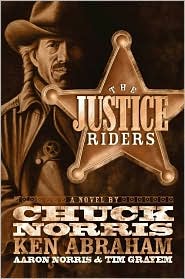
    Critical Monkey entry #2: The Justice Riders: The Best Little Roundhouse in Texas

    In the second instalment of Critical Monkey, I risk a roundhouse kick to the head as I take on the might of literary heavyweight Chuck Norris and his debut novel:

    The Justice Riders (!)
    by Chuck Norris (!!), Ken Abraham (?), Aaron Norris (?!), and Tim Grayem (??)

    Why I might hate it: I do try not to let people’s political or personal views mar my appreciation of their work, but let’s be real, that rarely works. I used to enjoy Orson Scott Card, but his virulent and grotesque attitude toward homosexuality has completely ruined any enjoyment of his work I once may have had. And Chuck? I once enjoyed his films in a pulpy sort of way—and make no mistake, there are some fairly strong movies in his filmography, especially Code of Silence, and he did raise the roundhouse kick to such an artform that he got himself an eight-year television series based solely on his ability to spin in the air, wear a cowboy hat, and grow a beard—but as he’s aged, he’s transformed himself from a B-movie action star and Soloflex hypester into that mainstay of almost all D-list celebrities, a born-again, bitter right-wing shill, a religious fundamentalist and all-round unpleasant crackpot, eager to espouse any nutjob political theory, unsure if Barack Obama is an American, and unaware that his celebrity caché has withered to the point where he is an object of camp and outright derision. But hey, as long as he’s still getting his face out there, right? And lately, the trend of ‘celebrities’ getting book deals has reached the point where there is no more humour to be had. When 'celebrity' Lauren Conrad gets a three-book deal, it’s time to admit that irony is well and truly dead, and satire is a thing to set on the museum shelves next to the dodo.

    Why I might like it: It’s a long shot, but the Chuckster did not write this opus alone, no, no. He brought along three people to help fine-tune the tale. Surely four people, working together, could craft something worth reading.

    The book: dear god. Four people who can't write equals a novel four times as bad as normal.

    Perhaps all you need to know is this; on page twelve, in the middle of a Civil War battle, the hero roundhouse kicks an opponent. I’ll repeat that; in the middle of a Civil War battle, there is a roundhouse kick to the face. I am not a Civil War historian and cannot with any accuracy comment on the fighting styles of the time. Nor do I believe that a fiction narrative must be rigidly bound to its setting without room for imagination. I’m not saying that there were no roundhouse kicks in the time period, or that a soldier fighting for the Union army could never have that skill. I actually don’t know what I’m saying, as I am positive that roundhouse kick smushed my brain into goop.

    But there’s still 283 pages to go, so…

    The Justice Riders concerns the exploits of Chuck Norris/Ezra Justice, a captain in the Union, fighting for the north in the Civil War (check out that cover for my confusion as to his identity). I should mention here that Team Norris has already etched a place in my heart, as I have always harboured a fondness for novels wherein the lead character’s name takes a less-than-obvious place in the title, such as in Karen Kijewski’s Kat Scratch Fever (protagonist – Kat Colorado), Robert B. Parker’s Stone Cold (Jesse Stone), Ernest Hemingway’s The Old Man and the Sea (Old Man), and Joanne Fluke’s Cherry Cheesecake Murder (Professor Cornelius X. Cheesecake).

    Ezra Justice leads (wait for it) The Justice Riders, an elite group of men known both for their skill in warfare and their ability to be practically indistinguishable from each other except for exceptionally broad stereotypical traits. There’s the Irish drinker and fighter named Shaun O’Banyon (presumably because Fighty O’Drinkington was already taken); Harry Whitecloud, the well educated half-breed Indian tracker; Roberto and Carlos Hawkins, the gypsy thieves; Nathaniel “Big Nate” York, former slave of Justice (although The Norris Gang takes pains to point out that this was only because of Ezra’s family that he owned Nate, and he himself was having none of it); and Reginald Bonesteel, English sharpshooter and winner of Britain’s Most Foppish Yet Manly Name Award 1864.

    Together, the Justice Riders go head-to-head against the Confederate version of their gang, the (wait for it) Death Raiders, led by “the type of man that men feared and women could not resist,” the hissible villain Mordecai Slate (again, presumably because Snidely McBadGuy was busy that week).

    I don’t mean to be snarky, but boy howdy, it’s just. So. Easy. I mean, sure, Twilight (my previous entry in Critical Monkey 2009) was poorly written, but it’s target audience was the younger set. The Justice Riders is aimed at adults, so when you get writing such as
    Slate sat high on his horse, his revolver aimed at Ezra’s chest. “Justice!” he called. “How about some of Mordecai Slate’s brand of justice?”
    well, you pretty much give up any hope of a finely-tuned western a la Larry McMurtry, and the best you can wish for is a broad oater along the lines of the worst of John Wayne (i.e. most of the films not directed by John Ford).

    Even by those deeply lowered expectations, The Justice Riders is absolutely garbage, only earning any entertainment value from the hooting, derisive laughter it provokes.

    A huge portion of The Justice Riders’ failure as a novel is in its inability to recognize its place as a novel, rather than a movie. The character do not talk to one another, they speechify. Take this typical question from O’Banyon:
    “Now that General Joe Johnston and his boys have been slowed down, are we going to keep chasing them, trying to distract them like we did Hood’s infantry and Nathan Bedford Forrest’s cavalry back in Franklin a few months back?”
    No one talks like this. Only in poorly written movies do people talk like this, filling in the audience with seemingly important exposition. These men have been hardened in battle together, they have lived these adventures, there is no reason for them to fill in the blank spots, yet at every opportunity they fill in each other as if this is the first time each has heard the story. Rather than use the form of the novel to fill in exposition through backstory or inner monologues, everything is said out loud, leading the reader to assume that, wounded in battle, the Justice Riders collectively suffer from short-term memory loss, and only the constant repetition of their past exploits keeps their memories alive. And as much as I admire the moxie of a novel that actually contains the utterance, “You’ve got to be…aarraghh! Help!” I must cry foul on the literary merit of The Justice Riders as a whole.

    More concerning, however, is the queasy addition of Christian themes, an ill fit considering Ezra’s penchant for killing all who oppose him in his path. I wouldn’t normally comment on such moral themes, but as Norris Plus Three continually bring it up, the hypocrisy of a novel that makes claims to a Christian belief system yet has no compunction against the ‘justifiable’ killing of others is fair game. There’s no room for introspection in Team Roundhouse’s west, and aside for a single paragraph where Ezra considers that Confederacy soldiers may believe they are on God’s side equally as much as he believes it about himself, there’s no discussion other than ‘our way or no way.’ There are good, solid novels out there about the interplay of religious teachings and personal actions, but this ain’t it. And as Ezra and his men preach to dying soldiers about the importance of embracing Jesus before they die, the utterly despicable nature behind The Justice Riders becomes abundantly clear. This is preaching love while practising death, and The Chuckmeister Four revel in their false virtue.

    But then Ezra goes and kills a crocodile with a knife, and all is right again. And as Ezra actually considers hitting on a woman whose husband and child died not hours before, his stature as a man’s man is all but assured, so who cares how many people he's killed. He's still a simple, godly man, so it'll all work out.

    In conclusion, The Justice Riders is more than poorly written claptrap, although that would usually be bad enough. There is enough shoddy plotting, needless digressions, and ridiculous dialogue to fill a dozen bad novels. But as an extra, the Beard Posse’s tale is morally repugnant to boot.

    VERDICT: MONKEY CURSES A GOD THAT WOULD ALLOW THIS
    Related Posts Plugin for WordPress, Blogger...