Nov 30, 2006

The Devil's Picnic by Taras Grescoe - thoughts


“Every era chooses its poisons. What a society ends up stigmatizing is often more revealing of its own phobias and prejudices than the inherent nefariousness of the substance in question.”

Taras Grescoe knows whereof he speaks. He has travelled the world in search of the banned, the taboo, and the outlawed. And, with one potent exception, he has willingly consumed the lot of them.

His previous book, The End of Elsewhere, took the fearless journalist where few travel writers would dare, directly into the darkest heart of the tourist industry. Witty and provocative, Elsewhere set Grescoe up as a man willing to challenge the status quo, always at the ready with an incisive quip or informative commentary.

The Devil’s Picnic: Around the World in Pursuit of Forbidden Fruit finds the writer on another quest, this one both physical and historical. Forget the exotic locales, it’s the illicit comestibles Grescoe is interested in, the commodities that administrations see fit to ban, then “react with shock when their citizens start to act like naughty children, breaking the law to get at what they’ve been deemed too immature to handle.”

Picnic, thus, finds Grescoe in full confrontation mode, determined to discover why governments are hell-bent on prohibition despite overwhelming evidence that such actions do not work. “When you can’t have it, you want it,” Grescoe decides early on, and finds ample evidence that this theory will always win.

Setting out, Grescoe discovers a wealth of illegal pleasures, both sublime and silly. He sips cocaine tea in Bolivia; ingests “deadly” unpasteurized cheeses in France; and smokes Cuban cigars in San Francisco. Most amusingly, he brazenly chews gum in Singapore, a land so Orwellian in design, “the road of excess is not only barricaded: the boys in the Palace of Wisdom have also strewn it with land mines from curb to curb.”

Make no mistake; Grescoe is on a mission, and many will not appreciate what he has to say. Grescoe is a committed apologist for the freedom to live the way we choose, despite governments that insist they know best. Regrettably, his tendency to speechify dilutes valid criticisms toward prohibitions that serve no useful purpose but to maintain a level of power over the citizenry.

Nearing the end of his travels, wisely declining to sample the Swiss suicide cocktail pentobarbital sodium, he rants, “[When] it comes to some of the most important issues—assisted suicide, capital punishment, gay marriage, drugs—it is as if the Enlightenment never happened.” Grescoe’s argument thereby becomes swamped in despair, and while his anger is invigorating, it overwhelms the book, lending him the impression of the lone man screaming in the wilderness for sanity.

Yet his reasoning remains valid, and while some may dispute his ideals, there is no denying his passion. In a world where lines are drawn in the sand, “you are either on the righteous side of the line, or in a world of shame, picnicking with the devil.” Grescoe has chosen his side, and it is highly tempting.

Originally published in The Winnipeg Free Press.

Nov 29, 2006

Proof that I exist!

Now, it's not often that we get what we deem to be irrefutable proof of our own existence. Was Descartes correct, i.e. "I think, therefore I am?" Who knows.

But I now have what I consider to be proof of my own existence, at least among literary circles. So, without further ado, I hereby present the proof I exist:

The official Shelf Monkey ISBNs!

ISBN-10: 1-55022-766-1
ISBN-13: 978-1-55022-766-6

Are you getting shivers? Oooh, it feels so good!

Nov 20, 2006

World War Z by Max Brooks - thoughts


To use an intentional pun, the living dead have had quite the resurrection of late. Starting with the glut of zombie films over the past few years, the undead are now making significant inroads into the realm of the printed word.

From the bloodstained pulp sensibilities of Brian Keene’s The Rising and David Wellington’s Monster Island, to Stephen King’s diverting (if lightweight) attempt to update the zombie image in Cell, it appears the shambling corpses have become the literary monster du jour.

And no one takes the dangers of their resurgence more seriously than Max Brooks.

Brooks (son of comedian Mel) takes an unusual slant in his zombie epic World War Z. Where other authors emulate the traditional plot of a group of individuals trapped within a confined space with the undead moaning just outside, Brooks instead fashions a frighteningly credible representation of how a zombie apocalypse would be greeted by the governments of the world.

World War Z is organized as a series of oral testimonials, presenting an alternative history where “the greatest conflict in human history” has already taken place. Billions of people have perished, the vast majority of the victims transformed into zombies themselves, and the survivors are only now coming to grips with the terrible after-effects.

Tracing the route of the virus from “Patient Zero” onward, the various narrators lay out how humanity reacted. From profiteers who seize the opportunity to market a placebo cure, to government officials who ignore the crisis because of “the damage it would have done to that administration’s political capital,” to soldiers facing an enemy who “will, never, ever be afraid,” World War Z presents a deeply bleak view of humanity caught with its collective pants down.

As monsters go, zombies are among the least interesting, personality-wise, being mindless hunks of flesh that only exist to kill, resulting in movies that are conventionally bleak and humourless. Consequently, as George Romero’s gore-soaked classic Dawn of the Dead shows, tales of zombie madness resonate best as a form of social commentary.

Accordingly, there is no shortage of parallels between Brooks’ bloody battlefields and our continuing obsessions with pandemics, terrorism, religious fundamentalism, and environmental catastrophe. The analogies are not subtle, but when you’re dealing with creatures that devour human brains, subtlety is always going to be in short supply.

Yet the originality of Brooks’ conceit is also its weakness. The constantly-shifting viewpoints tell the story well enough, but prevent the plot from building any real momentum.

The work as a whole keeps the audience at arms length, becoming almost as dispassionate as its antagonists. While many narrations are superbly effective—an episode with the anti-zombie canine corps may be the most moving use of a dog in a horror novel since Richard Matheson’s I Am Legend—the overall impact is muted.

Brooks should earn kudos for a serious and thought-provoking take on world politics in the face of “an enemy that was actively waging total war,” but all his research amounts to little in a horror novel with few scares. World War Z has the gore, and admirable intentions, but as horror, it rarely captures the visceral savagery of its predecessors.

Originally printed in expurgated form in The Winnipeg Free Press, November 20, 2006.

Nov 13, 2006

They like me! They really like me!

When last we met, I had hinted at the eventual outcome of this disoriented narrative, namely, that I was to become a published author. The quest for a publisher now takes a new turn: who could publish Corey Redekop? And more importantly, for the love of god, why?

Allow me to set the scene:

I had recently begun a short tenure as an assistant librarian at the John E. Robbins Library in Brandon, Manitoba. I had decided that five+ months without an answer from House of Anansi (the second publisher I contacted) was enough, and after some research, I sent my first twenty pages to ECW Press. Even though this was only my third mailing of Shelf Monkey, I didn't hold out much hope of a positive reply.

Three weeks later (a far shorter period of time than I had ever hoped), I was checking my e-mail at work. The date was october 19, 2005, just 8 days shy of my birthday. Sitting there in my Junk pile was a message from a unknown sender, with the subject, "Shelf Monkey."

This should have been a dead giveaway of interest, but I still opened the message with some trepidation. After all, I receive tons of spam every day, with differing subject lines of bewildering topics. Was it outside the realm of possibility that the words "Shelf" and "Monkey" would be somehow combined in an anonymous e-mail that would turn out to be an advertisement for a sure-fire method to enlarge my manhood? Could "Shelf Monkey" somehow be slang for the sexual act?

But it was not to be, and my manhood would have to stay at its normal size (Dammit!). Yet what I opened gave me a definite woody:

***

Dear Corey,
I've just had a chance to take a look at Shelf Monkey, and on first glance I thought it was funny and refreshing to read (I'm plowing through a very, very large pile of manuscripts right now, so I was glad to finally find one I could say that about... about which to say that?... anyway...). Would you mind sending me the complete manuscript?
Thanks!


***

Holy s#!+!

I don't often like to reveal that when excited I shriek like a little girl getting a pony for her birthday, but that day, everyone in the library heard me. It wasn;t an acceptance, but the mere idea that someone, somewhere, actually liked something I wrote? Well, if that doesn't add a little iron to your pole, nothing will.


So, after telling everyone in hearing distance, I printed off the manuscript in its entirety and proudly sent it off, Xpresspost. Of course, there was a chance that a little Corey goes a long way, and 260 pages of him might be a little too much to bear.

Three weeks later, another note:

***

Dear Corey,
I've had a chance to read through Shelf Monkey, and I liked it a lot. I thought the scene of Thomas's first day at the bookstore (with the adult music pumping through the sound system) and his exasperation with people's book choices was hilarious. I thought the mystery of what really happened to Purvis kept me turning the pages -- was he dead? did they beat him up? is he just missing? -- and the scene where we ultimately find out what happens is a good one. I'm very interested in this book, and I think with some minor alterations it would be a great fit to the fiction line at ECW.
Let me know how open you are to making some alterations, and I'll send you along my thoughts on the book.
Thanks again for sending this manuscript to me, and I look forward to your response. :) I hope we'll be able to work together.


***

Once again - YES! The world was mine! All I had to do was sign the contract, and the money would come rolling in.

Next installment: The Awful Truth

Nov 7, 2006

A quick confession

I've been very lax in my updates/propaganda as of late, so I thought I'd make amends by revealing a heretofore untold secret about myself.

As you know (or should know), my novel Shelf Monkey is to be released in April of 2007 by ECW Press. In anticipation of that glorious day, when thirty-seven years of life finally culminates in a work very few people will ever actually read, I do the following:

Whenever I am in a bookstore, or library, I find the place on the shelves where my novel will take up space, visualize my as-yet-unpublished novel, try to fill the space with good vibes, and mentally rejoice/curse my nearby shelfmates.

I mean, I'd love to be next to Michael Redhill. The man can write! But more often than not, especially in stores that do not differentiate between Canadian literature and the other stuff, I find myself buttressed up against James Redfield. *shudder* *gag*

There. Confession over. Hope it'll tide you over for awhile.

Nov 5, 2006

All This Town Remembers by Sean Johnston - thoughts


Who, in the end, owns grief? Is it an intimate, personal experience, or can it be co-opted by the community at large? And when does the act of grieving become an exercise in selfishness?

Sean Johnston does not pretend to be able to answer these questions. But if the Saskatchewan native’s moody debut novel All This Town Remembers is any indication, Johnston lays admirable claim to appreciating the underpinnings of such sorrow.

The town in question is Asquith, Saskatchewan, where the citizenry is abuzz at the arrival of a CBC film crew. The subject of the film is Joey Fallow, a high-school hockey star whose death twenty years earlier has become a defining moment in the town’s identity.

Less than impressed with the excitement is Adam Stieb, Joey’s teammate and best friend. Recuperating from a workplace accident, Adam views himself as “the man with the broken brain,” with a memory “full of gaps like air.”

Adam’s life is one of chronological challenge; “there was no rhyme or reason to what he remembered, and the things he did know…were either more important to him than they should be, or he was too cold to them.”

What Adam does clearly remember is the accident that took Joey’s life. The town’s elevation of Joey to local icon somehow rankles Adam, and he sets about alienating his neighbours with his distaste for what he sees as “endless celebrations of the one dead boy.”

Johnston, 2003 winner of the Relit Award for short fiction for his collection A Day Does Not Go By, displays a true aptitude for creating muted poetry from the mundanity of prairie life. Sentences such as “Her hair smelled to him of beer and bruises” pepper the plot with memorable imagery, yet never overwhelm with pretension.

Johnston is not overtly concerned in deeply examining the despair a single devastating event can immediately inflict upon a mass community. Such an exploration already exists in Russell Banks’ emotionally resonant novel The Sweet Hereafter, a spiritual cousin to All This Town Remembers in both setting and atmosphere.

What more interests Johnston is the effect of time upon such memories, whereby the incident becomes less an occasion of grief, and more a part of the public consciousness. It evolves into something that nourishes the community, but such an evolution denies those immediately affected by the initial event any sense of ownership of their own emotions.

It is this clash between private mourning and public adulation that drives Adam (and Johnston) to try and better define what the memory of Joey’s death should mean. But memory is slippery, especially in Adam’s instance, and cannot be inherently trusted; “To imagine, you revise—it’s the same as anything and begins innocent enough—but you think of yourself as more than you were.”

Johnston has delivered a haunting celebration of the nuances and vagaries of memory, and a cautious examination of small-town insecurities. In it’s own subdued fashion, All This Town Remembers heralds the arrival of a sterling new voice in Canadian prairie fiction.

First printed in The Winnipeg Free Press, November 5, 2006.

Nov 1, 2006

Horeck + Mecca = Horecca?

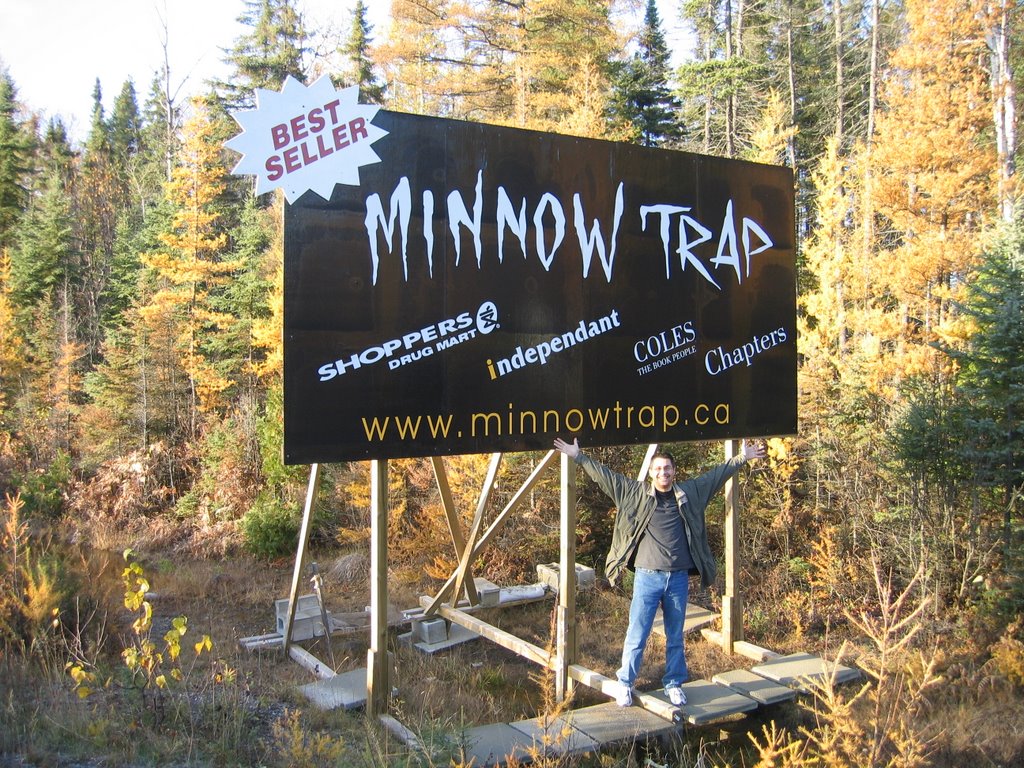
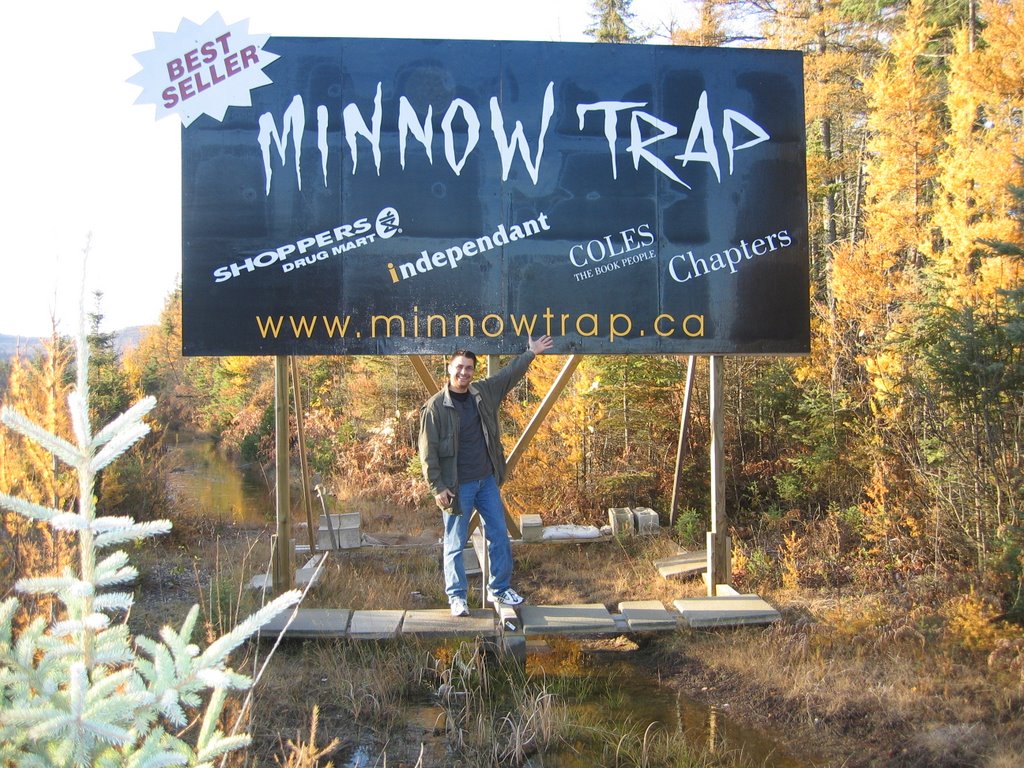
While traversing the great wilds of Northern Ontario, I came across the most remarkable site: an actual billboard promoting the worst novel of all time, the immortal Minnow Trap!


As you can tell from the photo, I was overcome with excitement. Needless to say, I was also astonished, amused, and filled with an emotion most closely resembling nausea. I immediately set about burning a copy of Rosellen Price's Blood & Wine as a sacrifice.


Woe be to those who do not admire the immortal Horeck! Worship him, lest you be destroyed!
Related Posts Plugin for WordPress, Blogger...