Showing posts with label The Monsters of Templeton. Show all posts

Jun 14, 2010

Monkey Droppings - two short (and sweet) tales of death

Today, the Monkey fights his innate timidity and delves into a duet of terrors both subtle and gross.

Mind you, these are rather offbeat terrors, so the worry of night screams is diminished somewhat.

These'll be quick reviews, but heartfelt.

One Bloody Thing After Another
by Joey Comeau (2010)
There's something a little spooky about the girls, but Charlie can't put his finger on it. Everything's spooky these days. A headless woman in the lobby, haunting them from beyond the grave. A creepy little girl isn't going to make much difference.
Scary stories are not for everyone, neither as a listener nor a teller. Some people don't know how to handle being scared. Some people don't know how to scare.

Joey Comeau does not know how to scare. The writer of the wonderful web comic A Softer World and the absurdist storytelling of Overqualified does not, in his 'horror' novel One Bloody Thing After Another, scare the reader. Unsettles, yes, but never scares.

This may sound like a negative, but it isn't meant as such, because Comeau - despite crafting a story filled with monsters, death, and one absolute corker of a scene involving kittens and a baby - isn't out to scare. What he is out to do isn't exactly clear, but as One Bloody Thing After Another has stayed with me for days, I'm going to call it a triumph, albeit a goofy and off-kilter one.

Throughout the pages of Comeau's short narrative, we are introduced to several characters. There's Charlie and his elderly dog Mitchie, both being haunted by a headless apparition - "The ghost takes a shaking step toward them. She's off balance, not that Charlie could blame her. Having your head cut off would certainly affect your equilibrium." There's Amy, troubled by an uncertain relationship with her friend Jackie, and nearly unhinged by having a zombie mother chained up in her bedroom. And there's Jackie, an unbalanced young woman who may be able to communicate with the dead, perhaps because of some prenatal disturbances; "You know how mothers play Mozart against their bellies during pregnancy? Jackie's mom went around swinging a tire iron, bashing headlights in the street all night, belly enormous. Who else could say their mother had been in a riot while pregnant?"

Like Andrew Kaufman's similar (in tone) All My Friends are Superheroes, Bloody is a sneaky beast, content to let the reader parse out the story from glimpses and hints. Comeau is not out to write a horror novel per se. He's far more interested in presenting little snippets of tales, letting his unique voice weave his fables together in a method designed to subtly dislodge the reader from the limitations of conventional storytelling and simply let Comeau's mix of sly humour and genuine unease co-mingle in the brain. Comeau's story is weird in the best definition of the word, melancholy, disturbing, and unexpectedly uplifting. I can't say that One Bloody Thing After Another is a perfect novel, but in its own gentle, meandering way, it is perfectly wonderful.

VERDICT: MONKEY ENJOYS TO THE DEPTHS OF HIS ODD LITTLE SOUL

The Thief of Broken Toys
by Tim Lebbon (2010)
Now, every day is the last day of the past.
First off, let me say that ChiZine may well be my new favourite genre publisher. For such a new company, there track record is already stellar, as Lavie Tidhar's and Nir Yaniv's The Tel Aviv Dossier is an expert piece of theological lovecraftian weirdness, and Douglas Smith's Chimerascope is an absolutely stunning short story collection of sci-fi, fantasy, and horror, one of the best I've ever read.

Tim Lebbon's The Thief of Broken Toys continues the streak. The English horror writer has penned a deeply affecting ode to loss and loneliness, wrapping it in a fantastical riddle that makes the heart ache.

Lebbon's novella sets itself in the scenic seaside town of Skentipple, where we find Ray, a man without a reason to live. His son Toby has died, his wife has left him, and Ray, like most grieving parents, spends most of his time alone and unwilling to grasp the enormity of what has happened. All he has are his memories, which suffuse his being to the point that Ray isn't much more than a walking tragedy.

Into this, Lebbon injects an element of magical realism in the form of a strange old man who takes an interest in Toby's old toys. I don't want to give too much away (the novella is not that long), so suffice to say, there is a price to be paid for everything, including finding a way out of grief.

I've never read any of Lebbon's other writings, but if Thief is any indication, he is a master at evoking mood and atmosphere. There is a rough-hewn yearning that permeates every sentence, a sense of foreboding that magnifies every action. Lebbon knows that grief both dulls and enhances every moment of life, but he's wise enough to keep his tale brief. Were this story to expand to the length of an average novel, the pain would be well-nigh excruciating.

The Thief of Broken Toys is far more of a mood piece than a horror story, and where there is horror, it is of the more cerebral variety. This is the horror of loss and memory, and the horror of recovery. As Lebbon's fable wends it's way to a close and the importance of grief is made apparent, it is clear that he's a writer of vast talents and sublime emotional wisdom.

VERDICT: MONKEY ADMIRES THE HELL OUT OF

May 31, 2010

Monkey droppings - Dog Blood by David Moody

The Monkey has the taste for blood and gore, for some reason.

Must be a monkey thing. No way humans have that impulse, right?

Right?

Dog Blood
by David Moody (2010)
NOTE: Spoilers abound in this review, particularly if you have not read Hater, Moody's unnerving first novel, and a direct precursor to the events in Dog Blood. Sorry, can't be helped.
When all the living have been infected and there's no one left to kill, what happens next? Does the hunger every go away, or is rotting all that's left for them?
There are a few ways to write a novel from the monster's point of view. One way is to soften the creature, try to make it seem sympathetic while it does monstrous things. See the canon of Anne Rice for many examples of this, taking the terrifying vampire of lore and making him a gothic romantic. There's nothing inherently wrong with this approach, and it can be done quite well - I love the first few instalments of Rice's Vampire mythos, but lost complete interest when Lestat slithered his way into Hell.

The other way is to embrace the monster for what it is, a monster. Something irredeemably grotesque and vile. This is what David Moody does. He started it with Hater and directly continues it with Dog Blood, presenting the monster as pure monster, crafting the story in such a way that the reader gets confused as to who to root for.

Hater posited a world where something (something never explained) transforms a good third of the world's population into violent, bloodthirsty fighters (or 'Haters') who will stop at nothing to kill the unaffected or 'Unchanged.' Moody started slowly, mixing his tale with equal parts Invasion of the Body Snatchers, 28 Days Later, and Night of the Living Dead. Part of Hater's grindhouse brilliance was to be narrated by Danny, one of the infected, a rather unassuming and put-upon father whose brain simply clicks over into destructive mode. There is no explanation offered, there is no room for questions. The Hater exists to kill the Unchanged, and there is no arguing points of logic or intellect.

However, where Hater was an exercise in sustained tension, Dog Blood finds itself firmly in sequel territory wherein the audience is already primed and ready. So, as sequels go, will Dog Blood be an escalation of themes and gore a la Dawn of the Dead or 28 Weeks Later, or will it be, well, a dog?

Luckily for the discriminating reader of hard-core horror, Dog Blood is pretty damn good. It's clumsy, and the writing is rarely more than serviceable, but Moody amps up the violence while driving his pseudo-zombie narrative into some uncharted territory, expanding his own mythos while staying true to the designated monster-movie format of killing anyone and everyone.

Dog Blood opens on Danny, a few months or so after the outbreak has firmly taken hold. The world is already heavily militarized; the Unchanged are kept behind walls that threaten to burst from overpopulation, while the Haters roam free, picking off any remnants of humanity they can find. But as with all addictions - like all good monster stories, the plot is rife with subtext, drug addiction being one of the more obvious - once the supply begins to dwindle, there's very little for the addict to do:
I don't get the same highs anymore, just the cravings. The euphoria has faded, and life's more of a struggle now. It's getting harder to find food, and I'm tired. The gap between kills in increasing, and all that's left to do in those gaps is think.
While Danny still gets a powerful high from killing, enough time has past that he has gained some perspective on the situation. Indeed, he is not the only one, as the Haters are beginning to mobilize and organize, believing that only once the Unchanged are wiped from existence can their lives return to normal. But Danny has a modicum more self-interest than most of his new brethren, understanding the risk concentrated attacks may pose the new world order.
When we're together we become an easy target for the Unchanged to pick out of the sky. Cowardly bastards. Face-to-face they know they don't stand a chance. Long-distance battles are the only ones they can win.
Speaking of subtext, the parallels to America's response to terrorism come through loud and clear. It may be unfair to ascribe a whole mind-set to one novel, but it would appear Moody does not hold out much hope for humanity's chances under sustained periods of strife.

But for Danny, his new comrades are only a tool to help him get what he truly seeks; his missing daughter Ellis, a five-year-old Hater he lost when his initial transformation overwhelmed him. Danny's quest takes him into the heart of the new Hater hierarchy, where the infected able to control their impulses plan a new strategy, that of subterfuge and infiltration.

No mistake, Dog Blood is not for everyone, and there are many who will see little value in its intense cynicism and graphic violence. But connoisseurs of the genre will realize the craft behind the mayhem, and will appreciate Moody's refusal to enliven his grim fairy tale with humour or hope. This is the horror of blood and guts, the horror of vintage Romero and Fulci, and if you're not prepared for it, why are you reading it?

It's the possibility of a new working world after the devastation that drives much of Dog Blood; in many ways, it is a sister novel to Octavia E. Butler's masterful Clay's Ark, about a space-borne pathogen that slowly alters the whole of the human race. Moody, like Butler, isn't interested in the whys of the infection, but in the consequences. In both stories, man is slave to his passions, and all the intellect in the world can only hold it at bay for so long. Moody isn't afraid to show the unpleasantness of his universe; despite Danny's identifiable personal quest, he's a conniving monster, as are his cohorts, and the rampant violence in Dog Blood is not for the squeamish.

In the end, Dog Blood, like Hater, is a true grindhouse horror movie translated onto the page. It is vile, nauseating stuff, done with verve and more style than you'd think. I recommend both books to the devoted horror fanatic who can appreciate both good art and good trash. I'd also recommend skipping lunch before you start.

VERDICT: MONKEY ENJOYS, IF THAT'S THE CORRECT TERM

Aug 21, 2008

A few quick reviews for your conisderation

It's been a little while since I updated my three regular readers, five irregular readers, seven imaginary readers, and two demon readers who haunt my dreams with their cries of "Ph'nglui mglw'nafh Cthulhu R'lyeh wgah'nagl fhtagn!" so I thought I'd give a little shout out to several novels and collections I recently read and (it goes without saying, but I'll say it anyway) heartily recommend.

Robert J. Sawyer

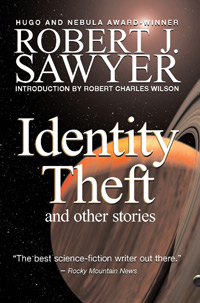
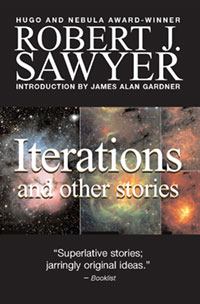
These two collections from Canada's grand master of sci-fi are absolutely terrific reads. Sawyer is arguably the best-selling Canadian author on the planet, and has won approximately 41 awards for his work, including the esteemed Nebula, Hugo, and John W. Campbell awards. He has the unique ability to wield hard-science elements with a delicate touch, resulting in works that challenge the mind yet don't bog down the reader with theorems and equations. The man can write, and he's blessed with an imagination of vast potential and an adoration of all things scientific. Add in dashes of philosophy, and you've got the true heir apparent to Clarke and Asimov. And he's Canadian, did I mention that? Do you have any idea how rare it is to see science-fiction set in Canada? I don't have any statistics to back me up here, but I'm betting, not much.

These two collections dip into the stable of reliable and time-honoured science-fiction conventions; time travel, artificial intelligence, immortality, and alien visitations are all well-represented, but Sawyer brings to the usual tropes a fascination for plot twists, a genuine empathy for his characters, and some really, really cool ideas. The title story "Identity Theft,"along with its followup "Biding Time" co-mingle the concepts of robot bodies, immortality, and alien planetscapes with classic private eye conventions. "On the Surface" provides H.G. Wells completists with a compelling and Morlock-laden sequel to The Time Machine. "Shed Skin" provides a tantalizing treatise on what selfhood and identity mean when personalities can be swapped with other bodies as easily as breathing.

Iterations and Identity Theft are ideal primers for Sawyer's already-impressive output. Never less than thought-provoking, these two compendiums of Sawyer's imagination should be required reading for all persons who consider themselves fans of the genre.

Lauren Groff

From the overtly fantastic to the subtly grotesque;

Lauren Groff's The Monsters of Templeton is a spectacularly weird, funny, and uncategorizable novel. I would classify it as a family-roots drama, with overtones of mysticism and magic realism, but labeling it as anything other than remarkable does it a disservice.

Willie Upton has returned to her hometown of Templeton in disgrace, licking wounds that won't heal at all easily. At the same time, a leviathan of the deep has washed shore of Lake Glimmerglass, sending the town into turmoil. Upon her arrival, Willie's mother informs her that she is the descendant of the town's founder Marmaduke Templeton. What follows is a historical descent into two centuries of character reminiscences and family dramas, as the town itself begins to feel the loss of a resident it never knew it had.

It's very difficult to classify Monsters into one single genre, and far easier to praise it as wondrous and strange. Groff has a Dickensian gift for sweeping family drama, and a gorgeous flair for imagery. I was sorry to see it end, which is likely the highest praise anyone can bequeath to a novel.

I'll have more substantive (read: longer) reviews of Rawi Hage's novel Cockroach up soon, as well as Neal Stephenson's massive missive Anathem.

Nov 20, 2006

World War Z by Max Brooks - thoughts


To use an intentional pun, the living dead have had quite the resurrection of late. Starting with the glut of zombie films over the past few years, the undead are now making significant inroads into the realm of the printed word.

From the bloodstained pulp sensibilities of Brian Keene’s The Rising and David Wellington’s Monster Island, to Stephen King’s diverting (if lightweight) attempt to update the zombie image in Cell, it appears the shambling corpses have become the literary monster du jour.

And no one takes the dangers of their resurgence more seriously than Max Brooks.

Brooks (son of comedian Mel) takes an unusual slant in his zombie epic World War Z. Where other authors emulate the traditional plot of a group of individuals trapped within a confined space with the undead moaning just outside, Brooks instead fashions a frighteningly credible representation of how a zombie apocalypse would be greeted by the governments of the world.

World War Z is organized as a series of oral testimonials, presenting an alternative history where “the greatest conflict in human history” has already taken place. Billions of people have perished, the vast majority of the victims transformed into zombies themselves, and the survivors are only now coming to grips with the terrible after-effects.

Tracing the route of the virus from “Patient Zero” onward, the various narrators lay out how humanity reacted. From profiteers who seize the opportunity to market a placebo cure, to government officials who ignore the crisis because of “the damage it would have done to that administration’s political capital,” to soldiers facing an enemy who “will, never, ever be afraid,” World War Z presents a deeply bleak view of humanity caught with its collective pants down.

As monsters go, zombies are among the least interesting, personality-wise, being mindless hunks of flesh that only exist to kill, resulting in movies that are conventionally bleak and humourless. Consequently, as George Romero’s gore-soaked classic Dawn of the Dead shows, tales of zombie madness resonate best as a form of social commentary.

Accordingly, there is no shortage of parallels between Brooks’ bloody battlefields and our continuing obsessions with pandemics, terrorism, religious fundamentalism, and environmental catastrophe. The analogies are not subtle, but when you’re dealing with creatures that devour human brains, subtlety is always going to be in short supply.

Yet the originality of Brooks’ conceit is also its weakness. The constantly-shifting viewpoints tell the story well enough, but prevent the plot from building any real momentum.

The work as a whole keeps the audience at arms length, becoming almost as dispassionate as its antagonists. While many narrations are superbly effective—an episode with the anti-zombie canine corps may be the most moving use of a dog in a horror novel since Richard Matheson’s I Am Legend—the overall impact is muted.

Brooks should earn kudos for a serious and thought-provoking take on world politics in the face of “an enemy that was actively waging total war,” but all his research amounts to little in a horror novel with few scares. World War Z has the gore, and admirable intentions, but as horror, it rarely captures the visceral savagery of its predecessors.

Originally printed in expurgated form in The Winnipeg Free Press, November 20, 2006.
Related Posts Plugin for WordPress, Blogger...