Wednesday, January 31, 2007

Christopher Moore on Bat Segundo

Just a quick promo for:
a) the Bat Segundo show, a terrific literary podcast that boasts some absolutely stellar author interviews, and

b) this week's guest, Christopher Moore.

Mr Moore is an author whose books are an absolute blast, and if you must compare my own literary style to someone else's, I would be flattered by the comparison. The interview is a lot of fun, and Moore's commitment to his craft is inspiring.

Banning Books in Toronto - the last refuge of the cowardly

Now, I fully acknowledge that there are books that either hurt me, disappoint me, or offend my sensibilities to such a degree that I let loose a rant of such eardrum-shattering verbosity that my partner has lost all her hearing in one ear. However, to play both sides, I would never take the stance that others have no right to read it.

Censorship based on personal mores is never a good thing. Free speech, etc, all that stuff which I whole-heartedly agree with. We are Canadians, we value the opinions of others. We brag about this constantly.

Well, not all of us. In an act of extreme cowardice, the Dufferin-Peel Catholic District School Board has removed from shelves a copy of Snow Falling on Cedars, the PEN/Faulkner Award-winning novel by David Guterson. All this at the behest of one solitary parent who whined to the board about sexual content.

Now, there's nothing new I can add to the argument against such narrow-minded censorship, except to add that this example pales next to the irony of the Fahrenheit 451 debacle in Texas from late 2006. Yet I will say that the board's claiming that they have not made a final decision is, for the moment, a moot argument. A book removed from the shelves cannot be read, whether it is banned or not. And caving in the pressure of one individual without a thought to the greater ramifications of such an act show a timidity towards bullies that should never be tolerated.

Labels:

Monday, January 29, 2007

Ah, the spoils!

At long last, the advance has come! I am literally rolling in money, if you cash the cheque and ask for the money in nickels, in which case there's enough to roll around in, although I have a few too many nooks and crannies for the experience to be anything more the mildly enjoyable. Now why did I take off my clothes for this example? Honestly, is it weird that that's the first place I went, total nudity?

Now, I don't want to lend you the impression that I am ungrateful. I loves me the money, believe me, and it is an astonishing rush to have actual financial proof in your hands that someone, somewhere, values your work (yes, again, I have low self-esteem, leave me alone). But when you do a little basic math, well...

Let's take as a start date September 1, 2003, the day I officially began writing the now-classic novel of confused angst known as Shelf Monkey.

Now, we take the date of January 22, 2007 (the date of official receipt of said advance monies) as our end date.

That gives us...(mental calculation, gears whirring, smell of burnt toast)...3 years, 4 months, and 22 days, or 1,240 days.

Now, grade 3 math comes into play...1240 into...carry the 1...

End result: 80.6 cents a day.


Now, hypothetically, were someone to come up to you on the street and remark, "I will provide you with 80.6 cents a day to write the great Canadian novel," I wonder what your answer would be.

Labels: ,

Wednesday, January 24, 2007

Editing the classics - A Shelf Monkey prediction comes true!

As anyone who has read Shelf Monkey (or will read it, release date April 2007, get cracking on pre-ordering several copies for yourself), I love books. Thus, and unsurprisingly, it was with a heavy heart that I read here (via the wonderful literary blog Biology of the Worst Kind) that the publishing company of Weidenfeld & Nicolson is planning to re-release classic novels for the public. What's wrong that that? you ask. Well, for a start (actually, the whole problem), they've done market research which indicates that (as quoted in The Guardian) many readers are put off on reading the classics because of "daunting length and small print.

Boo-hoo, you say. But wait, the worst is yet to come! Their solution to this 'problem' (please note sarcastic tone in use of quote marks): editing their lengths. I mean, what could be simpler? Why read 400 pages, when you can read 200? Problem solved!

Here's the segment in its entirety:

"Despite the trend for new-look classics lists, no publisher has dared to meddle with the texts - until now. Weidenfeld & Nicolson is to launch a list of edited literary classics, called Compact Editions. It claims that market research shows many readers are put off by the "elitist" image of classics and by their daunting length and small print. So the Compact Editions - slogan "Great Books in Half the Time" - have been "sympathetically edited" down to fewer than 400 pages each. Weidenfeld insists that the novels retain the core plot, characters and historical background. The first six titles - Anna Karenina, Vanity Fair, David Copperfield, The Mill on the Floss, Moby-Dick and Wives and Daughters - are to be released in May and will doubtless be snapped up by students eager to cut down their reading time."

Attributed to Joel Rickett, The Guardian, January 20, 2007.

To say it better than I ever could:

"The justification for simplifying and eviscerating books, as well as for inventing category nonsenses such as teenage fiction, is that it's better for people to read those than to read nothing. I don't think so. A sympathetically edited Moby-Dick is nothing. At any rate, it isn't Moby-Dick. You can screw around with the novel to make a film or a play if you like, even to make a new novel of your own. It could be wonderful. But the book that Melville wrote remains intact. It's available to be read as it was written and as generations have read it. It was written the way it was for a reason. For Melville's reason. That's what a novelist does. It's what the publisher ought to publish. It's what a reader should take or leave. For Weidenfeld & Nicolson to offer cut-down versions is to disgrace publishing, to give up on writers and on the possibility of literature. Actually to give up on anything except making money."

Attributed to Jenny Diski, Biology of the Worst Sort, January 22, 2007.

Now what's truly weird about all this (and I admit no small amount of prescience) is that I jokingly predicted this in Shelf Monkey. At one point (no plot spoilers here), a character rants over the antagonist's plans to re-release classic novels in drastically edited form. I even use Moby Dick as an example, editing it to 100 pages, and the whale loses. Man, I am changing my name to Nostra-Damn!-us.

Join with me in weeping for our children.

As well, check out this disturbing piece by Thomas Washington (a high-school librarian) in The Washington Post. It turns out that editing books for length might be the only option to appeal to children with short attention spans.

Labels: ,

Monday, January 15, 2007

Quill & Quire: Let the Publicity Onslaught Commence!

Let me set the scene for you:

An aging yet boyishly handsome man (let's call him, oh, I don't know, Corey R.) is perusing the stacks of the local bookstore. He comes across the newest issue of Quill & Quire, a publishing industry magazine of no small repute. Idly, he flips through the pages, until his eyes alight upon the heading Spring Preview 2007: This Season's Hottest Books. Being no novice at reading, he decides to peruse the article more closely, hoping to catch a glimpse of the newest novels by his favourite authors. Ondaatje is present, as is Michael Winter and Barbara Gowdy. Then in the corner of the first page, he reads this:
A couple of smaller presses have spring titles that should resonate with book-biz types.

Well, this sounds promising. Corey had just finished writing his own novel, which (strangely enough) was about characters and settings that might appeal to said book-biz types as well.

He turned the page, and discovered this:
A megabookstore is the setting for Corey Redekop's satirical novel Shelf Monkey (ECW Press, $18.95 pa., April), which grew out of the 3-Day Novel Writing Contest. The novel relates the conflicts between the bookstore's employees and a popular TV talk-show host with a book club. No word yet on whether Indigo has booked a special display table.

Now, tell me honestly, how cool is that? Coming across publicity for your novel completely unawares? In a recognized and highly-regarded trade publication?

WWWWWWHHHHHHHHOOOOOOOOOOOOOOOOOOO!!!!!!!!!!!!!!

Tell your friends, neighbours, cousins, co-workers, and various personal enemies: Shelf Monkey is coming! You can't avoid it! Deal with it, or it'll destroy you!

*Quotation attributed to Derek Weiler, Quill & Quire, Volume 73, Number 1.

Labels: , ,

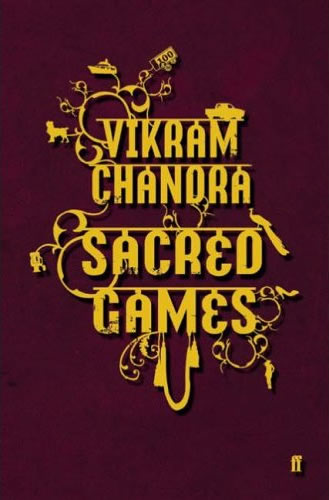
Sacred Games by Vikram Chandra - review


Vikram Chandra has achieved the near-impossible. He has constructed a superbly-realized world of alien languages and customs, mores and styles, presented on the page without apologies or explanations, and has somehow created a wholly believable universe.

That fact that this world actually exists, and is, in fact, modern-day India, makes his achievement all the more astonishing.

Sacred Games represents a quantum leap in the India-born author’s evolution as a writer. His first novel, Red Earth and Pouring Rain, was an alternately hypnotizing and maddening mélange of Indian folk tales and modern tribulations that, for all its excesses, showcased a writer of superb raw talent.

Now, in a fiction cunningly disguised as a straightforward crime drama, Chandra comes into his own, harnessing his narrative powers to reveal an India of “aged-and-cured wickedness,” in all its “piquant scandals, its bitter breakdowns, its ferociously musty unfairness…its resplendent and rotting flesh.” You could call it the unholy love child of Rohinton Mistry and James Ellroy (and you wouldn't be far off), yet Sacred Games is so much more than the bastard descendent of its progenitors.

In a novel of many disparate threads and teeming throngs of secondary characters, there are two personalities that drive the bruised heart of Sacred Games.

The first is Sartaj Singh, a police inspector in Mumbai, investigating the strange death of a local crime lord. Sartaj is a conflicted man, at ease with the strange dichotomy of being a police officer in a land where “the rule of law was an illusion that not even children believed in,” yet troubled by “fragments of the dead” that follow him from every successive crime scene.

The second is the deceased gangster, Ganesh Gaitonde, a charming yet ruthless villain who understands India as a complex world where illiterate farmers “carried mobile phones and murdered their daughters and sons for marrying out of caste.” Chandra leapfrogs through time periods, superimposing the two worlds as a study in striking contrasts and similarities.

Chandra might have been content to simply concentrate on the crime elements, resulting in a lean, bloody entertainment of blackmail, double-crosses, and bullets, but there is a heft and passion at work that elevates the plot from its pulpy origins. The expansive breadth of Sacred Games reveals a truly Dickensian worldview of events and people “randomly tossed about and nudging into each other, splitting each other’s lives apart.”

Like Charles Dickens, Chandra has an unrestrained view of life, revealing truths through both plot and setting. His expletive-laden India is a perfectly-rendered character unto itself, its back-alleys, high-rises, and slums as integral to the story as the streets of London are to Dickens’ masterpieces.

Sacred Games, then, is not so much a crime thriller (although it succeeds brilliantly in that fashion as well), but a rich commentary on a land so plentiful in conflict it is a miracle it doesn’t implode. Chandra clearly loves India for all its many faults, but it is a testament to his strength as an author that the narrative never once becomes sanctimonious or swamped in despair.

As Satraj navigates the punishing terrain of India’s religious strife and class warfare, he imagines that “maybe one day it’ll all just fall apart.” Chandra runs the same risk: Sacred Games, like India, is massive, intimidating, and violent, and, like India, it somehow manages to weave its many elements together, to become something altogether original and special.

Originally printed (expurgated version) in the Winnipeg Free Press, January 14, 2007.

Labels: ,

Thursday, January 11, 2007

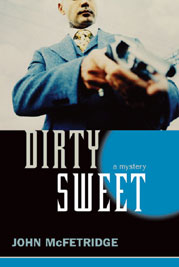
Dirty Sweet, by John McFetridge - thoughts


It’s hard to be compared to the greats. Let’s face it, they are the greats for a reason; they have achieved a measure of success, their names are near-synonymous with a certain area of expertise, their works are bandied about and admired both for their individual qualities and for their cumulative effect on the general public.

Elmore Leonard and Carl Hiaasen are two of the greats in the genre of crime thriller. Leonard’s total output—chock full of acknowledged classics such as Rum Punch, Out of Sight, Fifty-two Pick-up, The Big Bounce, Get Shorty, et al.—has ensured him a permanent place in the canon. Hiaasen, while not looked upon as being in quite the same sphere of genius, is nevertheless an equal, and novels such as Strip Tease and Sick Puppy have garnered him a likewise enthusiastic following. Both authors specialize in combining true pop culture sensibilities with a style and wit that belies their subject matter. In their pages, you find lowlifes, dim-wits, hitmen, mobsters, and cops gone dirty, all deluded by their own visions of glory, and all supremely entertaining.

What has all this got to do with John McFetridge? Well, all authors have got start somewhere, and almost all will earn comparisons with works of similar techniques and subjects. And in Dirty Sweet, McFetridge is bound to hear the names Leonard and Hiaasen come up again and again. Not bad company to be lumped in with, but the comparisons could be hazardous.

Is McFetridge up to the ranks of Leonard and Hiaasen, or their contemporaries Westlake, McBain, Block, etc? Well, no, not yet. But he could be. Dirty Sweet is not a perfect book, but its pages hold the guarantee of talent.

The plot can accurately be described as Leonardesque. After a brazen, broad-daylight assassination of a Russian businessman, the last thing on anyone’s mind (except the police, and even that is debatable) is bringing the perpetrators to justice. The main witness, Roxanne Keyes, has aims of using her position to help her in a real-estate deal. The man behind the hit, Boris Suliemanov, now has a hitman uncle who won’t leave, a mother who complains constantly, a reputation with the Russian mafia as a coward, and an upscale strip-club that is in danger from violent take-over bids from rival gangs. Throw in slick cops, a charming Internet pornography entrepreneur, several various seamy characters of the unlawful variety, and you have a meandering, dipsy-doodle narrative that always entertains even while the reader tries desperately to play catch-up with the convoluted plotlines.

Now, if that doesn’t sound like an Elmore Leonard novel, what does?

Not to damn McFetridge with faint praise, but Dirty Sweet is not up to the levels of Leonard, Hiaasen, et al. Not their best works, at any rate. His characters are likeable to a point, but none quite so memorable as, say, Judge Bob Gibbs, Leonard’s maniacal title character in Maximum Bob. In Leonard’s works, the characters and dialogue are the main attractions, and while McFetridge tries, there’s something missing. McFetridge weaves his plotlines competently, but the machinations are too rough, the characters too numerous. He has tremendous ideas, but at least three personalities too many. Roxanne and Boris (and especially the porn king Ryan) are sterling, but there’s a lack of depth that keeps them from becoming truly outstanding.

But Leonard and Hiaasen are not perfect. Their lesser works are uneven at best, and Dirty Sweet is more fully realized than Leonard’s Be Cool, and almost on par with his entertaining Mr. Paradise. Hiaasen’s Double Whammy is like Dirty Sweet in its promise of exceptional talent, and its uneven execution.

Dirty Sweet holds such promise for McFetridge as a true heir to the greats, not simply an imitator (for examples of bad quality simulations, see Dave Barry’s Big Trouble, a good concept buried underneath a too-self-conscious style). It equals the lesser works of the giants, and to help rank it, it is miles above Brown’s Requiem, the first novel of James Ellroy (another crime writer who has gone so far past his early works that American Tabloid should have earned him the Pulitzer). McFetridge’s storytelling talent is terrific, and with a little seasoning, he will have earned a place among the greats.

Labels:

Tuesday, January 09, 2007

My First Public Reading [updated]

I was going to bore my three faithful readers with the story of my finagling with the publishing contract I eventually received, but you know what? Borrr-ingggg!

Instead, let me regale you with the tale of my first public reading, complete with ironic twist!

While it was still to be some time before Shelf Monkey was released (April 2007, if you haven't been keeping track), I was approached by a friend in the MLIS program I was enrolled in at the time. Jason Hammond (a swell fella, and kickass librarian) was organizing a speaker for the Brown Bag* lunchtime speaking series that the Faculty of Library and Information Sciences occasionally hosts for its student body. Jason had lined up a local author/publisher to speak on the perils and joys of publishing, and as he knew of my novel, invited me to speak as well.

How could I say no? A chance to unleash my literary genius upon the world? Why, I'd be crazy not to. In my head, I pictured a full room of eager beavers, each clutching $20 for a possible pre-order.

Let me tell you, reality? It bites. The room was crammed with all of seven people, five of which construed my immediate circle of friends. But, hell, an audience is an audience, after all, and I had performed for smaller: one particular outdoor performance of The Fifteen-Minute Hamlet during the Winnipeg Fringe Festival had, I believe, an audience of six, if you don't count the twelve children wondering when the hell the juggling magician was scheduled to start.

I stumbled through an abbreviated version of the tale you've currently been so enraptured by, and concluded with a few minutes from my tale, the job interview section, I believe. Afterward, giddy with the rush that can only come from a spontaneous burst of scattered indifference, I took a few questions, and was then presented with an unexpected gift: a novel that Jason had gotten from the recent Book Expo in Toronto. I accepted the gift gratefully; a free book is a free book, even if I had never heard of it. The cover blared BESTSELLER, and apparently involved aliens of a sort.

You can guess the ironic twist, can't you? If you've been a faithful reader, of course.

For those not in the know (*SPOILER ALERT*), Shelf Monkey concerns a group of young booknerds, who take it upon themselves to become the champions of literary culture, with results I shall delicately describe as catastrophic. A main theme of the novel is poor literature, poor as in badly-written tripe (such as this blog), the kind of literature that makes you shudder. Dan Brown, I'm looking at you.

So, quite unbeknownst to poor Mr. Hammond, he bequeathed unto me a most thoughtful and delightfully ironic gift: the worst novel I have ever read. A novel of such staggering incompetence as to make the aforementioned Mr. Brown a literary icon of near-Dickensian talent. The Ed Wood Plan Nine from Outer Space of novels.

Minnow Trap.

Weeks later, after the giggles had finally subsided from myself and my partner (seriously, it is the most inadvertently funniest novel I've ever read), I cornered Jason, and congratulated him on an absolutely perfect gift, given the subject matter. Today, Minnow Trap holds a special place in my collection, and in my heart. There shall never be another like it.

Except, of course, until...the sequel!

*Jason has since written me with the reminder that he actually hosted the Lunch Bucket Speaker Series, not Brown Bag series, which was the 'official' FIMS speaker series. My bad.

Labels: ,

The Guardian's Digested Reads

The bounty hunter looked on helplessly as the geek killed himself with liquid nitrogen.

"I guess we'll never know what happened to the embryos," Dolly groaned.

"Luckily for us, no one will remember they had nothing to do with the story by the time they've finished this book," the bounty hunter replied.

I know, I know, I haven't been very diligent in my ongoing story of the trails and tribs of getting Shelf Monkey published. And the release date is fast approaching!

I promise, more very soon. But first, my new favourite find:

Every week, the Guardian (a UK newspaper) has something called Digested Reads, in which the reviewer summarizes the entirety of a novel in 400 words, so you don't have to read it at all! Concise, quick, and spectacularly mean, which of course I admire tremendously.

No RSS feed, so you'll have to check on your own. Still, their analyses of Michael Crichton's Next (see above) and Thomas Harris' Hannibal Rising are riotous and time-saving.

Sunday, January 07, 2007

The Devil's Publishing Dictionary

The Blog Making Light has a very cool listing of new definitions for the publishing industry. Here's a sample:

Vanity Press: A way of getting published that anyone can see is folly, unless the book in question is their own.

Very funny, very true.

The Devil's Publishing Dictionary

Also, the original idea comes from the blog Paperback Writer, another fantastic blog.

Paperback Writer: The Devil Made Me Do It

Thursday, January 04, 2007

Brilliant Blog Alert!

Just a quick note to promote a terrific blog. Tim Footman, an author and apparent masochist, has undertaken the terrifying job of scouring the works of Dan Brown for inaccuracies, goofs, and all-round awfulness. Bookmark his site immediately.

Truly, a man among men, this Footman. God speed.

Chasms of the Earth

Wednesday, January 03, 2007

Best & Worst, 2006

Being a huge fan of lists (and hey, honestly, who isn't?), and as this blog is supposedly aimed at those with a literary bent - at least until my next blog entry, "What I did During My Christmas Vacation" - I thought it would be in everyone's best interests if I reveal my personal Best & Worst in Literature list of 2006.

A forewarning: these are my favourites from the 97 novels that I read over the past year, not necessarily novels written in 2006. There are many, many novels written in 2006 that occupy a place on my to-read list, such as Cormac McCarthy's The Road, Paul Malmont's The Chinatown Death Cloud Peril, Trevor Cole's The Fearsome Particles, Kenneth J. Harvey's Inside, Mark Haddon's A Spot of Bother, and others too numerous to mention here.

So, without further fanfare, and in no particular order, the novels that stayed with me long after I finished the last line:

The Best of 2006!

His Dark Materials (trilogy - 1995-2000) - Philip Pullman
I wasn't sure what to expect from these stories, other than some fantastic praise. What I discovered was a dense, intensely nuanced, and unabashedly mature 'young adult' trilogy that contains all the trappings of great fantasy, plus a determinedly bleak worldview that has major parallels to today's world. The movie had better retain the story's inherent distrust for certain authoritarian organizations, or else all is truly lost.

The Steampunk Trilogy (1995) - Paul Di Filippo
A truly remarkable series of novellas, set in the 'steampunk' genre of science-fiction in Victorian times a la Jules Verne. Di Filippo's three tales are superbly silly, always entertaining, and completely unforgettable.

Jonathan Strange & Mr. Norell (2004) - Susanna Clarke
This one was so huge I never bothered with it on its initial release. But damn if Clarke doesn't pull off the richest fantasy this side of Neil Gaiman. Spectacular.

Oh Pure and Radiant Heart (2005) - Lydia Millet
In a just world, Millet's name would be bandied about with the same awe and admiration as Vonnegut's. A blistering satire on everything that matters.

The Divine Ryans (1990) - Wayne Johnston
I absolutely loved Johnston's The Colony of Unrequited Dreams, but Ryans showed me that he had his talent from the word go. Tender, yet hilarious, Ryans should be considered the Newfoundland Catcher in the Rye

Father of Frankenstein (1995) - Christopher Bram
I am a great admirer of the movie adaptation Gods and Monsters (always makes me cry), and was relieved that the novel was an equally moving an exploration of old age, love, and friendship.

The Brief History of the Dead (2006) - Kevin Brockmeier
Of all the novels published specifically in 2006, the only one that left me utterly breathless. Wow.

Great Expectations (1860-61) - Charles Dickens
I'd never read Dickens before, but after Expectations, I finally understand the term 'dickensian.' A glorious, full-blooded soap opera.

Joyland (2006) - Emily Schultz
As precise an evocation of mid-nineteen-eighties teenage angst as you're likely to find.

Bright Lights, Big City (1984) - Jay McInerney
Truly, a Sun Also Rises of the yuppie set.

The Bear Went Over the Mountain (1996) - William Kotzwinkle
This was a re-read, but I found it as playful and absurd as when I first read it. Maybe it's because of my current state as published author, but the fancy of a bear finding a manuscript and becoming a best-selling Hemingway figure tickles me no end.

Life of Pi (2001) - Yann Martel
Another re-read, but I was relieved to discover my initial love of Martel's delicate masterpiece was not in error. Oddly, this is the one novel that everyone either loves or hates, with no middle ground.

Down and Out in the Magic Kingdom (2003) - Cory Doctorow
Marvelous imagination. Doctorow describes a future Earth so precisely that I have a hard time believing he doesn't have some kind of inside source on the matter.

The Talented Mr. Ripley (1955) - Patricia Highsmith
I have read every Ripley novel but the first. Just as good. Highsmith was a genius.

All This Town Remembers (2006) - Sean Johnston
Superbly poignant rendering of the small-town mindset, a companion piece to Russell Banks' The Sweet Hereafter.

The Devil's Picnic (2006) - Taras Grescoe
Grescoe travels the world to discover the forbidden, and won't take no for an answer. Hilarious, grotesque, and maddening.


And with that out of the way:

The Worst of 2006!

Minnow Trap (2005) - Brian Horeck
In all my years, I have never read anything this incompetently bad. That is, until...

Blood & Wine (2004) - Rosellen Price
Along with the above, proof positive that self-publishing is, at it's very worst, a deeply saddening experience. C'mon, spellcheck, people!

Airframe (1996) - Michael Crichton
Admittedly not that bad, but I needed something other than the first two crimes against the humanities. Crichton was once a fun and talented writer, but as he gets older, he gets less imaginative, more pedantic, and hugely boring.

Labels:

Blogarama - The Blog Directory Add to Technorati Favorites