Showing posts with label Winnipeg Free Press. Show all posts

Jun 3, 2007

Shelf Monkey - interview in Uptown Magazine


I love that title.

A fun hour of coffee and conversation was distilled into this tiny interview hidden within the pages of Winnipeg's Uptown Magazine.

While not my first, it was probably the most fun interview I've had to date. Interviewer Quentin Mills-Fenn (a nom de plume, but who am I to reveal his true identity - if the guy wants to feel like he's Batman, let him) and I chatted over a tremendous amount of topics, most of which has nothing to do with the issue at hand. But he refers to Shelf Monkey as "a savage and funny book, like Fahrenheit 451 meets Revenge of the Nerds," so I'll forgive him anything.

Click on the image to read the article.

May 20, 2007

The Halifax Connection by Marie Jakober - review

There is, no doubt, a sterling thriller to be made surrounding Canadian involvement in the American Civil War. Warfare has often served as a fertile ground for rousing tales of cloak-and-dagger espionage, and Canada’s heretofore-unheralded background role in the ultimate creation of the United States seems an ideal launching point for such a yarn.

Canadian author Marie Jakober certainly would appear to have the chops for such an undertaking. A past winner of the Michael Shaara Award for Excellence in Civil War Fiction for her novel Only Call Us Faithful, Jakober has published seven well-received novels of historical/fantastic fiction, and deserves kudos for unearthing a little-discussed area of Canadian history for fictional dissection.

Unfortunately, Jakober cannot decide what she wants her novel The Halifax Connection to be, and the resulting plodding narrative does the subject matter a disservice.

Erryn Shaw is a lanky English expatriate living in Halifax, an unemployed theatre owner who, in the words of his handler, is “a fish to whom the whole world is water…[and] the best God damn natural spy I’ve ever seen.”

Recruited for his talents at blending in, Erryn is charged with infiltrating the Grey Tories; “Canadians who actively supported the Southern cause; or, in plainer words, Confederate agents.” Such men scheme to involve England in a war against the United States, a conspiracy that would unavoidably result in England backing the Confederate cause.

There is an obvious and important modern-day analogy brewing in The Halifax Connection, as 19th century Canada flirts with involvement in a war between two parties it holds no allegiance to. Yet despite the possibilities for intrigue inherent in a war that would result in a “little ribbon of colonies crushed between two empires, precious to neither, sacrificed by both,” Jakober squanders the opportunity with a romantic sub-plot as obvious as it is unnecessary.

Shaw’s protracted dalliance with Sylvie, a working-class woman with a tragic past, is meant to illustrate the personal compromises Erryn must undertake to fulfill his mission, yet bleeds the story dry of any true tension. Purple descriptions of “kisses to burn up all the fogs of the North Atlantic” distract from the plot, lending undue emphasis on the least interesting storyline.

The major problem with The Halifax Connection then comes from the uneven pairing of these two elements. The far more attention-grabbing secret agent storyline suffers from its episodic structure, while the admittedly strong characters of Erryn and Sylvie are stuck serving a by-the-numbers romance.

There is a fascinating tale to be told in the Canadian angle of the American Civil War, but The Halifax Connection is not that tale. Jakober should have trusted the material to be strong enough on its own.

Originally printed in The Winnipeg Free Press, Sunday, May 20, 2007.

Apr 24, 2007

Planet Reese by Codelia Strube - review


Cordelia Strube is a realist, in the most extreme sense. Not for her the provincial world of traditional CanLit, where horrific events classically occur through the gauzy mist of nostalgia, in a tiny Newfoundland community where the inhabitants are untouched by world events.

Strube rejects this cliché, embracing Canada as it exists in all its healthcare fiascos, climate change, and shortsighted government policies. Her Canada is one overrun by “doughy cretins, unable to see beyond their own greed and consumption,” and after six novels, Strube holds claim to being a premier purveyor of feel-bad Canadian literature.

Planet Reese continues this trend, beginning with its protagonist Reese Larkin at the lowest depths of despair, and seeing how much more punishment one man can take. It is more or less a retelling of the Book of Job, except far funnier, and holy salvation at tale’s end appears exceedingly unlikely.

Reese is an environmentalist beset on a multitude of fronts by the plagues of the 21st century. His wife has taken their children, and only communicates through a social worker. In order to prove he can hold down a ‘real’ job, he has taken a position with a marketing/phone centre, “a thankless, repulsive job and only the desperate or truly naïve can stand it, and even they never last.”

Making matters worse, he accidentally kills an innocent man on a plane, and is thereafter mistakenly heralded as a hero for thwarting a presumed terrorist attack. Overwhelmed with guilt and shame, his days are now filled with news reports of domestic abuse, murder, and environmental degradation, and for some reason he cannot find himself a comfortable mattress or a good, cheap pair of shoes.

Reese’s manic rage at being ostracized for caring about the planet forms Planet Reese’s blackly comic heart. A Quixotic figure, even Reese is surprised by his cynicism, unable to even enjoy a documentary on Christopher Reeve without thinking about “the money involved in trying to mend a severed spinal cord…money that could be sent to seventeen month-old babies in North Korea or Iraq or Afghanistan.”

Strube’s refusal to sugarcoat the insanity of “the Western world’s insatiable quest for the perfect chair and mattress” may serve to dissuade a reader from visiting Planet Reese. It is a valid criticism of the majority of Strube’s past output that too much hopelessness can be hard to take.

Yet Strube’s fondness for her put-upon characters is such that Planet Reese remains entertaining even as Reese digs himself a psychological hole so deep he cannot competently function in life. Bewildered at how “anyone could rest their head on a hundred dollar pillow when stick-thin Ethiopian children and stacks of corpses were in the news,” Reese sets himself up for the kind of self-destructive breakdown good literature excels at.

“When you no longer hope for signs of intelligence, compassion or kindness,” Reese howls, “are you safe from harm?” Strube doesn’t provide an answer, but in asking the question, she has ensured that Canadian fiction will remain relevant to the perils of our age.

First published in The Winnipeg Free Press, April 22, 2007.

Mar 3, 2007

4x4 by Wayne Tefs - a review

Travel as backdrop for human psychology is a traditional and fertile literary device. North Africa scoured the soul in Paul Bowles’ The Sheltering Sky. Alex Garland investigated Generation X angst through an island Eden in The Beach.

Now, Manitoba writer Wayne Tefs transforms a 1992 Jeep Cherokee on Highway 6 between Winnipeg and Thompson into a Pandora’s box of familial sorrow, trapping a mother and two sons in a suffocating blend of repressed anger and camouflaged guilt.

4x4, Tefs’ ninth novel, mixes a hazardous blizzard, strained relations, and close quarters into a dramatic powder-keg, with concealed skeletons the fuse. As Darryl Dokic quips, they are driving “in a snowstorm on the road to godforsaken Thompson. Lucky thing we don’t have to do this sober.”

As befits the title, 4x4 relates itself through four dissimilar narrators. Clint Dokic sells real-estate, sees angles in every conversation, and describes life as, “There’s them on the road to success and them dawdling along through the grass in the ditch.” Brother Darryl is an under-achiever who dreams of Australia, imagining the Outback as an escape from “the nonsense of industry and commerce and the once-a-week nod in the direction of God.”

Mother Meg in the back seat, meanwhile, is a survivor of a marriage reminiscent of Roddy Doyle’s The Woman Who Walked Into Doors. As the family challenge rising drifts and poor visibility, Clint’s wife Kaly, the fourth narrator, sits alone at the Burntwood in Thomson, pregnant, scared, and harbouring secrets of her own.

Tefs, winner of the Margaret Laurence Award for Fiction for his novel Moon Lake, has a spare, sharp style of writing, admirably capturing the inherent claustrophobia of a lengthy road trip. As the storm’s power and the Dokic’s anxieties begin to swell, the Jeep begins to loosely resemble a Manitoba adaptation of Jean-Paul Sartre’s play No Exit: “Hell is other people.”

The Dokics themselves are archetypes of a dysfunctional family, but Tefs never permits them to slip into unsympathetic stereotypes. As the present and past engagingly unfold from alternating viewpoints, all facets of the family are studied, engendering empathy that might otherwise be nonexistent.

Yet despite the undeniable strength of Tefs’ style and depth, elements exist that seem out of sync with the whole. For all its realism of tone and character, there exist too many mysteries and buried tragedies to be easily believed.

Each character hides some key that, if revealed, would destroy the others. While each is compelling, presented in muted, realistic hues, when put together they lend an awkward soap-opera-like facade that muffles the quality of the storyline, as if Tefs did not trust his characters to be interesting enough on their own.

Luckily, 4x4 is simply too good to be dismissed for overreaching. If the story at times stretches credulity, it is salvaged by Tefs’ honest humour and compassion. In 4x4, Tefs has fashioned an impressive tale of unflinching humanity and ultimate redemption, a road trip where “the destination only makes up half the journey.”
Originally published in the Winnipeg Free Press.

Feb 28, 2007

The Letter Opener by Kyo Maclear - review

“In Japan, there is a tradition of honouring broken things, things that people have used for many years, in particular belongings that they have worn close to their bodies. It is a pleasing thought that something spiritual might rub off on objects that age with us.”

Kyo Maclear understands the urge to view inanimate objects as talismans, as “memory magnets” that somehow fill in the blanks left by a person’s absence. Such subjective application of meaning supplies each object with “its own genetic code,” investing a great deal of personal importance in items which another person might find to be mere trinkets.

Maclear’s first novel The Letter Opener examines our unconscious attachments to the knick-knacks we hold dear, but her story is not at all a treatise on obsessive behaviour. Rather, the Canadian author is more concerned with craftily unraveling the stories behind our curios, when they are all we have left to hold onto.

Naiko has good reason to ponder the intuitive importance of such artifacts. A sorter in the Undeliverable Mail Office, she is responsible for reuniting missing objects with frantic owners, delving daily into buckets of “things that didn't yield well to friction belts, flat sorters and mechanized claspers…rebel objects that had bobbed away from the mail stream and now required human hands.”

Because of past family mishaps, Naiko has a difficult time in forming personal and lasting relationships, instead comforted by “the chaos and the change” she sees in the constant flow of packages through her workspace. Her closest bond is with her co-worker Andrei, a Romanian refugee who fled the tyranny of the Ceausescu regime with his lover Nicolae. When Andrei suddenly disappears, Naiko is left with nothing of their friendship but transitory memories and the contents of his desk. As she fights against the “alchemy of loss,” searching for clues as to his whereabouts, she begins to examine her own life as well, and begins to question her fixation on the paraphernalia of strangers.

Maclear, a frequent contributor to Canadian culture magazines, writes in a clear, thoughtful style, coolly charting Naiko’s expanding search to encompass decades and continents, all the while revealing the depths of memory we unconsciously associate with simple objects. Andrei’s grandmother, a holocaust survivor, sorts through the personal effects of prisoners at Birkenau, seeing life while surrounded by death. Naiko’s mother, slowly succumbing to senility, compulsively hoards pens, somehow locating “virtue in repossessing the things we call garbage and junk.”

Despite the admirable care Maclear takes in unraveling her plotlines, the result is too lopsided a story to stand. Andrei’s history is far more compelling than Naiko’s, and by comparing their innate similarities, Maclear inadvertently highlights the fact that Naiko is far less intriguing a figure. Her sense of loss is palpable and touching, but Maclear has too much invested in Andrei’s backstory to ever create a similar empathy for Naiko, and the resulting imbalance results in an alternately tender and maddening novel that never quite satisfies.

There is a sublime aspect to humanity’s insistence on infusing the inanimate with the weight of memories, keeping them as repositories of the sum total of a life. Maclear understands this, and it is to her credit that The Letter Opener creates some incisive memories of its own. Unlike the beloved pens of Naiko’s mother, however, the novel is unlikely to become anyone’s long-term treasure.

Originally published in the Winnipeg Free Press, Sunday, February 25, 2007.

Jan 15, 2007

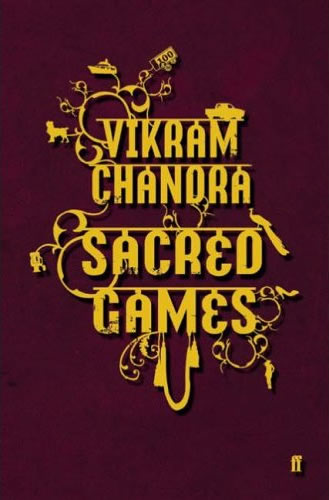
Sacred Games by Vikram Chandra - review


Vikram Chandra has achieved the near-impossible. He has constructed a superbly-realized world of alien languages and customs, mores and styles, presented on the page without apologies or explanations, and has somehow created a wholly believable universe.

That fact that this world actually exists, and is, in fact, modern-day India, makes his achievement all the more astonishing.

Sacred Games represents a quantum leap in the India-born author’s evolution as a writer. His first novel, Red Earth and Pouring Rain, was an alternately hypnotizing and maddening mélange of Indian folk tales and modern tribulations that, for all its excesses, showcased a writer of superb raw talent.

Now, in a fiction cunningly disguised as a straightforward crime drama, Chandra comes into his own, harnessing his narrative powers to reveal an India of “aged-and-cured wickedness,” in all its “piquant scandals, its bitter breakdowns, its ferociously musty unfairness…its resplendent and rotting flesh.” You could call it the unholy love child of Rohinton Mistry and James Ellroy (and you wouldn't be far off), yet Sacred Games is so much more than the bastard descendent of its progenitors.

In a novel of many disparate threads and teeming throngs of secondary characters, there are two personalities that drive the bruised heart of Sacred Games.

The first is Sartaj Singh, a police inspector in Mumbai, investigating the strange death of a local crime lord. Sartaj is a conflicted man, at ease with the strange dichotomy of being a police officer in a land where “the rule of law was an illusion that not even children believed in,” yet troubled by “fragments of the dead” that follow him from every successive crime scene.

The second is the deceased gangster, Ganesh Gaitonde, a charming yet ruthless villain who understands India as a complex world where illiterate farmers “carried mobile phones and murdered their daughters and sons for marrying out of caste.” Chandra leapfrogs through time periods, superimposing the two worlds as a study in striking contrasts and similarities.

Chandra might have been content to simply concentrate on the crime elements, resulting in a lean, bloody entertainment of blackmail, double-crosses, and bullets, but there is a heft and passion at work that elevates the plot from its pulpy origins. The expansive breadth of Sacred Games reveals a truly Dickensian worldview of events and people “randomly tossed about and nudging into each other, splitting each other’s lives apart.”

Like Charles Dickens, Chandra has an unrestrained view of life, revealing truths through both plot and setting. His expletive-laden India is a perfectly-rendered character unto itself, its back-alleys, high-rises, and slums as integral to the story as the streets of London are to Dickens’ masterpieces.

Sacred Games, then, is not so much a crime thriller (although it succeeds brilliantly in that fashion as well), but a rich commentary on a land so plentiful in conflict it is a miracle it doesn’t implode. Chandra clearly loves India for all its many faults, but it is a testament to his strength as an author that the narrative never once becomes sanctimonious or swamped in despair.

As Satraj navigates the punishing terrain of India’s religious strife and class warfare, he imagines that “maybe one day it’ll all just fall apart.” Chandra runs the same risk: Sacred Games, like India, is massive, intimidating, and violent, and, like India, it somehow manages to weave its many elements together, to become something altogether original and special.

Originally printed (expurgated version) in the Winnipeg Free Press, January 14, 2007.
Related Posts Plugin for WordPress, Blogger...