Feb 28, 2007

The Letter Opener by Kyo Maclear - review

“In Japan, there is a tradition of honouring broken things, things that people have used for many years, in particular belongings that they have worn close to their bodies. It is a pleasing thought that something spiritual might rub off on objects that age with us.”

Kyo Maclear understands the urge to view inanimate objects as talismans, as “memory magnets” that somehow fill in the blanks left by a person’s absence. Such subjective application of meaning supplies each object with “its own genetic code,” investing a great deal of personal importance in items which another person might find to be mere trinkets.

Maclear’s first novel The Letter Opener examines our unconscious attachments to the knick-knacks we hold dear, but her story is not at all a treatise on obsessive behaviour. Rather, the Canadian author is more concerned with craftily unraveling the stories behind our curios, when they are all we have left to hold onto.

Naiko has good reason to ponder the intuitive importance of such artifacts. A sorter in the Undeliverable Mail Office, she is responsible for reuniting missing objects with frantic owners, delving daily into buckets of “things that didn't yield well to friction belts, flat sorters and mechanized claspers…rebel objects that had bobbed away from the mail stream and now required human hands.”

Because of past family mishaps, Naiko has a difficult time in forming personal and lasting relationships, instead comforted by “the chaos and the change” she sees in the constant flow of packages through her workspace. Her closest bond is with her co-worker Andrei, a Romanian refugee who fled the tyranny of the Ceausescu regime with his lover Nicolae. When Andrei suddenly disappears, Naiko is left with nothing of their friendship but transitory memories and the contents of his desk. As she fights against the “alchemy of loss,” searching for clues as to his whereabouts, she begins to examine her own life as well, and begins to question her fixation on the paraphernalia of strangers.

Maclear, a frequent contributor to Canadian culture magazines, writes in a clear, thoughtful style, coolly charting Naiko’s expanding search to encompass decades and continents, all the while revealing the depths of memory we unconsciously associate with simple objects. Andrei’s grandmother, a holocaust survivor, sorts through the personal effects of prisoners at Birkenau, seeing life while surrounded by death. Naiko’s mother, slowly succumbing to senility, compulsively hoards pens, somehow locating “virtue in repossessing the things we call garbage and junk.”

Despite the admirable care Maclear takes in unraveling her plotlines, the result is too lopsided a story to stand. Andrei’s history is far more compelling than Naiko’s, and by comparing their innate similarities, Maclear inadvertently highlights the fact that Naiko is far less intriguing a figure. Her sense of loss is palpable and touching, but Maclear has too much invested in Andrei’s backstory to ever create a similar empathy for Naiko, and the resulting imbalance results in an alternately tender and maddening novel that never quite satisfies.

There is a sublime aspect to humanity’s insistence on infusing the inanimate with the weight of memories, keeping them as repositories of the sum total of a life. Maclear understands this, and it is to her credit that The Letter Opener creates some incisive memories of its own. Unlike the beloved pens of Naiko’s mother, however, the novel is unlikely to become anyone’s long-term treasure.

Originally published in the Winnipeg Free Press, Sunday, February 25, 2007.

Feb 16, 2007

My new digs

Well, after some thought, I have decided to uproot myself from my comfortable lifestyle of doing nothing, and go somewhere and do something.

Specifically, Thompson, Manitoba.

It's my hometown, and I'll be the administrator in charge of the above public library.

That's right. I'm in charge of the whole library.

It's all mine. And I'm scared to death.

Feb 7, 2007

A Small and Remarkable Life by Nick DiChario - a review

Theodore Sturgeon is one of the great unsung heroes of science-fiction, a genius of style and character, and a true visionary when it came to intricate plotlines that were completely unpredictable yet completely, devastatingly logical. Sadly, while his name is still held in high esteem by the literati of the sci-fi genre, he has never truly risen above the level of cult author, largely ignored while his contemporaries and imitators attain a level of popularity denied to him. We hear of Philip K. Dick, of Frank Herbert, of Clarke, Asimov, Bradbury, Zelazny, and Delany, yet Sturgeon is relegated to the sidelines, more often known as the inspiration for Vonnegut’s famed character Kilgore Trout (himself a failed science-fiction author), or as the original writer for the famed Star Trek episode, “Amok Time.”

Sturgeon’s true flair was in plotting, excelling in narrative’s which always keep the reader in a state of heightened suspense. Take his novel More than Human (his acknowledged masterpiece), wherein six strange and damaged individuals discover that they each form a part of a whole, a “blesh” organism which takes on the next step of human evolution, the “homo gestalt.” To Marry Medusa is a brilliant exploration into another evolutionary concept, as humanity becomes infected by a hive mind, and learns to function and defeat the alien host through its collective strength. Sturgeon had a definite knack for revealing the many facets of humanity through stories of alien contact that spurned the popularity of their shoot-‘em-up alien invasion space opera cousins (a la Independence Day), and rose to the level of art. But the genre he wrote in denied his fame, as for the most part people still reject science-fiction as being ‘popular,’ and therefore not literature.

There, of course, have been many, many examples since Sturgeon passed away of excellent writers consigned to relative obscurity because of their chosen literary field. Nick DiChario may suffer the same problem; it’s far too early in his career to tell. But let us hope he achieves more: based on his deeply surprising first novel A Small and Remarkable Life, we may have discovered the 21st century Sturgeon.

Taking the form of a ‘first-contact’ novel (i.e. a story based on the presumption of Earth’s first contact with an alien life form), DiChario’s tale bears all the hallmarks of the classic ‘fish out of water’ scenario so beloved in science-fiction: an alien, trapped on Earth, must learn to adapt and survive. Yet as in Sturgeon’s best, DiChario subtly subverts the concept, taking the reader down unexpected paths.

Setting his narrative in the mid-19th century, DiChario intriguingly lays out the story of Tink Puddah, an unusual bluish-hued individual that most people refer to as “the foreigner.” Tink is the mysterious progeny of Nif and Ru, two aliens from “Wetspace” who have decided to adapt themselves to life on earth:
“Their metamorphosis had begun—they had each developed two miniature spherical structures of jelly-like eyes with which to see the new world. Bodies shrinking, rounding, bending. Bones to support the eco-matter. Small, bipedal, humanoid creatures they would become. Atoms, molecules, joints, nails, skin, glands, hormones, blood.”
Right from the start, DiChario propels the story through startling imagery that pays homage to the tenets of the genre while at the same time raising the bar.

Unfortunately, Nif and Ru fall to misfortune as Tink’s body is adjusting itself to a human shape. Their motives for coming to Earth are never explained, nor should they be, as Tink’s tale would be forever spoiled from too much back-story. DiChario presents Tink’s life in two ways, weaving a standard chronological narrative of his life with the tale of Jacob Peirsol, a preacher who presides over Tink’s funeral (it gives nothing away to say that Tink dies, as the story begins with his memorial service). Jacob, like Tink, has been searching for meaning in his life, and his collision with Tink alters his lifepath irrevocably.

By keeping Tink confused as to his past, thereby becoming a blank slate on which an existence on Earth can imprint its various glories and cruelties, DiChario manages the not-inconsiderable feat of having Tink function as both character and parable. He truly becomes the ‘good Samaritan,’ traveling the land, dispensing kind acts for no compensation, yet persecuted for both his outward appearance and a case of mistaken identity. There are strong parallels to the messiah myth, but also present is a strong homage to Mary Shelley’s Frankenstein (Tink’s odyssey as an incompletely-formed human is directly analogous to Shelley’s Monster wandering alone and unloved through the world), as well as Robert Heinlein’s Stranger in a Strange Land – although how any modern Christ analogy in science-fiction could not but harken to Heinlein’s revolutionary sci-fi parable is hard to fathom.

Interestingly, despite the abundance of evil in Tink’s world, the true ‘villain’ of the piece, Jacob, is hardly a villain at all, in the traditional sense. His only crime is one of pride, as he cannot comprehend Tink’s unwillingness to consider the possibility of God;
“Jacob had always believed Tink Puddah nothing more than a heathenish savage and feared for his misguided soul. And, as any preacher would have done, he harbored a secret resentment for someone who could turn so easily from the Word of the Savior, Lord Jesus Christ, to a belief in…well…nothing.”
Jacob's eventual outcome, like Tink’s, is blazingly unexpected, completely logical, weirdly touching, and bewilderingly original.

It does a disservice to DiChario’s accomplishment to lump it in with the usual assortment of ‘aliens lost on Earth’ stories such as the cinematic adventures of E.T. and Starman. A Small and Remarkable Life does perform the archetypal function of holding up a mirror to the acts of mankind, reflecting all their flaws and triumphs, but DiChario’s talent for pathos (and his skill at creating a colonial world that doesn’t feel stale or trite) ensures that A Small and Remarkable Life holds itself tall over its competitors, a small and remarkable novel.

Feb 5, 2007

Why I hate the funny pages

I cannot claim to ever consider the comics in my local newspaper (or, more recently, online) to be a representation of 'real life.' There are liberties that must be taken for the sake of entertainment. Even Doonesbury (still the greatest, most incisive comic strip of all time), while holding to a semblance of reality, has toyed with talking plants, zombies, and trash-talking robots.

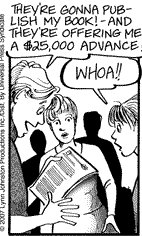
But For Better or For Worse was different. Lynn Johnston aged the characters over the decades, rarely strived for cheap jokes, and created an empathy for her cartoon family that cannot be compared to any other comic strip out there. Johnston courted controversy when a secondary player came out, toyed with fate when the family's beloved dog Farley died, created righteous anger when daughter Elizabeth was attacked by a co-worker, and has always maintained a fairly strict adherence to the realities of everyday life.

But this...this will not stand. Even more than her recent statements that she will no longer age the family, this is something completely ridiculous:

Michael, the eldest, has recently finished his first novel (and by recently, I mean last month). Now, suddenly, he receives an unexpected contract in the mail, offering him an advance of $25,000.00

WHAT?

I accept that there are liberties that must be taken. Perhaps he already had a firm promise from this publisher (although this is never mentioned). Perhaps the publisher had a relatively small slush pile, and was somehow able to give Michael's manuscript more than a cursory once-over.

But, c'mon! $25,000? Without so much as a phone call beforehand? Out of the blue? Johnston has always flirted with treacle, but this plot twist, coming as it does as Michael and his family are enduring the hardship of losing their belongings to a fire, doesn't hold to a single element of realism. If a single publisher is willing to put $25,000 on the line for an unproven talent, Michael should hold out for more money, for he is truly the second coming of Hemingway (or Robert James Waller, if the glimpses into his prose style over the years can be trusted).

It's agony to be jealous of a fictional character, but there it is. Lynn, you have always, always sought to present a reality in line with our own. You stood out from the pack of Beetle Baileys, Lockhorns, and Born Losers with a sharp understanding of character relationships and plot development. Don't stop now. If we can't relate to your characters, then For Better or for Worse may take a disastrous turn towards the abomination that is Family Circus. Consider yourself warned.

Feb 1, 2007

33 Reasons Librarians are Still Essential

Just thought I'd put up a quick link to this thoughtful and important list, via the blog DegreeTutor.

I particularly like point 23: The Internet is a mess.

Yes, you can write a book (or part of one)

In what can either be described as brilliance or the most insane literary project to date, the lovely people at De Montfort University have launched the first-ever novel in wiki form. That's right, it's a work in progress, and anyone can contribute.

What will the result be? A new Bonfire of the Vanities? Breakfast of Champions? Blood & Wine? And how can we put this on our literary CVs?

A Million Penguins
- for anyone who's yearned to write a book, but not the whole damn thing.
Related Posts Plugin for WordPress, Blogger...