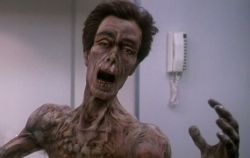
Today, the monkey holds his breath as he steels his nerve for another annual onslaught of Palahniukian proportions.
Will Chuck return to form? Or will he continue his sad descent towards irrelevancy?
The monkey, being a cautious optimist, refuses to bet either way.
Are you there, Satan? It’s me, Madison. I’m just now arrived here, in Hell, but it’s not my fault except for maybe dying from an overdose of marijuana. Maybe I’m in Hell because I’m fat--a Real Porker. If you can go to Hell for having low self-esteem, that’s why I’m here. I wish I could lie and tell you I’m bone-thin with blond hair and big ta-tas. But, trust me, I’m fat for a really good reason.
So begins
Damned, Chuck Palahniuk's newest foray into obscenity-laden satire. As a fan of Chuck's works, I once looked forward to each new novel with a tingling sensation in my nethers. Chuck was a carnival barker extraordinaire, an energetic guide to a literary freak show of humanity's worst traits. It wasn't for everyone, but when Chuck was on fire (see:
Fight Club,
Choke,
Lullaby,
Rant), there were few who could compare.
Then came
Snuff, a divisive work about a porn star striving to break the record for most conjugal partners in one day. Many hated it; I found much to admire, although there was the sense of Chuck spinning his wheels a little. After
Lullaby travelled into magical realism,
Diary showed a growth to other genres (reminding me much of
Rosemary's Baby), and
Rant displayed a razor-sharp style akin to
J.G. Ballard,
Snuff seemed a step back.
And then came
Pygmy, a limp terrorist satire that vastly outstayed it's welcome and became the first Palahniuk novel to ever become outright boring.
And then came
Tell-All, about which the less said, the better (but if you are inclined,
here's a link to my review, and
another link discussing his publisher's dishonest promotional techniques concerning said review).
But being the cautious optimist that I am,
Damned looked like fun. Described as a
Judy Blume novel set in Hell, it promised an unusual experience, and (hopefully) a return to Chuck's glory days.
Annnnnnnnd . . . meh.
Damned is the tale of young Maddie Spencer, the thirteen-year-old daughter of a movie star and a real estate tycoon who crosses the threshold of life during an ill-advised exploration of drug use. Maddie, through her wicked ways, has been condemned to Hell (as, it turns out, will most of us):
As it turns out, the way-fundamentalist Christian creationists were correct. How I wish I could tell my parents: Everybody in Kansas was right. Yes, the inbred snake-handlers and holy rollers had more on the ball than my secular humanist, billionaire mom and dad. The dark forces of evil really did plant those dinosaur bones and fake fossil records to mislead mankind. Evolution was hokum, and we fell for it hook, line, and sinker.
Maddie spends her days in a cage, keeping her spirits up through hasty friendships with nearby cellmates, a
Breakfast Club sandwich of a jock, a nerd, a prom queen, a punk, and herself (which makes her the
Ally Sheedy of the group, I guess). The group sits in gore-encrusted cells, waiting to be devoured by passing demons, which isn't as final an end as it sounds:
If anything, life in Hell is like a vintage Warner Bros. cartoon where characters are forever getting decapitated by guillotines and dismembered by dynamite explosions, then being completely restored in time for the next assault. It's a system not without both it's comfort and it's monotony.
Damned is not without it's charms, one of which, unfortunately, is not Maddie Spencer, as annoying a protagonist as you could imagine. Part of this is because of Palahniuk's by-now-familiar style of meta; Maddie is forever reminding the reader that she is not an idiot, that she understands certain words, that she is smart. "Yes, I know the word
absentia," she pouts. "I'm thirteen years old, not stupid - and being dead, ye gods, do I comprehend the idea of absentia." After a short time, these asides speed past precocious/cute and run headlong into precocious/put her outside already. Maddie never becomes a believable character, and her voice often grates with the worst tendencies of Palahniuk.
After a time in Hell, during which our heroine escapes and trudges past the Sea of Insects, the Great Plains of Broken Glass, the Ocean of Wasted Sperm, and the Swamp of Partial-birth Abortions, Maddie finds herself a job in one of the two major areas of Hellish employment; telemarketing (the other area is Internet porn). Maddie finds that she has a knack for it, and soon her organizational skills come to the fore, and it turns out that Hell may be exactly the terrain where Maddie can finally shine.
As I said,
Damned is not without charm, if one can affix the descriptor 'charm' to anything Palahniuk writes. He has plainly done some research into literary depictions of the abode of the damned, and his eternal plane of misery is a vividly-described wasteland of torment. Palahniuk has not, it seems, lost his knack for shock, evident in a gruesome scene wherein Maddie uses the severed head of the punk to sexually gratify a particularly nasty demon. And when
Damned starts to ultimately become an afterlife
bildungsroman, the novel finally begins to catch the reader's attention.
But there's a laziness afoot. Comments that
The English Patient and
The Piano are the only movies that play in Hell smacks of an exhaustion of imagination. Ditto the concept of telemarketers as damned souls reaching out to make human contact, an idea not nearly as clever as Palahniuk thinks. The plot never decides what, exactly, it is satirizing, and there isn't enough energy to propel the plot over its massive rough spots.
Damned is hardly as lazy a product as
Tell-All, but it doesn't have enough sustained imagination to lift it past, say,
Snuff.
Damned is hardly the worst thing ever, not nearly even the worst thing Palahniuk has written. There are sparks of effort, and near the end, when the narrative gains some momentum, the story begins to actually involve the reader beyond a superficial appreciation of Palahniuk's wilting wit.
Damned could be seen as notice that Chuck is not yet spent, that there are reservoirs he has not yet tapped. But the man is treading water when he should be swimming.
VERDICT: THE MONKEY TRIED. LORD, HOW HE DID TRY. BUT HE'S GOING TO GO RE-READ LULLABY FOR A PICK-ME-UP.