Well, I had a strange day yesterday. In amidst all the goings-on of getting a book published (marketing, promotion, actually writing the damn thing, etc.), I took a day to undergo what is surely the silliest, most rigorous aspect of it all: getting my picture taken.
Yes, it turns out that people want to see my pretty face. Worse, my publisher demands it, over my strident objections that such photos could only serve to hurt sales.
So, sucking in my gut and applying a liberal amount of makeup to certain less photogenic areas of my face (thank you, recurring adolescent acne!), I underwent the sort of day only supermodels should ever be subjected to. If a person look that good, I figure you might at least torture them a little for it.
I enlisted the help of my uncle, the only person I know with easy access to a high-quality digital camera. He, my girlfriend-cum-photographer's assistant, and myself spent a lovely rain-free hour on the campus grounds of the University of Western Ontario, capturing the many moods of Corey Redekop: snide, bemused, bored, hungry, asleep, ad infinitum. I must admit, there was a fun aspect to it all: the advent of digital photography means we can take hundreds of photos where before we had to make do with a select few, wait a week for the local A&P to develop it, then gnash our teeth as we view photo after photo of lovely landscapes, all perfectly in focus, all marred by the highly blurry individual sitting contentedly in the foreground.
So we wiled away the hour, then set about choosing the best from a group of hundreds. I mailed a CD of the best, least stomach-upsetting pictures to my publisher, and also chose one as my new Profile Picture. I think you'll agree, as plain and unassuming as it is, that it is a far more appealing picture than that of my current target of literary scorn. Ah, self-publishing! The last remaining refuge for true delusions of grandeur.
It's strange and unsettling to think that my visage will soon stare out from the back flap of a novel. Aside from the front cover and blurb, this could be the element that ultimately discourages potential buyers. "Oo, he looks insane. Reading this novel will only waste valuable hours." Maybe I'm over-reacting, but putting my picture on a book could be the greatest literary miscalculation since Jenny McCarthy decided she had enough insight on motherhood to write a book about it.
And yes, I'm aware I have low self-esteem issues, so there's no need the bother pointing that out.

Sep 30, 2006



Sep 27, 2006
New word - Horeckian
After our patron saint Brian Horeck, he of the immortal masterpiece Minnow Trap, I hereby coin the term Horeckian, meaning, "Man, I thought I knew what bad was, but that...now that is bad."
And the first writer to be termed Horeckian is...Rosellen Price, she of the almost as immortal classic Blood & Wine.
Let us all gaze upon the magnificence of an author who misspells Lieutenant not once, but twice, with alternate spellings each time in case you get bored. An author who is convinced that people "waive" hello to each other. An author who is engaged to a "lvoing" husband. An author who continually uses two words where one would do, i.e. "ass hole" for "asshole," "what ever" for "whatever," etc. An author who, like St. Horeck, cannot for the life of her tell a remotely convincing or interesting story.
So, here's to you, Rosellen! You've lowered the bar for us all!
And the first writer to be termed Horeckian is...Rosellen Price, she of the almost as immortal classic Blood & Wine.
Let us all gaze upon the magnificence of an author who misspells Lieutenant not once, but twice, with alternate spellings each time in case you get bored. An author who is convinced that people "waive" hello to each other. An author who is engaged to a "lvoing" husband. An author who continually uses two words where one would do, i.e. "ass hole" for "asshole," "what ever" for "whatever," etc. An author who, like St. Horeck, cannot for the life of her tell a remotely convincing or interesting story.
So, here's to you, Rosellen! You've lowered the bar for us all!
Sep 23, 2006
The next step...
Y'know, keeping a blog is hard. I was never a journal-keeper, and any attempts at such have always been quickly shunted aside for the latest Playstation game.
Anyway, when last we spoke, our hero (i.e. me) had received his first rejection letter. Crushed, disheartened, but unsurprised (Corey prides himself on being a realist), Corey decided the next step had to be something...bigger. More dramatic. The small, independant publisher route was hereby discarded for the time being. Corey has going to aim high.
So, flushed with my own bravado (alright, I'm trying to make this seem more exciting than putting a package in the mail actually is, so sue me), I reprinted the 250+-page beast, quickly updated my cover letter, and Canada Post-ed my masterpiece to House of Anansi Press. If you're going to get a rejection letter, might as well have it stamped with the prestige of one of Canada's premier publishing houses.
Then, the waiting. And waiting. And (wait for it) waiting.
It's the ultimate insult. No response at all. Nada. Not even a "Are you kidding us?" email. Zilch.
Now, there could be many reasons why I never heard back. Anansi was in the middle of a corporate shake-up at the time: Shelf Monkey simply got lost in the shuffle. Or, Canada Post is to blame. Or, the editor, so impressed by the quality of my writing, quits his job, spending the rest of his life in quiet contemplation of the perfect book he has so long yearned for.
Take your pick.
Coming soon - success?
Anyway, when last we spoke, our hero (i.e. me) had received his first rejection letter. Crushed, disheartened, but unsurprised (Corey prides himself on being a realist), Corey decided the next step had to be something...bigger. More dramatic. The small, independant publisher route was hereby discarded for the time being. Corey has going to aim high.
So, flushed with my own bravado (alright, I'm trying to make this seem more exciting than putting a package in the mail actually is, so sue me), I reprinted the 250+-page beast, quickly updated my cover letter, and Canada Post-ed my masterpiece to House of Anansi Press. If you're going to get a rejection letter, might as well have it stamped with the prestige of one of Canada's premier publishing houses.
Then, the waiting. And waiting. And (wait for it) waiting.
It's the ultimate insult. No response at all. Nada. Not even a "Are you kidding us?" email. Zilch.
Now, there could be many reasons why I never heard back. Anansi was in the middle of a corporate shake-up at the time: Shelf Monkey simply got lost in the shuffle. Or, Canada Post is to blame. Or, the editor, so impressed by the quality of my writing, quits his job, spending the rest of his life in quiet contemplation of the perfect book he has so long yearned for.
Take your pick.
Coming soon - success?
Sep 21, 2006
50 Books: BOOKS: How to Judge a Book by Its Cover
I thought this was a really great piece on book covers. As I'm in the process of choosing one myself, it's a topic near and dear to my heart.
50 Books: BOOKS: How to Judge a Book by Its Cover
Also, check out Book Covers Blog. It's a neat little site that has some great artwork and discussion on what makes a good (or bad) cover.
50 Books: BOOKS: How to Judge a Book by Its Cover
Also, check out Book Covers Blog. It's a neat little site that has some great artwork and discussion on what makes a good (or bad) cover.
Sep 19, 2006
The world's worst writer?
Contrary to popular opinion (in these here parts, anyway, by which I mean the living room, kitchen, and adjacent areas), the world's worst writer is not Brian Horeck. It is, according to Irish literary types, a lass named Amanda McKittrick Ros.
Read about her, and the accompanying festival in her honour, here and here.
However, in defence of our own personal Canadian hero Horeck, I submit that we make Minnow Trap a catch-phrase, meaning to have achieved the lowest standard humanity can tolerate. "You've been Minnow Trapped!"
Read about her, and the accompanying festival in her honour, here and here.
However, in defence of our own personal Canadian hero Horeck, I submit that we make Minnow Trap a catch-phrase, meaning to have achieved the lowest standard humanity can tolerate. "You've been Minnow Trapped!"
Sep 11, 2006
Off Season by Jack Ketchum - thoughts

Have you ever felt you just missed the boat on an author? You know what I'm getting at, that one book that everyone raved about, but you simply couldn't fathom its popularity? Perhaps it's Yann Martel's Life of Pi, an amazing book that a surprising amount of people loathe. Or Margaret Atwood's The Tent, critically acclaimed yet snooze-inducing.
Well, Jack Ketchum's Off Season affects me in this way. I just don't get the hype. Stephen King raves on the cover, "If you read Off Season on Thanksgiving, you probably won't sleep until Christmas." No dice. I love Stephen, and will defend even his lesser efforts to the death, but his blurbs have led me down troubled paths before, most notably Bentley Little's The Walking, a novel that King apparently admires, but which I found to be a dreary, repetitive, and downright terrible, terrible novel. Really. I can't emphasize this enough. Just awful.
Off Season is not nearly that bad. It is a grimly effective horror novel with several moments of absolutely grosteque imagery. So no, it's not that bad. It's just not that good.
The plot harkens back to the glory days on grindhouse flicks, those cheaply-made exploitation movies with titles like I Spit on your Grave. A group of attractive young professionals arrive at a rented cottage for a weekend of relaxation. A hideous family of in-bred monstrosities attacks the group. Carnage ensues.
Right from the start, Ketchum is deliberately evoking the pulpy b-movie slasher films of the 1970s. These were usually terrible, but there were glimmers of true art and passion amidst the dreck. George Romero's classic Night of the Living Dead comes to mind, a nihilistic masterpiece that Off Season owes more than a nod to. He says as much in his afterword, a lengthy and entertaining discussion on the evolution of the novel, from its original and highly-neutered first publication in 1981, through its gaining cult status as a no-holds-barred horror epic, up to its ultimate re-release in its original, unexpurgated glory. It's strange that Ketchum, while noting Living Dead as an influence, never mentions Wes Craven's The Hills Have Eyes, another low-budget gorefest that Ketchum's plot is almost an exact recycling of.
Now, there is nothing wrong with this sort of story. As Roger Ebert said in his droll and literate defense of George Romero's zombie epic (and the greatest zombie film of all time) Dawn of the Dead, "It is not depraved...it is about depravity." The same can be said of Off Season: it is definitely about depravity. Ketchum knows that we are all voyeurs, and we have a dark fascination with gore and subjects society considers taboo. He then proceeds to show us exactly what depravity is, in all its forms. Murder. Rape. Cannibalism. Mutilation. And it goes on like this.
Now, I'm no prude (although remarking on one's lack of prudity pretty much guarantees the moniker 'Prude' will be hung around the speaker's neck). I absolutely love the gritty low-budget movies that had the courage to go all the way with their ambitions. There is no better summation of the perils of consumerism than Dawn of the Dead (the original, not the surprisingly fun but lesser remake). The Hills Have Eyes, while not in the same league, does provide an in-depth satire on the bonds of family. Depravity can be a terrific entertainment, when done correctly. Look at Stephen King's Pet Semetary, a novel even he found too scary, and as depraved an examination of grief as there ever could be.
Ketchum's story does not have the heart of Pet Semetary. Nor does it have the resonating satire of Dawn. What it has, is gore. Buckets of it. People are skinned alive. Tongues are hacked off. Women are raped, dismembered, and disembowelled. No one gets off easy. No one is spared.
So, we've established that Off Season is ugly, and nihilistic, and bleak. So what? Such a vantage point does not make a novel worthless. But for all its in-your-faceness, there seems little point to all the blood-letting. That may also be Ketchum's point, that there is no point to it all, that life is brutish, short, and unpleasant. Mission accomplished.
But there's nothing beyond the ability to quease that makes Off Season anything more than moderately interesting. In the end, it's exactly like most of the grindhouse films it emulates. It's short, has flashes of originality, and vanishes from your memory once completed.
Shelf Monkey - soon to be covered!

I thought I'd jump ahead in my narrative of the perils and triumphs of getting my novel Shelf Monkey published, and let people in on what is undoubtedly the coolest part of getting a novel on the shelves: choosing a cover.
Now, due to copyright and ownership issues, I am currently unable to show the three possible selections. However, I can show you the artist's first cover, seen to the right. This is the novel Showbiz, by Globe & Mail columnist/reviewer Jason Anderson. David Gee is the artist, and I think you'll agree, it's a striking cover.
I should also mention, Showbiz the novel is quite a memorable read as well. I'd advise anyone with a yen for humour and an adoration of the strange to pick up a copy for themselves.
Sep 10, 2006
Brown's Requiem - quick thoughts
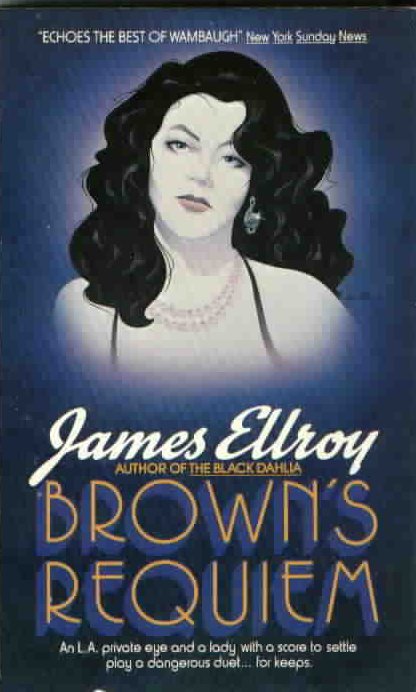
It is to much to hope that every great writer's first attempt will be a home run. Sure, Joseph Heller catch-phrased American irony with Catch-22, Harper Lee moved us to tears with To Kill a Mockingbird, and John Kennedy Toole changed the world (or my world, anyway) with A Confederacy of Dunces. But for every astonishing debut, there are innumerable debuts that only hint at greatness to come. John Irving's meandering Setting Free the Bears. Neal Stephenson's self-indulgent The Big U. Kurt Vonnegut, Jr.'s Player Piano, a good book that only hinted at how truly astonishing its creator could be. And let us not forget Brian Horeck's Minnow Trap, the worst novel ever written (I realize Boreck is not considered a great writer by anyone, but I couldn't come up with a more-memorable example).
And so it is with James Ellroy. His later works such as L.A. Confidential, The Big Nowhere, and American Tabloid are breathtaking masterpieces of the darkest criminal noir. Ellroy's never having been awarded a Pulitzer Prize is one of modern literature's great oversights.
Yet Brown's Requiem, his first novel, barely whispers the spectacular heights Ellroy is capable of. Where his later works (most specifically his L.A. trilogy) combine grotesque crimes, gnarled plots, and dialogue so hard-boiled it leaves bruises, Brown's Requiem displays all the hallmarks of an author struggling to find his voice.
The plot, it must be said, is the weakest element, a limp mix of Hammett, Chandler, and every other influence a novice writer may try to emulate. Fritz Brown is an L.A. detective/repo man who unwittingly becomes embroiled in a bizarre case involving arsonists, welfare fraud, crooked cops, sexy dames, heroin, and many other standards of the crime thriller. As Brown tries to sort out the mess, he begins to view the overall case as his chance to make a change in his life.
So far, so good. No one ever said a plot had to be overtly original to be entertaining. The greatest detective novel ever published, Raymond Chandler's The Long Goodbye, has very little plot at all. What matters in these cases is style, voice, and attitude. Chandler had it in spades. Current Ellroy wields attitude like a bludgeon. Early Ellroy is all pose, no threat.
Part of the problem is the anachonistic tone Ellroy sets up. Brown is set in 1980 (very late, for Ellroy), yet the story reads like something set in 1950. It's the way the characters talk, the use of dialogue like "Do your stuff, Daddy-O," and "Onward, Hot Rod," and so forth: for whatever reason, the fact that this story takes place in 1980 is never remotely believable. Perhaps this is why Ellroy's later works are unabashedly nostalgic for the fedora-and-cigarette world of 1950's Los Angeles. Ellroy's L.A. of 1950 is effortless; his L.A. of 1980 is faintly ridiculous.
All this sounds like an out-and-out pan, but it's not; Brown is still quite entertaining, with a labyrinth of a plot and a firm grasp of what drives a scene, and is worth a read by those familiar with the ouvre of hard-boiled detective fiction. If nothing else, Brown's Requiem could serve as an example of how much an author can improve, given time. Ellroy is one of the finest novelists in America today. Comparing his newer efforts to his earlier ones only serves to prove it.
Sep 5, 2006
The first taste of reality
So, having had my manuscript looked at and critiqued by a famous Canadian author (Miriam Toews - see below), it was time to get the thing published. I don't know what I expected, but what I hoped for was automatic praise, fame, and money. Is that unrealistic?
Two facts ran through my mind:
1) It took Frank Herbert over seven years before he was able to find a publisher for Dune.
2) Stephen King scored a huge hit with his first novel Carrie.
I figured if I could end up somewhere in-between those two, I'd be happy.
So, first step - publisher, or agent? A literary agent can be a wonderful thing, but most agents won't accept you as a client until you've already established yourself. Conversely, most publishing houses won't accept you without an agent. After puzzling out the paradox for awhile, I decided to go the direct route, and send the manuscript in whole to a local publisher who gave Miriam her start as well, Turnstone Press.
I've always been a fan of Turnstone, and felt a weird connection with the publisher through another of its releases, John Gould's book of short stories kilter: 55 fictions. Through my work as a book reviewer with the Winnipeg Free Press, I was able to read and review (very favourably) an advance copy of the work. While I have had no contact with Mr. Gould, I felt a connection had been made through the fact that I was the only book reviewer in the entire country to have reviewed the book. Months later, when kilter became nominated for that year's Giller Prize, I was interviewed by BRAVO!, and appeared on the televised award ceremony talking about the work. Let me tell you, having Graham Greene say my name is a thrill unto itself. Gould didn't win, but I won't take that personally.
Alas, the Turnstone was not to be. A few months after I submitted, I received the following letter:
Dear Corey Redekop:
Thank you for the submission of your manuscript , Shelf Monkey. Although it was reviewed with interest, it does not coincide with the publishing plans of Turnstone Press in the near future.
My first rejection letter! I still have it, and will have it framed as soon as I end up in a house for more than four months at a time.
So, my hopes lie dashed on the floor. Whatever will poor Corey do? Give in to defeat, or rise to challenge the fates themselves? Or at least find enough spare change to mail the manuscript to another publisher?
Stay tuned, gentle readers.
Two facts ran through my mind:
1) It took Frank Herbert over seven years before he was able to find a publisher for Dune.
2) Stephen King scored a huge hit with his first novel Carrie.
I figured if I could end up somewhere in-between those two, I'd be happy.
So, first step - publisher, or agent? A literary agent can be a wonderful thing, but most agents won't accept you as a client until you've already established yourself. Conversely, most publishing houses won't accept you without an agent. After puzzling out the paradox for awhile, I decided to go the direct route, and send the manuscript in whole to a local publisher who gave Miriam her start as well, Turnstone Press.
I've always been a fan of Turnstone, and felt a weird connection with the publisher through another of its releases, John Gould's book of short stories kilter: 55 fictions. Through my work as a book reviewer with the Winnipeg Free Press, I was able to read and review (very favourably) an advance copy of the work. While I have had no contact with Mr. Gould, I felt a connection had been made through the fact that I was the only book reviewer in the entire country to have reviewed the book. Months later, when kilter became nominated for that year's Giller Prize, I was interviewed by BRAVO!, and appeared on the televised award ceremony talking about the work. Let me tell you, having Graham Greene say my name is a thrill unto itself. Gould didn't win, but I won't take that personally.
Alas, the Turnstone was not to be. A few months after I submitted, I received the following letter:
Dear Corey Redekop:
Thank you for the submission of your manuscript , Shelf Monkey. Although it was reviewed with interest, it does not coincide with the publishing plans of Turnstone Press in the near future.
My first rejection letter! I still have it, and will have it framed as soon as I end up in a house for more than four months at a time.
So, my hopes lie dashed on the floor. Whatever will poor Corey do? Give in to defeat, or rise to challenge the fates themselves? Or at least find enough spare change to mail the manuscript to another publisher?
Stay tuned, gentle readers.
Sep 3, 2006
Pope's exorcist denounces Harry Potter
According to this story, the Pope's exorcist is re-igniting the Harry Potter/anti-Christian-values debate.
Now, while I enjoy/abhore such nonsense on innumerable levels, I'd just like to add...exorcist? The Vatican has an exorcist? Really?
I mean, talk about an easy job! Does this require any common sense at all?
Now, while I enjoy/abhore such nonsense on innumerable levels, I'd just like to add...exorcist? The Vatican has an exorcist? Really?
I mean, talk about an easy job! Does this require any common sense at all?
Sep 1, 2006
The Condensed Guide to Looking Like a Writer
I just love this description. I, too, cannot write without being surrounded by caffeine fumes. Although how he missed the prerequisite goatee I'll never know.
Condensed Guide to Looking Like a Writer
Condensed Guide to Looking Like a Writer
Subscribe to:
Posts (Atom)
