Sep 27, 2009

Monkey droppings - Generation A by Douglas Coupland

Today, we look at Canadian hipness, the fall of the bees, drug abuse, and pop culture references - all in the same book!

Generation A
by Douglas Coupland
"I wanted to tell them that what I would look for in a religion is an explanation of why life is so long...Forget religion, I want to mutate. I want so badly to mutate...I dream of the day we mutate into something better than the hyped-up chimps we are, chimps who eat Knorr Swiss cream of cauliflower soup while pretending not to notice that half the planet's at war, fighting over...what? Over the right to eat packaged soup without having to emotionally accept our species' darkness."
Right above in that thar sentence exists both the pros and cons inherent in my relationship with the works of Canadian author Douglas Coupland. His is an eminently readable style, clear and often memorable. Much like Kurt Vonnegut, Jr. (although certainly less so), Coupland's style is almost immediately recognizable as his own. His writings have a certain rhythmic syntax that always draws me in. Coupland has a way with words that allows me the pleasure to see things in a new manner, with a new point of reference. Such is the fun of a good story.

And then there's the reference to Knorr Swiss cream of cauliflower soup. Its specificity. This is what often bugs me. Coupland's style can often draw attention to itself though such examples. I still enjoy it (I've never actively disliked anything of his I've read), but such little jibes and nods to his own cleverness draw me out of the story and remind me that I am only a reader of a story, and not a participant. This is accurate, but it is also alienating. I understand the need for such a mode of description within the pop culture context of the stories he tells, but they can perform a disservice to the narrative.

This is my state of mind when I approach Generation A, Coupland's latest release. (And let's get this out of the way up front; this is not in any way a sequel to his debut [and, to my mind, still his best] novel Generation X, a novel that expertly captures the zeitgeist of its time as well as Jay McInerney's Bright Lights, Big City and Ernest Hemingway's The Sun Also Rises). I hope for a novel that reaches the satirical highs of X and Microserfs, but I am prepared for a lesser effort such as Eleanor Rigby. I'm sure I'll be entertained, but will I be moved beyond that immediate sensation?

And at first, I am prepared for a new high. Coupland's initial theme is strong and exciting; in the near future, bees have become extinct, and the planet is suffering from the inevitable result of having far less plant pollination than it needs. Drought is rampant, food supplies are dwindling, and people have become addicted en masse to Solon, a drug that makes time pass more quickly, and also pretty much destroys any empathy users may have ever held toward anything but themselves. In five distinct areas of the globe, five people are unexpectedly stung by members of the insect family thought to be long dead.

So far, so good. Despite its trappings, Generation A is only nominally a science fiction tale. There are hints that Coupland may want to use his central idea as a method of exposing the hypocrisy rampant in religion. When, early on, Julien, one of the five victims, remarks, "Fundamentalists rejoiced when the bees died out; to them it was proof that the planet exists entirely for and was entirely about people," I was instantly hooked. There is a gloriously rich mine of satire available in this theme just waiting for a prospector willing enough to dig (James Morrow comes to mind).

But Coupland takes a weird turn as his five narrators are gathered together by a scientist with unnamed intentions to tell stories a la Boccaccio's Decameron (or, if you prefer, Chuck Palahniuk's Haunted). Somehow, the act of storytelling may have something to do with the bees, and Solon. Or, it may all be a confusing mess. Six of one, really.

Coupland's real misstep is in having Generation A narrated in first person by five separate individuals. It can take a master stylist to pull off five distinct personalities, and Coupland is not up to it. His five characters are too similar; each talks with the same cadences and rhythms, the same cultural cross-references. There is something to the idea that a rapidly shrinking world will lead to a homogeneity of speech patterns, but even accepting that premise, the difference between each character is razor-thin. One character, Diana, suffers from Tourette's, and even with her frequent bursts of obscenities, it's hard to tell her apart from the others. And as her affliction doesn't go anywhere, it's hard to say why Coupland felt compelled to include it.

This isn't to say that Generation A is a failure. Coupland still tells a story remarkably well, with some sharp insights and clever zingers. When Harj, a Sri Lankan, finds that everyone in America refers to him as Apu, he settles on this explanation: "I believe Americans can only absorb one foreign-sounding word or name per year. Past examples include Haagen-Dazs, Nadia Comaneci and Al Jazeera." It's clever, witty, and memorable, and keeps you interested.

But by the end, Coupland's story has ground to a halt. His characters have become irritating in their sameness, and any resolution found is exceedingly minor. There is talk of hope, of people becoming more connected to each other after the past few years of Internet technology have effectively eroded human relationships to 140 character bites. But there's no reason to care anymore. Coupland has provided no line of empathy to any of his characters, and thus their fate is uninteresting.

There are glimpses of a great novel in Generation A. As I said, it's still a good read, with interesting ideas such as "We all wanted the bees to come back, but in our hearts, none of us believed we deserved them." In that sentence lies more pathos than anywhere else in the entire novel, which is its great failing. Generation A is entertaining, yes, a fait accompli for Coupland, and I was never bored. But it could have been so much more.

VERDICT: MONKEY LIKES, BUT WANTED TO LOVE

Sep 26, 2009

Monkey droppings - The Manual of Detection by Jedediah Berry

On today's menu: hard-boiled noir, served with heavy dollops of magical realism.

by Jedediah Berry
Objects have memory, too. The doorknob remembers who turned it, the telephone who answered it. The gun remembers when it was last fired, and by whom. It is for the detective to learn the language of these things, so that he might hear them when they have something to say.
From chapter two of The Manual of Detection, "On Evidence."
Like pretty much everyone, I enjoy a good mystery novel. I rather like being led about by an intrepid sort of chap, all the while pulling the pieces and clues together on my own. As long as the mystery plays by the rules and doesn't cheat, I'm there all the way.

But I also love novels that play with my sense of reality, that distort the edges of my understanding to unearth new truths, or old truths revealed in a new light, such as in Tim Davys' weird and often wonderful Amberville. So, by way of deduction, I should love The Manual of Detection.

And so I do.

Jedediah Berry, in his first novel - I kind of hate it when a debut novel is this good, call it professional jealousy - puts together an intricate, bizarre, and dreamlike noir of a mystery, using all the classic tenets of the private detective genre while invigorating them with healthy doses of the magical realism of Jorge Luis Borges. Part Dashiell Hammett, part Franz Kafka's The Trial, The Manual of Detection is familiar yet thrillingly original.

Charles Unwin ('unwin' = 'lose'?) is a clerk in an unnamed city, working for a vast detective agency. His sole job is to transcribe and organize the notes of Detective Travis Sivart, which he has been doing for some fourteen years. However, Unwin's fairly uneventful life is about to be transformed; Sivart has gone missing, and Unwin is unexpectedly promoted to the rank of detective. All he is provided is a badge, a gun, and a copy of every detective's most important tool, The Manual of Detection. He also has an odd dream in which Sivart, naked in Unwin's bathtub, doles out some less-than-transparent advice on what is happening. And quite suddenly, the city is laden with sleepwalkers, and someone is stealing all the alarm clocks.

Soon, the familiar tropes of the noir detective make themselves more known to Unwin. There's Cleopatra Greenwood, the femme fatale who continually crossed swords with Sivart; Detectives Peake, Pith, and Crabtree, three fellow P.I.s who may or may not be against Unwin; and finally, the biloquist Enoch Hoffman, Sivart's nemesis and known as being the mastermind behind such cases as 'The Man Who Stole November Twelfth' and 'The Oldest Murdered Man.' And of course, there are henchmen; Jasper and Josiah Rook, brothers once-conjoined at the foot who are described thusly: "They lost something. I don't know what to call it. 'Conscience' isn't quite the word. Some people do cruel things, but the Rooks are cruelty itself, monsters under the moon. And they never sleep."

Berry expertly weaves together these strands of plot (plus a few others) with an assurance that belies his first-time novelist status. His world is that of the classic noirs of the 1950s, alongside a vision of a gothic city (caught in a perpetual rainstorm) straight out of Terry Gilliam's visionary film Brazil. When one character comments to the deceptively competent Unwin, "I do know a thing or two about detectives, Mr. Unwin. I know that with a few words you could have won my heart. But you're one of the noble ones, aren't you?" you can feel the ghosts of Hammett and Raymond Chandler urging Berry on. There is also a hint of steampunk, although far less than Michael Moorcock's glowing review would have you believe.
But Berry is after more than the mystery itself, creating a world of dreams and illusions that pushes his noir in new directions. To call elements of the novel surreal is to damn it with faint praise, because while Unwin's puzzle takes a corner into the fantastic, there are still rules at play. That Unwin doesn't understand them does not mean they don't exist, or play fair. And as he learns the secrets behind the mysteries of Sivart, he uncovers a dark, magical plane where the purpose behind such mysteries becomes clear.

"To the modern detective, truth is rarely its own reward; usually it is its own punishment. And if you cannot track mystery to the back of its ugly cave, then be content to stand at the edge of the dark and call it by name." I can honestly say I've read very few mysteries as intricate and complex as The Manual of Detection. It demands a second and third reading, and it'll get it from me.

VERDICT: MONKEY LOVES

Sep 16, 2009

Now you too can smell like a moist netherworld beast.

Tired of perfumes that lend you the aroma of flowers and Jennifer Lopez? Looking for a replacement to that library-related scent I told you about a few months back?

Well, your prayers to the demon underlords of your nightmares have been answered!

Presenting The Lovecraft Collection from the Black Phoenix Alchemy Lab; "scents inspired by the works of H.P. Lovecraft and the Cthulhu Mythos."

Who's Lovecraft? Why that's H.P. Lovecraft, early 20th century teller of tall tales, many of which surrounded a bizarre mythology of 'the old ones', beasts of unfathomable terror who paraded about our planet long ago.

And what's a Cthulhu? You silly, Cthulhu's not a what, it's a who. And it is this:

Mmm, I'll bet that smells great!

From the description of Cthulhu (the scent):
A creeping, wet, slithering scent, dripping with seaweed, oceanic plants and dark, unfathomable waters.
Doesn't that sound divine? Also available are odours such as Azathoth, R'lyeh, and Shoggoth.

All kidding aside, I am wholly heartened by such efforts to combine a passion for literature with a passion for fragrances. I wholly hope that they embark upon further literary/olfactory adventures. May I suggest Clive Barker's
Cenobite, a lovely commingling of acrid steel and blood-soaked flesh? Or Jeff Vandermeer's Grey Cap, an earthy mushroom with hints of death?

Thank you to the good folks at io9 for bring my attention to this wonderful, wonderful product.

Sep 10, 2009

Arthur Slade's the Hunchback Assignments

Once in a great while I do a few reviews for the venerable Canadian publishing magazine Quill and Quire. They have just posted my review of Arthur Slade's terrific new steampunk novel for young people, The Hunchback Assignments.
Slade’s London is an engrossing mélange of the historically precise and the ridiculously imaginative. Working within the genre of steampunk, a mode of speculative fiction that posits a world of technological invention within the trappings of the Victorian Era, Slade crafts a world in which the sad reality of children “[sifting] through the mud at low tide for coal, bits of rope, anything to sell for a penny” exists alongside fantastic armoured men powered by gyroscopes made of “steel bones, the steam pumping out of holes in narrow iron plates.”
Read the entire review here.

Sep 6, 2009

Monkey droppings - a trio of pleasures both subtle and gross, and not for the timid

On today's agenda, a triumvirate of testaments to creativity. And zombies. Lots and lots of zombies.


by Tim Powers

For me, the fantasy genre has always been a mixed bag of pleasures. For every tasty chocolate truffle of pure imagination (Lev Grossman’s exemplary The Magicians, for instance), there are three or four of the cheap Hallowe’en candy no one likes, the post-Tolkien ‘orcs and trolls’ variety a la Ed Greenwood, wherein each novel reads like a particularly dense night of playing Dungeons & Dragons.

While I appreciate the effort such authors take at expansive world-building, I find that fantasy works much better when it is incorporated into a more familiar world, using fantasy to enhance the reality of recognizably human characters. Clive Barker, Jeff Vandermeer, Susanna Clarke and the aforementioned Grossman weave tales of wonder I wish would never end. And Tim Powers? I’ll have to read more of him to make sure, but based on reading his recently re-released 1989 novel The Stress of Her Regard, this guy is the real deal.

Stress follows the adventures of Michael Crawford, a young doctor in England in the 1800s. After his new bride is brutally murdered while he slept next to her, Crawford finds himself ‘wedded’ to a nephelim, a vampire-type creature that has claimed him for her own. Crawford flees, and subsequently becomes an acquaintance of such famous Romantic figures as Percy Shelley, John Keats, and Lord Byron, all of whom also have had dealings of some kind with the supernatural world Crawford now realizes swirls all about him. The Nephelim, while jealous and possessive to the point of murder, also enhance artistic expression in their partners, a double-edged sword for poets such as Shelley who are addicted to the creativity their unnatural spouses allow them yet despair as their earthly loved ones die about them. Powers crafts a secret history that underlies the world of the 1800s, wherein magical elements have had a profound impact on many of the major figures of the time.

This is not ‘easy’ fantasy; this is dense, intricate work more akin to ‘hard’ science-fiction in its approach to its subject matter. If you are easily befuddled by sentences such as “This phantom and the sphinx evidently each existed at specific intensities of the time-slowing they’d been experiencing—each of the apparitions only became visible or invisible as a viewer approached or receded from its characteristic point of the time spectrum,” you’re going to find Stress a grind of a read. Stress also defies easy categorization, being at any one time a historical fiction, a fantasy, a vampire novel, or all three at once. It brings in elements of Egyptian, European, and Middle Eastern mythology, resulting in a sometimes-breathtaking literary epic of scope and grandeur.

I won’t say that I loved The Stress of Her Regard unreservedly. I often got lost in the labyrinth of the plot, and was as often befuddled as I was astonished. But Powers has erected a complete world of dense and mythic proportions, one that is at once familiar yet completely alien. Stress may not be the easiest read, but it is a deeply rewarding one.

VERDICT: MONKEY LIKES


Steampunk

by Ann & Jeff Vandermeer (eds.)

Steampunk, for those out there unfamiliar with the genre, is usually defined as an alternate reality fiction that combines elements of the Victorian era with more advanced technological developments of the modern age, although usually, as the name implies, powered by steam. It is an often rich and intricate world, allowing authors to travel the realms of historical fiction while at the same time adopting the tropes of science fiction. And its acceptance into the mainstream is gaining steam, so to speak. From early works (H.G. Wells and Jules Verne are usually cited as progenitors of the genre) to more modern authors such as China Mieville, William Gibson (who alongside Bruce Sterling may have written the definitive steampunk novel,The Difference Engine) and Jay Lake, steampunk is definitely catching on. Young adult novels such as Philip Pullman’s His Dark Materials trilogy, Stephen Hunt’s The Court of the Air, Scott Westerfeld’s upcoming Leviathan, and Arthur Slade’s terrific The Hunchback Assignments are bringing a whole new generation into the fold.

It is a tricky procedure, but when it works (as in my personal favourite, Paul Di Filippo’s Steampunk Trilogy), the result can be gloriously entertaining.

And Steampunk, an anthology edited by the esteemed duo of Ann and Jeff Vandermeer – Jeff is the author of City of Saints and Madmen, a bizarre and twisted fantasy/sci-fi collection you should all read; he’s also one of my closest Internet friends, i.e. a man I’ve corresponded with but never actually met in the flesh (incidentally, Jeff has recently worked on a slideshow of the history of steampunk, and it is worth checking out) – is indeed gloriously entertaining stuff. Gathering together some of the masters of the category (including Di Filippo), the Vandermeers have attempted to bring some terrific examples of this burgeoning world to light.

Things get rolling with an example from one of the godfathers of the genre, Michael Moorcock, with an except from his Warlord of the Air. If I had to choose a favourite, my choice is the entry by the multi-talented Joe R. Lansdale (see next review below for more). His "The Steam Man of the Prairie and the Dark Man get Down" is by far the most visceral and disturbing piece in the collection, a vivid sequel of sorts to H.G. Wells' The Time Machine, following the exploits of the time traveller after he has ripped open tears in the fabric of reality and has harnessed the Morlocks to terrorize the world. Discomfiting stuff, but gripping. Molly Brown switches the tone to the delightful, positing a sequel to Jules Verne's From the Earth to the Moon. Brown's "The Selene Gardening Society" presents a plan to return to the moon to plant gardens for the benefit of future explorers. Ted Chiang's "Seventy-Two Letters" mixes in Kabbalistic magic and the myth of the golem, resulting in one finely-tuned piece of weird imagination. 

There are far more wonderful pieces, including authors as diverse as Michael Chabon and Neal Stephenson. Steampunk is an extravagant treat, a celebration of literary invention, and a perfect introduction to a rapidly expanding genre.

VERDICT: MONKEY LIKES A LOT


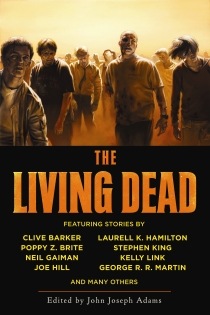
The Living Dead

by John Joseph Adams (ed.)

I loves me my zombies. Don’t know why. Don’t care to know why. But ever since a young me caught Night of the Living Dead on A&E (in the days when it really was about arts and entertainment, and not the reality filth-fest it’s sadly become), I have been hooked. Watching those fuzzy b&w monsters assault that house. Poor Barbara. And the ending? Ben, surviving a night of unthinkable horror, shot by excitable rednecks. For the first time, I became acutely aware that happiness was not a requisite part of an ending.

Since then, zombie movies have been a pleasure of mine, sometimes guilty, sometimes not. I winced and squirmed in the best way through Lucio Fulci’s Zombie, and winced and squirmed in the worst possible way through Uwe Boll’s House of the Dead, a movie so idiotic that it is far funnier than many comedies (sorry, Kira). I declare George A. Romero's Dawn of the Dead to be one of the greatest horror movies of all time, the remake surprisingly good, Romero's Day of the Dead uneven but memorable, and that remake even worse than House of the Dead. And I can only pray that patron saint Romero regains his balance with his newest opus Survival of the Dead, if only to wash away the bitter taste that was his Diary of the Dead (oh what a waste!).

But for me, zombie novels have been a mixed bag, with nary a classic in sight. Brian Keene makes a valiant effort, but his novels quickly become repetitive and sorta dull. David Wellington is a good talent, but Monster Island was too much Resident Evil-style video game action and not enough actual horror. World War Z was good, in some places excellent, and while I await the movie with much gleeful anticipation, it didn’t wholly overwhelm me. Stephen King’s Cell was half a great zombie novel, and half kind of meh. Pride and Prejudice and Zombies was a passable literary mash-up that quite frankly needed more zombies and less Austen. I withhold judgement on Robert Kirkland’s graphic series The Walking Dead, as I have not yet finished the last three books (but up to book seven, I’ll say the thing is damn awesome).

But The Living Dead fills the nooks and crannies of every literary need I’ve ever had (where they pertain to resurrected corpses, anyway). John Joseph Adams’ anthology of previously released stories hits so many high points I grew tired of counting them.

Even I’ll admit that zombies can be tiresome; not much personality, kind of slow, easily defeated on a one-to-one basis. Certain liberties must be taken with the mythos to make such creatures interesting over the course of 400+ pages, but Adams puts in just the right mix of classic monster mayhem and mythological experimentation to make the whole of The Living Dead an absolutely spectacular collection. There is everything a zombiphile could want; gore, satire; parody, gore, emotion, comedy, gore, sex, nostalgia, and gore.

I can’t possible list every favourite moment, but there are a few standouts even among all the excellence. Dan Simmons, an amazing writer whom I hope returns to horror very soon, starts off the collection with a bang with “This Year’s Class Picture.” A teacher, driven almost mad, continues to try and teach a class of dead students while the world collapses around her. Grim, gruesome, and sensitive, Simmons’ tale hits all the right classic moments. “Death and Suffrage” by Dale Bailey takes the collection into satire, envisioning a world where the dead arise during a presidential election and begin to exercise their right to vote (Joe Dante adapted Bailey’s story into the vastly entertaining “Homecoming,” an entry in the Masters of Horror anthology series on Showtime). Nina Kiriki Hoffman’s “The Third Dead Body” veers the anthology into romance and obsession, albeit of the most unsettling sort. Maestro’s Clive Barker and Stephen King contribute some early classics of their work. Darrell Schweitzer’s “The Dead Kid” rivals King in his mingling of childhood innocence with horror. “Those Who Seek Forgiveness,” Laurell K. Hamilton’s first story with her heroine Anita Blake, is so strong I’ll have to overcome my initial prejudice to her Vampire Hunter series and give them a try. Joe R. Lansdale (again!) moves the zombie into western territory with “Deadman’s Road.” “The Song the Zombie Sang,” by the formidable team of Harlan Ellison and Robert Silverberg, may be the most exquisite and beautiful story involving a zombie ever published.

Enough raving, I’m starting to sound like an undiscerning fanboy here. Suffice to say, The Living Dead is everything I’ve ever wanted in the zombie genre.

VERDICT: MONKEY LOVES, UNCONDITIONALLY, WHOLE-HEARTEDLY

Sep 2, 2009

Critical Monkey! Update the second!

Another month, another batch of goodness. Check here for the rules if you're a newbie. Enough preamble! Get to the stats!

Acceptance
(seven reviews)


Depression (six reviews)

Anger (five reviews)

Guilt (four reviews)

Bargaining (three reviews)

Look at that, we have a genuine contest going on here!

Some very interesting choices in the second month. Jeanne's excoriating review of Empire of Lies left me positive that Andrew Klaven was not an author I want to read, or have as a neighbour. Lori L and Steve Zipp have gone for the upscale classics we're all supposed to have read by now but haven't (I've never read Leacock either, but boy, I think it's a Canadian law that I should). Betty reviews a better-than-expected teen zombie novel, and gypsysmom takes on the best-selling Anne Rice. Myself, I still have no feeling in my legs after the roundhouse kick to my boys that was Chuck Norris' craptacular Justice Riders.

But I think Norris was enough of a punishment for me. Time to take a cue from my fellow contestmates and read something a little more, well, better. In the spirit of trying something new that should've been read long ago, I've put aside my plan to flagellate myself with Nicole Richie's novel and instead have opted for a slice of pure Canadiana.

Up next: W.O. Mitchell's Jake and the Kid. That ought to make my elementary school teachers happy.

Keep it up, Monkeys! Only ten more months to go! We've got a few people up to denial; who wants to bargain? As always, leave your book and link in the comments section. And if I missed one, let me know, I'll fix the mistake posthaste.

And tell your friends, the more the merrier. And I promise, next month, I'll have a freebie for someone, guaranteed.*

*Not a guarantee.
Related Posts Plugin for WordPress, Blogger...