Aug 27, 2009

Monkey droppings - Hater by David Moody

Today: A return to the wonderful scares of old, in a new novel equal parts Stephen King, George Romero, and Richard Matheson.


Hater
by David Moody


"If I find I cannot terrify the reader, I will try to horrify, and if I can't horrify, I'll go for the gross-out.” – Stephen King, Danse Macabre

Terror is arguably the hardest emotion to evoke from the page. As the maestro of modern horro says above, horror is easier to instill in a reader than terror, and gore easier than horror. Horror makes you think, “Wow, there’s an image I’ll never forget.” Terror makes you afraid to dangle your feet over the edge of the bed at night while you sleep, lest the shoggoths who inhabit the nether realm under your lower mattress get hungry. Horror makes you wince. Terror makes you wet yourself rather than go into the cellar without a flashlight. Horror is visceral and immediate. Terror infects your soul.

As such, true terror in printed fiction is relatively rare, an occurrence that only gets rarer as one ages and becomes hardened and cynical. There’s a reason they’re classified as ‘horror’ novels rather than ‘terror’ novels, after all. But a few tales out there still instill dread in my soul. Clive Barker’s The Damnation Game got to me early, and still makes me question how important my soul is to me. King’s masterpiece ‘Salem’s Lot, with its destruction of a small town by vampires, always gets me, and I find myself hesitant to leave the safety of the bed at night. Richard Matheson’s I am Legend left me chilled and spooked for days.

But as I grow increasingly older, I find such visceral responses become scarcer, the maturation of my medulla resulting in a soggy dampening of my reactions. Most recently, I anxiously anticipated the delicious terrors of Guillermo del Toro’s vampire epic The Strain, only to be rewarded with an enjoyable mix of gore and some effective scenes that, while definitely horrific, did not last much beyond the page. Only a few times of late have objects of the artistic bent triggered my dread receptors, and usually only in cinematic form. The sputtering panic that effortlessly ramps into an inferno in The Blair Witch Project. That lovely scene in the diner in David Lynch’s Mulholland Drive (or, for that matter, that slow camera pan down a dark hallway in Lost Highway or the lingering framing of a painting in Fire Walk With Me, cinematic shots so laden with dread that they somehow bleed fear). The finale to Frank Darabont’s The Mist, and tough for all you naysayers, that ending blew me away. And almost the entirety of a re-watching of George A. Romero’s Night of the Living Dead, the low-budget zombie horror opus of the 1060s that, despite poor acting and weak camerawork, evokes a sense of dread better than almost any film out there. The hopelessness, the paranoia, the insanity; NOTLD is nothing less than pure cinematic dread.

So consider me delighted, tickled pink in fact, when I discovered that David Moody’s novel Hater made me clutch my pillow as I slept oh so much tighter than usual. It has been a great bloody while since I felt the creeping tendrils of dread envelope me as I read, and Hater brings forth the forgotten emotion in great heaping shovelfuls.

The premise is simplicity itself; average citizens are suddenly embarking on murderous rampages, physically attacking and (gruesomely) killing people who moments previous were friends, co-workers, lovers, spouses. There’s no reason for the attacks (none provided, anyway), but as more and more people display symptoms – become ‘haters’, in other words – the world quickly begins to wind itself down. People stay inside lest they be attacked, or worse, ‘infected’. Paranoia quickly becomes the norm for society, freaked out over a villain with no face, no cause, and no remorse.

Moody presents his horrific little ditty from the point of view of Danny McCoyne, an average man who reacts as all do, with barely-restrained panic. Despite his dislike of his family – Danny’s life is an almost stereotypical example of the unhappy family man, stressed over work and more stressed over family - he knows that he must do whatever it takes to protect them from…what, exactly? Danny doesn’t know, and while the comforting platitudes from government officials play over the televisions and radio (shades of NOTLD), he begins to distrust everyone and everything around him. “Who is it going to happen to next?” he asks himself. “Me? Lizzie? Harry or one of the kids? Someone at work? It could be anyone.”

Moody lays out the basis of his story will spartan precision, documenting the quick fall of ‘civilized’ society with clarity and, yes, dollops of dread. His characters are flawed, relatable beings, reminding us that true terror only arises when you care about the personalities involved. There is an aura of uneasiness to the early scenes that grab you, an uneasiness that only increases as the paranoia and confusion sets in. Moody taps into the random, unfocused fear that appears to have infected western society, with its overarching fear of the ‘other’. Who is this other? What do they want? Yesterday’s fear of the communist agenda was been replaced with terrorism, but the effect is the same; we are all deathly afraid of each other, because we simply do not know each other’s thoughts or motives. Much as in the great zombie films of Romero and Fulci, Moody uses the infected in Hater as a metaphor for everything out there on the streets that we fear, including the worst fear of all, that we will somehow become that which we fear. In many ways, Hater is a superior example of the zombie novel, even more effective than Max Brooks’ scattershot yet undeniably effective World War Z.

But zombies, a versatile monster that easily functions as allegory for whatever the author seems fit, are often hamstrung by the limitations of their fearsomeness. Zombies are great as monsters but are boring as personalities, a design flaw that hinders attempts by Brian Keene and David Wellington to craft entire novels around their rampages. Moody sidesteps this by using the trappings of a zombie tale yet not using zombies, allowing us insight into the mind of the infected. In a third-act development I will not spoil here, Moody abruptly shifts the ground out from underneath the reader, proving that he understands how to present both sides of the issue.

Hater is not perfect, and it’s not for everyone. It’s a little shallow at points, and somewhat repetitive (although this repetition may be intentional to lure the reader in). It’s also markedly disturbing, vicious, and, yes, terrifying, with few answers and little in the way of a happy conclusion. This is a return to real scares, an event worthy of praise. On the last page, Moody declares that this is part one of the ‘Hater Trilogy.’ I can’t wait.

VERDICT: MONKEY REALLY, REALLY LIKES, IF THAT'S THE BEST WORD FOR IT

Aug 16, 2009

Monkey droppings - The Magicians by Lev Grossman

Who like fantasy? 'Cuz I gots a doozy of a tale for you!


The Magicians
by Lev Grossman

Quentin is a typical teen; imaginative, too smart for his own good, and positive he is meant for more than life offers, that somehow his real life has been “mislaid through some error by the cosmic bureaucracy.”

Oddly, Quentin is absolutely right, and his acceptance into the ethereal Brakebills college proves it. After all, it’s not every eighteen-year-old who gets to practice sorcery, as most people “lack the tough, starchy moral fiber necessary to wield awesome magical energies calmly and responsibly.”

With this brief synopsis, a reader can be forgiven for believing The Magicians to be a cynical retread of the Harry Potter children’s series. Indeed, author Lev Grossman layers his second novel with purposeful allusions to J.K. Rowling’s creation, alongside the fantasies of C.S. Lewis and T.H. White.

However, Grossman, the book critic for Time Magazine, is canny enough to comprehend the difference between homage and rip-off, and The Magicians is certainly no rip-off. While The Magicians wears its influences on its sleeve, its presentation marks it as the work of a marvelous wordsmith and a definite talent.

As Quentin advances through his classes, he discovers that the magical fantasies of his youth have little in common with the actualities of modern life. His hope that learning magic “would be a delightful journey through a secret garden, where he would gaily pluck the heavy fruit of knowledge from conveniently low-hanging branches,” is quickly demolished under the practical mundanities of spellcasting.

Stories of the kingdom of Fillory that consumed his childhood (think Narnia) have left him ill-prepared for a world with little need for magic. Grossman layers his story with identifiable pathos as he expertly tracks the transition from adolescent idealism to brooding disenchantment, a period marked by self-destruction and a burgeoning drinking problem.

When a classmate discovers that Fillory actually exists, Quentin sets himself a quest, something to save him from “the ennui and depression and meaningless busywork that had been stalking [him] since graduation with its stale, alcoholic breath.” But an actual dominion of necromancy is a far cry from his daydreams, and Quentin soon learns that a search for self is far easier than a search for magical amulets.

The Magicians is a psychologically astute coming-of-age novel ensconced within the overt trappings of fantasy. Far from the light-gothic sensibilities of Rowling, Grossman’s tale of mysticism is resolutely adult, rife with terror, depression, sexual confusion, and death.

If there is a real weakness to Grossman’s tale, it’s that the set-up and the payoff are unequally balanced. Quentin’s trek through the academics of the supernatural is enthralling, but his adventure in Fillory is sketchy.

The quest is a thrilling interlude, but considering the majesty of what came before, Grossman does a disservice to his characters by rushing the final third. The lackluster presentation of Quentin’s fate, combined with a few loose ends left dangling, hinders the emotional dénouement the story deserves.

Nevertheless, The Magicians is a thrilling entertainment, the finest, most literate adult fantasy since Susannah Clarke’s Jonathan Strange and Mr. Norrell. Should Grossman ever decide to revisit his otherworldly territory, it should be a trip well worth taking.

VERDICT: MONKEY LOVES

Originally published (expurgated version) in the Winnipeg Free Press, August 16, 2009.

Aug 14, 2009

Monkey Droppings - ManBug by George K. Ilsley


Today, we go subterannean to underearth a hidden Canadian gem.


ManBug
By George K. Ilsley
Sebastian, along with so many others, was a geek before geek was chic.
Also at that point in the history of the development of human culture, it must be acknowledged, frankly, that “gay geeks” were yet to be identified as a niche market.
Sebastian was ahead of the geek chic curve, and ahead of the gay geek curve, and to this day, has never even heard of a gay geek chic curve, or square, or whatever form such a thing would take.
In his own personal freak show, Sebastian was doing gay geek chic before anyone had even heard of such a thing. Sebastian was part of an important minor trend in human development in his own lifetime, without even knowing it at the time.
How many ways can the same story be told? If, as the mystic seers of storytelling have it, there are only seven (give or take) stories in the universe, and every story is only a variation of one of these themes, it would stand to reason that sooner or later the well is going to run dry.

I direct you to your local multiplex as proof positive that such a thing has already occurred, at least as far as major Hollywood productions is concerned.

Well, then, thank the literary god—an ethereal being I imagine as a multi-headed deity displaying the visages of Shakespeare, Aristotle, Chandler, Austen, and P.K. Dick, with the stout torso of Hemingway and powerful legs of Margaret Laurence supporting the heads, and Atwood’s batwings lending it the power flight—thank s/he for the gift of authors like George K. Ilsley, who manage the not insubstantial task of presenting the world in an almost entirely new light, shining beams of illumination into rarely observed corners of our world.

Yes, that’s a little hyperbolic, but my point is, I really love ManBug.

Sebastian is an entomologist with Asperger’s Syndrome, and consequently views the cultural and societal interactions of humankind with the same scientific dispassion and curiosity that he examines the insect world. His life has been one of constant observation and assimilation, a continuous examination of his actions and reactions to external stimuli. Tom is a Buddhist bisexual dyslexic who innocently gives Sebastian the nickname ManBug rather than his intended moniker BugMan. As the two commence a confused yet endearing relationship,

This quick and dirty plot summary makes the whole of ManBug seem precariously twee, an exercise in quirks and idiosyncrasies, and indeed the duo are spectacularly unique in oddball ways, in particular Sebastian’s additional experiencing of synesthesia, a condition wherein he sees colours in reaction to sounds or words. It’s to Ilsley’s immense credit that ManBug, a novel without a noticeable plot, reads not as overly-precocious experimental fiction, but rather as a funny, sexy, and surprisingly profound experience.

Much of this comes from Ilsley’s concise understanding of the way Sebastian’s mind works, as perfect and as unique a voice as Jonathan Lethem’s Tourette’s sufferer in Motherless Brooklyn and Mark Haddon’s autistic child in The Curious Incident of the Dog in the Night-time. These are explorations into heretofore unseen ways of understanding our world, and Ilsley’s evocation is often a joy. Sebastian perceives the world as inherently segmented, and his confusion at the new element of Tom entering his perception is delightfully funny in its depiction.

Sebastian’s brain used to focus almost entirely on Sebastian and matters directly related to his own care and feeding.
Now he thinks about Tom so much it is like his brain has been rewired.
Being in love is not easily indistinguishable from what it must be like to be totally taken over by an alien life form.
Sebastian’s rule of life is to approach life as he approaches his work, as a series of inter-related phenomena to be dissected. Yet his new relationship/interplay with Tom, a deeply emotional and sexual being, finds Sebastian searching for new rules to understand.
Was seduction really just a social formula? Was friendship entirely a matter of programming and subroutines?
Through Sebastian’s singular view of the world, Ilsley dissects the human heart much as Sebastian would dissect a bed bug. Human sexual interaction is as complicated a phenomenon as the colonies of lard worms that haunt our faces and nipples (Ilsley’s simile, not mine). We are all strange animals, but it is the inability for humans to follow norms of mating rituals that vexes Sebastian so. He lacks an inner vocabulary for love, and his scrutiny of his compulsions only makes his orderly life seem that much more chaotic.

Like life, there are no easy answers in Ilsley's novel, only moments of happiness, frustration, regret, and love. The author has created something truly special, a jewel amidst the dreary plains of Canadian literature (again, hyperbole for the sake of expression). ManBug is a joy of a read, to be read over and over.


Verdict: MONKEY ADORES

Aug 9, 2009

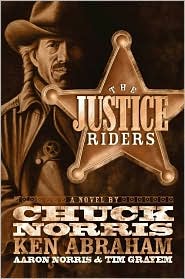
Critical Monkey entry #2: The Justice Riders: The Best Little Roundhouse in Texas

In the second instalment of Critical Monkey, I risk a roundhouse kick to the head as I take on the might of literary heavyweight Chuck Norris and his debut novel:

The Justice Riders (!)
by Chuck Norris (!!), Ken Abraham (?), Aaron Norris (?!), and Tim Grayem (??)

Why I might hate it: I do try not to let people’s political or personal views mar my appreciation of their work, but let’s be real, that rarely works. I used to enjoy Orson Scott Card, but his virulent and grotesque attitude toward homosexuality has completely ruined any enjoyment of his work I once may have had. And Chuck? I once enjoyed his films in a pulpy sort of way—and make no mistake, there are some fairly strong movies in his filmography, especially Code of Silence, and he did raise the roundhouse kick to such an artform that he got himself an eight-year television series based solely on his ability to spin in the air, wear a cowboy hat, and grow a beard—but as he’s aged, he’s transformed himself from a B-movie action star and Soloflex hypester into that mainstay of almost all D-list celebrities, a born-again, bitter right-wing shill, a religious fundamentalist and all-round unpleasant crackpot, eager to espouse any nutjob political theory, unsure if Barack Obama is an American, and unaware that his celebrity caché has withered to the point where he is an object of camp and outright derision. But hey, as long as he’s still getting his face out there, right? And lately, the trend of ‘celebrities’ getting book deals has reached the point where there is no more humour to be had. When 'celebrity' Lauren Conrad gets a three-book deal, it’s time to admit that irony is well and truly dead, and satire is a thing to set on the museum shelves next to the dodo.

Why I might like it: It’s a long shot, but the Chuckster did not write this opus alone, no, no. He brought along three people to help fine-tune the tale. Surely four people, working together, could craft something worth reading.

The book: dear god. Four people who can't write equals a novel four times as bad as normal.

Perhaps all you need to know is this; on page twelve, in the middle of a Civil War battle, the hero roundhouse kicks an opponent. I’ll repeat that; in the middle of a Civil War battle, there is a roundhouse kick to the face. I am not a Civil War historian and cannot with any accuracy comment on the fighting styles of the time. Nor do I believe that a fiction narrative must be rigidly bound to its setting without room for imagination. I’m not saying that there were no roundhouse kicks in the time period, or that a soldier fighting for the Union army could never have that skill. I actually don’t know what I’m saying, as I am positive that roundhouse kick smushed my brain into goop.

But there’s still 283 pages to go, so…

The Justice Riders concerns the exploits of Chuck Norris/Ezra Justice, a captain in the Union, fighting for the north in the Civil War (check out that cover for my confusion as to his identity). I should mention here that Team Norris has already etched a place in my heart, as I have always harboured a fondness for novels wherein the lead character’s name takes a less-than-obvious place in the title, such as in Karen Kijewski’s Kat Scratch Fever (protagonist – Kat Colorado), Robert B. Parker’s Stone Cold (Jesse Stone), Ernest Hemingway’s The Old Man and the Sea (Old Man), and Joanne Fluke’s Cherry Cheesecake Murder (Professor Cornelius X. Cheesecake).

Ezra Justice leads (wait for it) The Justice Riders, an elite group of men known both for their skill in warfare and their ability to be practically indistinguishable from each other except for exceptionally broad stereotypical traits. There’s the Irish drinker and fighter named Shaun O’Banyon (presumably because Fighty O’Drinkington was already taken); Harry Whitecloud, the well educated half-breed Indian tracker; Roberto and Carlos Hawkins, the gypsy thieves; Nathaniel “Big Nate” York, former slave of Justice (although The Norris Gang takes pains to point out that this was only because of Ezra’s family that he owned Nate, and he himself was having none of it); and Reginald Bonesteel, English sharpshooter and winner of Britain’s Most Foppish Yet Manly Name Award 1864.

Together, the Justice Riders go head-to-head against the Confederate version of their gang, the (wait for it) Death Raiders, led by “the type of man that men feared and women could not resist,” the hissible villain Mordecai Slate (again, presumably because Snidely McBadGuy was busy that week).

I don’t mean to be snarky, but boy howdy, it’s just. So. Easy. I mean, sure, Twilight (my previous entry in Critical Monkey 2009) was poorly written, but it’s target audience was the younger set. The Justice Riders is aimed at adults, so when you get writing such as
Slate sat high on his horse, his revolver aimed at Ezra’s chest. “Justice!” he called. “How about some of Mordecai Slate’s brand of justice?”
well, you pretty much give up any hope of a finely-tuned western a la Larry McMurtry, and the best you can wish for is a broad oater along the lines of the worst of John Wayne (i.e. most of the films not directed by John Ford).

Even by those deeply lowered expectations, The Justice Riders is absolutely garbage, only earning any entertainment value from the hooting, derisive laughter it provokes.

A huge portion of The Justice Riders’ failure as a novel is in its inability to recognize its place as a novel, rather than a movie. The character do not talk to one another, they speechify. Take this typical question from O’Banyon:
“Now that General Joe Johnston and his boys have been slowed down, are we going to keep chasing them, trying to distract them like we did Hood’s infantry and Nathan Bedford Forrest’s cavalry back in Franklin a few months back?”
No one talks like this. Only in poorly written movies do people talk like this, filling in the audience with seemingly important exposition. These men have been hardened in battle together, they have lived these adventures, there is no reason for them to fill in the blank spots, yet at every opportunity they fill in each other as if this is the first time each has heard the story. Rather than use the form of the novel to fill in exposition through backstory or inner monologues, everything is said out loud, leading the reader to assume that, wounded in battle, the Justice Riders collectively suffer from short-term memory loss, and only the constant repetition of their past exploits keeps their memories alive. And as much as I admire the moxie of a novel that actually contains the utterance, “You’ve got to be…aarraghh! Help!” I must cry foul on the literary merit of The Justice Riders as a whole.

More concerning, however, is the queasy addition of Christian themes, an ill fit considering Ezra’s penchant for killing all who oppose him in his path. I wouldn’t normally comment on such moral themes, but as Norris Plus Three continually bring it up, the hypocrisy of a novel that makes claims to a Christian belief system yet has no compunction against the ‘justifiable’ killing of others is fair game. There’s no room for introspection in Team Roundhouse’s west, and aside for a single paragraph where Ezra considers that Confederacy soldiers may believe they are on God’s side equally as much as he believes it about himself, there’s no discussion other than ‘our way or no way.’ There are good, solid novels out there about the interplay of religious teachings and personal actions, but this ain’t it. And as Ezra and his men preach to dying soldiers about the importance of embracing Jesus before they die, the utterly despicable nature behind The Justice Riders becomes abundantly clear. This is preaching love while practising death, and The Chuckmeister Four revel in their false virtue.

But then Ezra goes and kills a crocodile with a knife, and all is right again. And as Ezra actually considers hitting on a woman whose husband and child died not hours before, his stature as a man’s man is all but assured, so who cares how many people he's killed. He's still a simple, godly man, so it'll all work out.

In conclusion, The Justice Riders is more than poorly written claptrap, although that would usually be bad enough. There is enough shoddy plotting, needless digressions, and ridiculous dialogue to fill a dozen bad novels. But as an extra, the Beard Posse’s tale is morally repugnant to boot.

VERDICT: MONKEY CURSES A GOD THAT WOULD ALLOW THIS

Aug 7, 2009

Monkey Droppings - Darwin's Nighmare by Mike Knowles

Today, we boil away society, leaving only the hardened nubs of humanity behind.


Darwin's Nightmare
by Mike Knowles
ECW Press, 2008


“People die because I live. I’m what Darwin dreamed of at night. Top of the food chain, no remorse.” – Paolo Donati

Writing hard-boiled fiction is hard.

Scratch that. Writing good hard-boiled fiction is hard.

Example:
I saw a woman in a fitted business suit make her way up the stairs. I imagined her at first to be a lawyer or doctor, but her bag was just a bit too shiny to be high-class. I pegged her for a working girl stopping into the clinic. Most of the working girls I knew tried to pinch every penny. No one wanted to work under men forever, and hookers needed condoms like offices needed paper clips.
See? All hard-boiled prose is just a hair’s breadth away from being completely ridiculous. It all comes down to attitude. The author must take the genre absolutely seriously, without a nod or wink of condescension. These are tough guys talking tough talk.

When it works, as in the genre-high works of Raymond Chandler and James M. Cain, the first Mickey Spillane/Mike Hammer novels, or the early Burke novels by Andrew Vachss, it can be a wonderful thing. When it doesn’t, as in the later Vachss novels when he descended into self-parody, it can be a thing easily derided.

Another example:
She walked into my office on legs as long as one of those long-legged birds that you see in Florida - the pink ones, not the white ones - except that she was standing on both of them, not just one of them, like those birds, the pink ones, and she wasn't wearing pink, but I knew right away that she was trouble, which those birds usually aren't.
That’s from the Bulwer-Lytton contest to pen the worst opening sentences from the worst novels never written. As you might expect, hard-boiled prose is a favourite target. It’s way too easy to make the gritty dialogue seem absurd.

The first example, by the way, is an early excerpt from Canadian author Mike Knowles’ debut novel Darwin’s Nightmare, an exercise in the hardest of hard-boiled that comes off wonderfully. Knowles never flinches, never jokes, never shows the slightest hesitation. His tale is one of bad people doing bad things, and damn if it doesn’t work.

Knowles’ anti-hero is Wilson, a hired gun who harbours no pretensions about the life he lives. Wilson is the seedy in ‘seedy underbelly’, the man who gets things done, the man who can utter threats such as “Anything funny and you’ll be dead before you hit the floor. The receptionist will be next, way before she gets from nine to one one on the phone” with absolute conviction.

Wilson’s terrain is Hamilton, Ontario; not the most obvious choice for an exploration of the dark, but Knowles makes it work. Wilson was brought into his line of work by his uncle, a career criminal who (in quite an original teaching method) instructs a young Wilson on how to live the life through a game of Pac-Man:
I watched the take and learned slowly to think ahead of one ghost, then two, then three. After too many hours I began to see the whole table at once. I followed each ghost with my eyes, learning how they moved. Soon I learned how they reacted, and then I survived them. They couldn’t touch me anymore. I made a choice not to let them.
Wilson works primarily for Paolo Donati, doing jobs that require muscle, smarts, and a closed mouth. When Wilson steals a package for Paolo, he thinks it as just another job, but when he finds himself being tailed, Wilson has to pool his resources and work out exactly who’s coming after him, and why.

Wilson’s world is a tangled weave of criminals, people who owe favours, and relationships that can be turned with a flash of extra cash. There are no heroes, only villains. Knowles brings this subterranean world to vivid life, anchored by the possibly sociopathic but definitely intelligent Wilson.

But as violent as Wilson gets (and he gets plenty violent, whoo boy), his associates are indisputably worse:
Tommy Talarese was as scary a human as I had ever met. He was a man who had gotten where he was through nights of blood. He reveled in cruelty as though it were a religion. Tommy had butchered entire families, raped children in front of their fathers, and tortured enough people to fill a cemetery.
As the pages flip by, and bones break, and tendons rupture, and blood spurts, and bullets pierce flesh, the crunchy dialogue and pungent narrative drives Darwin’s Nightmare to new heights of hard-bitten cynicism. Knowles’ Hamilton is one unrelieved by humour or compassion. Wilson is a monster, but he has become one to survive the other, far worse monsters that populate his world. This is kill or be killed, Darwin’s theory put into brutal practice.

Such tales of unrelieved pessimism can easily wear out their welcome, but like the best practitioners of the genre, Knowles keeps his story moving, his action clear, and his character engaging even when he’s been shot and possibly bleeding to death. Darwin’s Nightmare is fantastic, bleak noir of the finest sort. Knowles and Wilson are working together again in Grinder, and if Nightmare is indicative of Knowles talent, it will be a gruesome trip worth taking.
VERDICT: MONKEY LOVES

Aug 2, 2009

Get me some blog recognition! And others, sure, why not?

Hey, did you know that Book Blog Appreciation Week is coming up? I know, I know, where has the year gone?

Anyways, nomination for your favourite book blogs are here until August 15, and although it would not do for me to toot my own horn:

toot.

So, go vote, have fun, and get some of those blogs you like some recognition.
Related Posts Plugin for WordPress, Blogger...