Jul 31, 2009

Critical Monkey Contest - update the first [UPDATED]

[UPDATE] I've put a new entrant into the first update, as I really shouldn't have published this until the official one-month anniversary of August 2, 2009. Welcome to the jungle, Betty! And as Betty is located in Missouri, this contest has officially gone international! Whooo!

Well, it's been a wonderful first month! And now that the shakes from my brush with Twilight have completely subsided, let's go to the leaderboard!

Acceptance (seven reviews)

Depression (six reviews)

Anger
(five reviews)

Guilt (four reviews)

Bargaining
(three reviews)

Denial
(two reviews)

Shock
(one review)

So, two [NOW THREE] souls (excepting myself) brave enough to push the envelope, max the extreme, and revolutionize outside the box! Well done!

For those new to this, I am running a contest to encourage people to read those novels or authors they have always avoided, be they critical darlings or those generally considered to be terrible. And from the scoreboard, I can safely say that we have two novels usually categorized in the 'good,' and one firmly in the 'bad.' You figure out which.

Remember, this contest runs for a full year, so you've got plenty of time to flagellate yourselves. I've already offered up a copy of Shelf Monkey as a prize to one lucky finisher, and now we have a second: Mark A. Rayner, friend of the blog and first-rate satirist, has generously offered up a copy of his debut novel The Amadeus Net as further inducement to leap feet first into the rich creamy broth that is the unexplored literary wonderment of our great planet! Mark's second novel, the weird and memorable Marvellous Hairy, arrives in September from Crossing Chaos Enigmatic Ink, so this would be a good time to introduce yourself to his unique brand of satire.

I will do a random drawing of all entrants at the 6-month mark in January for The Amadeus Net, regardless of the entrants overall score. So get cracking, and start punishing yourself!

As for me, I have already begun my second novel, passing from Shock into Denial. It is the stirring tale of Civil War soldiers adventuring it up on the front lines, in a tale so raucous only Chuck Norris could tell it (well, Chuck Norris and three other people). Prepare yourself for the awesome roundhouse-kick to the head that is: The Justice Riders!

Play us off, keyboard cat!

Jul 27, 2009

An open letter to the person did not like my review of Twilight

Recently, I put together an admittedly snarky but sincerely heartfelt review of Stephenie Meyer's pop-phenomenon Twilight. It was not complimentary. Such is my right.

Now, someone has commented on it (via the comments section of the Chapters website, where I lay a copy of the review). I would not normally respond to hate mail (or at the very least actively dislike mail), but I thought I'd take a moment in this instance to respond. As the author put this up on a public site, I assume he or she does not care about the privacy of its contents, although I will keep the name (possibly a pseudonym) anonymous.

First, the comment (whole and unedited):
Waste and Insultingly poor, may I ask how old you are because clearly you have no taste in reading material. Stephenie Meyer is a amazing author and YES her books are for young adults which you must not be. Did you even read the whole book or the whole series ? The first book in my opinion is not the best but it is farely well written. The first book is mostly about how gorgeous Edward is but it is because Bella a mire human is amazed by never imaging someone who could love her as much as Edward does. I suggest that the next time you read a book thats in the series you read the other books as well before posting rubbish like this. I believe that your comment was a waste of time.! You could learn so much from this prodigious author.
Now, my response:

I don't really care. If you disagree with me, fine. If you feel you must respond, more power to you. If what I wrote offends you to such a degree that you feel your voice must be heard, I can do nothing but allow you to continue. You didn't attack me personally, so I have nothing to say other than I respectfully disagree. 

But if there is one thing I've learned over the years, it is this; no one, no one will ever take you seriously if you cannot form coherent sentences. Spelling, grammar, and punctuation count.

Response?

Jul 24, 2009

Monkey droppings - The Resurrectionist by Jack O'Connell

Today, a quick little review, free of lengthy quotations. I'm sorry, I recently moved and can't find my copy.


The Resurrectionist
by Jack O'Connell

I have not read a great deal of Jack O’Connell’s past work. I really dug his Word Made Flesh, a bloody dark mystery rich with virtuoso passages and rich literary themes. But as with many cult authors, tracking down his other novels is usually quite a difficult task. Needless to say, when a copy of his latest showed up on my doorstep, I was quite happy.

But I cannot claim to love The Resurrectionist nearly as much as Word Made Flesh. Much like Word Made Flesh (and his other works, if my research is any good), The Resurrectionist is a twisty, convoluted tale that adheres only to its own rules of plot structure and interior narrative logic. But unlike my previous adventure with O’Connell, the tale never fully gels into something truly memorable, resulting in a strongly original piece that feels incomplete, a book I want to wholly cherish but simply cannot.

The Resurrectionist takes place (as in all of O’Connell’s works) in the fictional cityscape of Quinsigamond, a bleak, bitter place where despair seeps through the streets like rancid butter (think Detroit without the glamour). Sweeney, the books de facto hero, works at an eerie clinic for coma patients who are seemingly incurable. The physician Dr. Peck is perfecting his ‘arousal’ method of bringing hopeless cases back to life. His own son Danny is a client, having lapsed into unconsciousness. Sweeney’s only link to his son is in his collection of ‘Limbo’ graphic novels, a series concerning the adventures of Chicken Boy and his band of travelling circus freaks. O’Connell weaves Sweeney’s attempts to gain access to his son’s mind with the storyline of the comics, which are told prose-style rather than in their presumed graphic format. Together, the interlinking stories form a tapestry of sad realism and high-concept fantasy that combine in surprising ways.


There is a wonderful vividness to O’Connell’s world, a tantalizing mix of gothic horror and kitchen-sink drama along the lines of the earlier works of Patrick McGrath. There is always an underlying logic to the dreamlike nature of O’Connell’s work; David Lynch would be an ideal director to take the cinematic reigns of O’Connell’s novels (and wow, what a movie that would be, someone get on that right quick already!). But The Resurrectionist, for all its many superior strengths, falls apart in its final quarter, as plotlines dangle and coherence falls to the wayside. Biker gangs and insane clinicians come into play, and the ending left me wondering if I my copy was missing the final fifty pages.

O’Connell is a vastly talented writer, deserving of serious acclaim and success - go on and read him if you think I'm lying, you'll thank me for it - but The Resurrectionist is too wobbly a structure to rank as one of his best works. By all means read it (I believe I am in the minority of people who admire rather than absolutely love it), but be prepared to flex your brain in unusual ways.


Verdict: MONKEY ADMIRES

Jul 18, 2009

Monkey Droppings - the visual edition!

I've come across some rather amazing images lately, and rather than enjoy them by myslef, I thought I'd lump them all together and bring some very creative artists to your attention. If you don't like these, well, at least you've learned something about me, and what turns my crank.

First (via Geekologie), we have the immortal cartoon sad sack Charlie Brown, immortalized by artist Tim O'Brien as a living breathing human. Prepare to be amazed and likely horrified.


Next, continuing the cartoon-to-human theme, from artist Pixeloo comes a few images that have been around on the web for a bit, but I find them so fascinating I added them here.

First, the human Homer Simpson:


And next, the human Stewie Griffin:


And finally (again via Geekologie [great site, by the way]) comes the "I Can Read Movies" series, a collection of absolutely perfect, bang-on terrific vintage covers for paperback novelizations of movies. I don't know who spacesick is, but he or she should be designing the real thing.

Scroll down slowly, and try to guess the title of the movie from the image. And check the link for many more titles.


Boy, I wish I had talent.

Jul 15, 2009

Monkey Droppings - The Abortion by Richard Brautigan

What? A book about abortion? Outrageous! I'll never read your blog again!

I'm assuming that some readers who inadvertently come across this site may have that reaction. Now that they've left the building, let's continue.

The Abortion: An Historical Romance 1966
by Richard Brautigan
We don't use the Dewey decimal classification or any index to keep track of our books. We record their entrance into the library in the Library Contents Ledger and then we give the book back to its author who is free to place it anywhere he wants in the library, on whatever shelf catches his fancy.

It doesn't make any difference where a book is placed because nobody every checks them out and nobody ever comes here to read them. This is not that kind of library. This is another kind of library.
First, let's get this out of the way: horrible cover art to this novel. Horrible. Reeks of madness and self-pubishing. Does not entice the reader, but repels with the force of literary kryptonite. That's the author, Brautigan, gracing the cover along with a singer named Victoria, if my research is up to par. Bad, bad cover.

That said, I pretty much love this book.

The Abortion - a novel concerning "the romatic possibilities of a public library in California," which summarizes exacly why I picked up the book in the first place - is a weird little exercise, a librarian's fantasy combined with a second-act account of, well, the title. It's a trifle of a novel, a wisp of literature that threatens to blow away completely at any moment, yet lingers like hints of cigar smoke in an old room.

The public library in question, an unassuming few rooms in an unassuming building in San Francisco, is a gem of an idea that could never exist (and yet, thanks to the novel, apparently now does, although the exact placement of the library is hard to pin down). The library exists solely for the purpose of accepting any person's novel or book. A person can simply walk in off the street, drop off their magnum opus, and be on their way. The narrator (unnamed) is the librarian, a 31-year-man who has not left the building in three years. He accepts all offerings, and jots down personal entries on the subject and author in the ledger such as:
THE EGG LAYED TWICE by Beatrice Quinn Porter. The author said this collection of poetry summed up the wisdom she had found while living twenty-six years on a chicken ranch in San Jose.

"It may not be poetry," she said. "I never went to college, but it's sure as hell about chickens."
One day, the alluring Vida enters the library to drop off her book, shattering the librarian's world. Vida, born with a body "very sensual, inciting one to think of lust, while her face was Botticellian and set your mind to voyaging upon the ethereal," has written a treatise on the perils of being born as a physically perfect speciman, as she is a rather damaged human being as a result of the constant unwanted attention from both genders. Vida quickly envelopes the librarian's world, which eventually results in physical acts that, then, result in the topic contained within the title.

I cannot fully understand, or put into words, the effect The Abortion had on me, and I have the feeling that overanalyzing the work will only dilute its already-fragile nature. There is very little in the way of plot, and the work as a whole has the effervensence of nostalgia. It's part fantasy, part romance, and part jarring clash with reality. There is no way the narrator's job can exist, and I never once believed it could (although I desperately wanted to believe). The Abortion is a clumsy little beast, and hard to defend from any traditional narative standpoint. But it is one that engenders great affection.

Brautigan shows his strength as a novelist as the plotline develops from unusual love story to realistic drama. Vida and the narrator come to the conclusion that neither of them are equipped at the moment to deal with the baby, and they arrange for an illegal abortion in Tijuana. There is no sensationism here, no heart-felt debate, no histrionics. There is no back-alley abortionist, no crude sensationalism. What happens is the result of two rational human beings making a choice, and then following through to the consequences. The procedure is clean, unemotional, yet weighted with unsaid significance. And then their lives continue. They go back to the library, something happens (no spoilers here), and their lives continue.

I was unaware of Brautigan and his output until coming across this novel on the shelves of my local public library. He was a counter-culture author 10 the 1960s, acclaimed but never a huge seller, and he suffered from a variety of mental issues, arguably leading to his suicide in 1984. But I will now be seeking out his other works. The Abortion isn't a perfect creation; it's lumpy and shaky, constantly threatening to collapse. But its humour and passion shine through the cracks.

Verdict: MONKEY LIKES A LOT

Jul 13, 2009

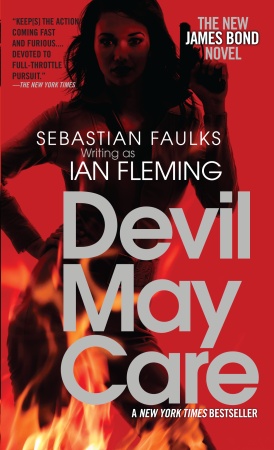
Monkey droppings - Devil May Care by Sebastian Faulks

On today's menu; spies and intrigue, with a side of 1960s glamour.


I like James Bond. Hell, I want to be James Bond. I want to romance women and kill henchmen and foil schemes for world domination. I live vicariously through my television whenever a Bond film is on, and will willingly sit through every single one of them again and again. Yes, even A View to a Kill, wherein the now-octogenarian secret agent seduces a twenty-something woman who is saddled with the intellect of a sub-literate teenager, and the talent of a wedge of cheese (read: Tanya Roberts, my vote for the worst Bond lady ever, with Denise Richards a close second).

The books? It's not that I'm against them, but my interaction with them is far more limited. It's beyond argument that the movie Bond is now a far cry from the literary Bond, although the best Bond films always tend to hew toward the books' meaner and more streamlined spy antics.

But as to the books, I've only read three of Ian Fleming's efforts, and a later John Gardner when I was a wee teen. I enjoy them, sure, and admire Fleming's surety of his craft, but I'm not as driven to them as to the more immediately visceral films.

So I approach Devil May Care without a lot of the baggage the more Fleming-aquainted reader may bring. I've also never read Sebastian Faulks, but I am aware of his reputation as a writer, and I was intrigued as to how he would fashion his more 'literary' skills to mingle with the pulp sensibilities of Flemings master creation.

The result? Surprisingly fun, if a little off.

Faulks' Bond, taking after the last of Fleming's novels, is an older, slightly wiser take on the secret agent. The 1960s are winding down, Vietnam is on the horizon, and the moral turpitude of Britain's young is under the devastating threat of cheap drugs. Bond, after a forced sabbatical, is brought back to investigate Dr. Gorner, a maniacal drug dealer with a rare disorder that has given him the large, hairy hand of a monkey. I kid you not. Along for the ride is Scarlet Papova, the obligatory woman/conquest who gets under Bond's hide. And as he uncovers the dastardly scheme - a baroque plan involving warheads and vengeance - Bond finds himself set far deeper in the fiendish plot than he could have anticipated.

Faulks, while closely adhering to Fleming's streamlined style, works more of a 21st sensibility into the proceedings. Fairly absent is the casual racism that marred Fleming's works, a product of their time that always left me a little queasy. Faulks' take on the secret agent shows a little alteration as well. This Bond is slower to anger, more aware of others. Less of a sociopath, I'd guess you'd say, and a little closer to the movie Bonds in spirit. This has its good points and less-than-good points. Part of the real appeal of the literary manifestations of Bond was how absolutely ruthless he was, ruthlessness of a level rarely seen in the films - although
Quantum of Solace (highly and unfairly regarded as a lesser Bond, in my opinion) was likely the closest we've come to seeing Bond as the conscience-absent machine of the novels. Seeing Bond develop feelings for Scarlet was a crack in his emotional armour that may have signified a new growth and maturity for the uber-spy, but felt false.

But there's enough derring-do, mayhem, and hissable villainy on display to make up for this shortcoming. Devil May Care may be, in the end, a minor Bond, but as with the movies, minor Bond is still a hell of a lotta fun.

Verdict: MONKEY LIKES

Jul 12, 2009

Monkey droppings - Necrophenia by Robert Rankin

The monkey has been a bit lax of late, up all night carousing and so forth, so he's going to blast off a few quick reviews to catch up. He apologizes for the brevity, unless you like it, in which case, that was the plan all along.


Necrophenia
It is a fact well known to those who know it well that very bright lights presage trouble. The arrival of aliens and booger men and bogey-beasts from the bottomless pit. Those ghostly things that come out of the televisions set. And dawn raids by the police.
Bright lights mean trouble, they do. Very bright lights, much trouble.
And this light was a bright'n. It wasn't helicopters, although it came from above, and it wasn't flying saucers either. Although it might well have been, because it did come to the accompaniment of some stonking great chords of the Albert Hall organ persuasion.
Reading Robert Rankin can be an overwhelming experience for the emotionally unprepared. A true comedy companion to Terry Pratchett and Douglas Adams, Rankin spins tales that go off on more tangents than should be allowed, and reference his other works with a gleeful abandon that punishes the newbie. The British author never met a pun he didn't like, or a gag he didn't milk. Neophytes to his work would be best served by starting with one of his stand-alone novels such as The Hollow Chocolate Bunnies of the Apocalypse, a mystery-thriller with the greatest title of all time.

Do not, if possible, with Necrophenia, Rankin's 30th novel, a bizarre comedy rant that will bewilder anyone unfamiliar with his canon. You can get through it (I did, so it is possible), but there is a certain amount of familiarity necessary to get the full gist and flow. I was not aware that one of the secondary characters, private investigator Lazlo Woodbine, was a Rankin regular. But prepared for the assault or not, there's no denying that Necrophenia is one original and bizarre piece of work.

Rankin tells his story through Tyler, a wanna-be rock star who swears that his band The Sumerian Kynges played after The Rolling Stones at Hyde Park, even though that "no one at all actually believes that The Sumerian Kynges even played there, let alone topped the bill." As well as being an obscure rock icon, Tyler is also a private investigator who almost saved mankind. Almost. And there's a city of gold somewhere in the plot. And zombies. And Elvis Presley. And Tyler's brother Andy, who changes the course of history when he literally kills the Zeitgeist of the 1960s with a clock. There's monsters, and mind-bending drugs, and ukelele maestros, and inside jokes galore.

And there's the Tyler Technique, a creation of Tyler's (natch), wherein the practitioner of the technique, to get something done, does nothing at all, because "by doing absolutely nothing, the required something would come into being." And it works. Needless to say, the Tyler Technique has become my new personal dogma for the remainder of my existence.

Rankin is working at full chaos in Necrophenia, throwing anything and everything at the wall and using it whether it sticks or not. It's a bit overwhelming, and maddening, and it must be said that Rankin does get on one's nerves occasionally. But there's a lot of insane creativity on display, and as unbridled as Rankin gets, at least he's not boring.

It's all well and good to appreciate your fans, but Necrophenia is almost too insular, punishing the reader for being unfamiliar. It does work on its own, but an appreciation of Rankin's previous work (particularly the eight-volume-and-counting Brentford Trilogy) will go a long way toward alleviating the mass confusion.

And as entertaining as Necrophenia can be - and at its best, it is damned funny - Rankin is shooting too many balls at the net, or something. Sports analogies are not my strong point. The story is too all-encompassing, too vast, too, well, ridiculous. Rankin has always been teetering on the edge, but he's completely off for much of Necrophenia, and the book suffers. It works better as a series of comedic vignettes than a full-fledged novel.

But despite this, Necrophenia is still a lot of fun, especially for those who miss the anarchic ramblings of Douglas Adams and the Monty Python boys. And while it is almost inarguable that the upcoming continuation of Adam's Hitchhiker's Guide series is a bad idea (and boy, do I want it to be good), what stretches credulity is that children's author Eion Colfer was tapped to pen it. Rankin is an obvious fit, and it would have had a far better chance of becoming something special in its own right.

Verdict: MONKEY LIKES

Jul 4, 2009

Critical Monkey entry #1 - Twilight, or, Bella feels chagrined and Edward chuckles.

For my first entry in my personal Critical Monkey list, I thought I'd go big or go home, and tackle a publishing juggernaut of almost unprecedented size:

Twilight, by Stephenie Meyer.

Why I might hate it: Let's face it, a near-forty-year-old man is not the target demographic for a tale of high school vampire romance. Also, Stephen King hated it, and while his output may have waned over the years, the man's a born storyteller with a true grasp of the craft of writing, and I'm inclined to follow his lead on this one. And the absolute saturation of the media with any and all things Twilight-related sets my teeth on edge. I mean, c'mon, she's written five books, and she accounted for one in seven books purchased in the U.S. during the first quarter of 2009. No one is that good, and my experience is that the more overblown sales of a book are, the worse the book is (see also: Tuesdays with Morrie) (Better yet, don't).

Why I might like it: The movie version, although I went in preparing to hate it, was actually not that bad. Yes, the special effects outright sucked, and the paleface makeup was laughable, but it was a movie of surprising quiet moments and effective atmosphere. Not a great flick, and nowhere near as good as the Harry Potter films (to make an analogy to another pop-culture landmark), but I was entertained despite myself. And despite my recent rant, I'm really not against re-examining the vampire mythos. I never agreed with the classic "can't be seen in a mirror" bit, and nothing is above a little tweaking now and then.

The book itself: Yee-ouch.

I went in with an open mind, I really did. The movie, as I said, had its moments, and gave me hope that perhaps, just perhaps, there was a reason for the hype beyond, well, hype. But what the movie proved is that gorgeous scenery and charismatic actors can go a long way toward rectifying piss-poor dialogue and repetitive, mundane writing. And what Twilight (the book) proves is that success is not dependent on talent. Because quite frankly, Twilight is one of the most embarrassingly amateurish novels down the pike in a good long while. And while I am aware that this may come across like the crank who can't get into today's music and pines for the olden days, I cannot fathom Meyer's success.

The plot, for those seven people out of the loop, follows Bella Swan, a seventeen-year-old girl come to live with her father in Washington State. At her high school, she becomes instantly attracted to Edward Cullen, a mysterious teen described thusly:
His skin...literally sparkled, like thousands of tiny diamonds were embedded in the surface. He lay perfectly still in the grass, his shirt open over his sculpted incandescent chest, his scintillating arms bare. His glistening, pale lavender lids were shut...A perfect statue, carved in some unknown stone, smooth like marble, glittering like crystal.
And it goes on like this, again and again, pages of purple. I could excuse a little over-enthusiasm on the part of Bella, but fully half the novel is given over to how perfect Edward looks. Which helps him, I guess, as his actual personality is that of a total ass. He makes a big show of how badly he feels for Bella, as she's in complete danger whenever he's around, but he shows no restraint and therefore dooms her anyway to satisfy his own emotional needs. Actually, he is a monster.

But then again, Bella is a conceited shrew, so that axiom that there is someone for everyone is likely true. Certainly no one else could stand to be around either of them for ten minutes. Bella is one of the least likable characters I can recall, a whiny neurotic who complains endlessly about how no one understands her, likes her, or appreciates her, yet is surrounded by people who understand, like, and appreciate her. I understand it's written from her point of view, but she comes across like a complete narcissist. There's nothing that says your central character must be likable, but somehow I'm not getting the vibe that we're supposed to dislike her.

But luckily for the plot, there's far more to Edward than being a self-centered dimwit. It turns out he's also a 100+-year-old vampire! (Sure, vampires that glow rather than die in sunlight, but, yeah, vampires, sure, let's go with that.) Which strikes one as odd because, for a centenarian, he provides little proof that he's learned anything over the years. Edward may look 18, but he should behave slightly older, I think. When you compare him to, say, Claudia, the 60-year-old vampire in a six-year old body in Anne Rice's Interview With the Vampire, Meyer's complete and utter lack of insight into the effects of age and experience on the psyche become even clearer. Edward does not come across as old, or even learned, but rather like a goth emo kid affecting a quasi-arch manner of affected speech that would come across as painfully annoying if it weren't so devastatingly dull.

I won't get into the actually mechanics of vampirism here, as Meyer is well within her rights to alter such mythological creatures to her whim. It would not matter a whit if her tale was in any way interesting. But it's not. It's boring. Utterly mundane and uninspired. And much of that can be ascribed to the fact that absolutely nothing remotely of any interest happens beyond two unlikable people mooning endlessly over each other. If there is a junior Harlequin Romance imprint, consider this a perfect example of the form.

Meyer does her plot no favours with the sort of amateurish hack writing that should make a tenth grader's creative writing homework, not a published author from an established press. Meyer never met an adverb she didn't use, and as every character angrily, hungrily, happily, sarcastically, or leeringly haunts the pages, Meyer's lack of actual talent becomes quite clear. Hardly a page flips by without Edward chuckling, or Bella feeling chagrined. I don't often recommend an author consult a thesaurus, but the advice in this instance is apt.

"But wait a moment, Corey!" I hear you ask (I have very good hearing). "This is a book for young adults! Don't overthink this, it's written more simply for a reason!" Point taken. There is an established (although arguable) tradition of writing with a slightly broader style for novels aimed at the younger set. But I put it to you that there is a wide difference between simple and simple-minded. And after having recently read Neil Gaiman's The Graveyard Book, Cory Doctorow's Little Brother, and Arthur Slade's The Hunchback Assignments, I am more convinced than ever that writing for young adults does not mean writing stupid. And while some have paralleled the ascension of Twilight and its sequels with the Harry Potter phenomenon, it only goes so far as sales, as Potter, while not art, was an entertaining and often gloriously exciting series.

Twilight is a spectacular waste, insipid and vapid. It is insultingly poor, and how anything this incompetent was allowed to pass through an editor's hands and into the public sphere is distressing.

Verdict: MONKEY WOULD DIG A DEEP DARK HOLE AND BURY THIS THING IF HE COULD

On the next Critical Monkey: Sure, taking on Twilight is like boxing a mountain (doesn't really get you anything), but for my next exercise in self-punishment, I take on the full roundhouse kick of Chuck Norris and The Justice Riders. But not right away, I need to recuperate.
Related Posts Plugin for WordPress, Blogger...