Mar 24, 2009

From the files of the prudish...

From Chapter 6 of James Patterson's mind-numbingly stupid online "chain thriller" Airborne:
Sh*t! Peter went over his plan again.
Yes, you read it right: Sh*t! In an adult novel about kidnapping and mysterious viruses, a character actually thinks to himself, Sh*t!, no doubt pausing afterward to genuflect and repent for daring to think up such a loathsome word.

Can we possibly hope to take any part of a novel seriously when an author is so much of a prude that they won't spell a curse word completely? What, expletive deleted was too subtle?

For the record, the 'novel' is written by 28 winners of an online writing contest. Each 'winner' submits a 750-note chapter, with James Patterson himself (ooh, thrilling!) penning the first and last chapters personally.

We're six chapters in, and it is as fantastically awful as feared, rife with hilarious exposition, howlingly bad inner monologues, and suprisingly enough, spelling errors. But if it might be true that a million monkeys can write for a million years and create a masterpiece, it is definitely true that 29 people can write for a few minutes each and create sh*t.

Mar 23, 2009

Apparently, she's a contortionist

From Chapter 3 of James Patterson's already depressingly awful online novel-by-committee "chain thriller" Airborne:

Amanda's throat felt hoarse from all the screaming, which must have lasted for at least 20 minutes – she couldn’t be certain because her watch was strapped to her left wrist, which was hogtied to her right one behind her back...She sighed and felt the perspiration drip from her temples down her face, and she wiped it away on her forearm – she needed to do something.
Her hands tied behind her back, but she somehow wipes her face on her forearm - go ahead, try it, I dare you. I'll wait.

If you aren't yet following this novel, you really should; it'll make you appreciate quality all the more.

Mar 21, 2009

Random Monkey Droppings, March 21, 2009

A few musings, to keep myself entertained whilst I drive nails into my forehead i.e. try to write something worth reading:

1) This sampling of TV blowhard and waste of DNA Bill O'Reilly reading the *ahem* sensual parts of his novel Those Who Trespass is too disturbing for words.

2) I'm reading Joe R. Lansdale's Sunset and Sawdust, and am really digging his overheated southern gothic style.

3) Here's my late-to-the-party thoughts on Watchmen:
  • Sure, it's not a perfect film, but after sitting through the deeply disappointing and empty The Incredible Hulk (despite the exquiste set design of Andrew Redekop [some relation]), I am prepared to be forgiving of its flaws, as a superhero movie with a brain is infinitely more impressive and rare a thing than one that has none. My god, people, it actually tries.
  • Yes, you can see Dr. Manhattan's wang. Get over it, it's like in 5-6 shots, it's not like the whole film is blue genitals.
  • I want someone to invent the Rorschach shifting facemask tout de suite.
  • I will definitely purchase the Director's Cut DVD.
4) With thanks to Jeff Vandermeer for the idea, this is my favourite book-related moment from TV:

Mar 15, 2009

Review - Portobello by Ruth Rendell

Portobello
by Ruth Rendell

I'm a book snob. I admit that up front. And the main reason that I had until this point never picked up a Ruth Rendell is that I am inherently distrustful of the prolific. And can you really blame me? Maybe it's just jealousy (ok, it's definitely part jealousy), but a novelist who apparently publishes every three months does not scream quality. Sure, it can be done. I devour Stephen King and Ed McBain like handfuls of Werther's Originals, but for every King and McBain, there's a Lori Wick, or Danielle Steel, or god help us all, James Patterson, an author so utterly overflowing with contempt for his audience he is now writing books under his name by committee. For pity's sake, Barbara Cartland wrote 664 books, sometimes at the rate of twenty a year. I don't care who you are, you can't create quality work on that scale.*

Sadly, Rendell found her way onto my snobbish little list, this despite her winning pretty much every major mystery award available. So it was with unfathomable tentativeness that I picked up Portobello. This was a stand-alone novel, not a part of her ongoing Inspector Wexford mystery series, so I figured I might not be too lost in references to past events.

Once again, my snobbishness has proved unfounded. Portobello is not a perfect novel by any means, but it displays an assurity of craft and ambition at vast odds with my assumption that Rendell was another, well, Patterson, or
Nora Roberts, or Nicholas Sparks. My bad.
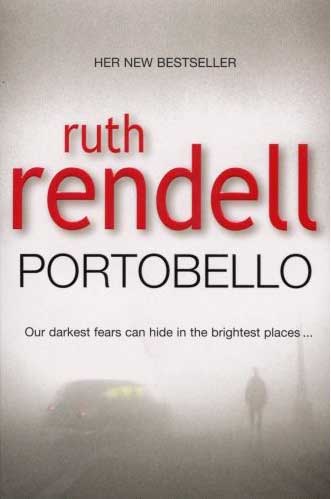
Rather than a mystery per se, Portobello is a character study surrounding the repercussions following the most insignificant of events; a man has a heart attack near Portobello Road in the Notting Hill section of London, and drops an envelope of money (Already my brain is yelling, "The plot's afoot!" expecting a chase thriller, or possibly a literary discussion of the perils of greed). Eugene, a wealthy art gallery owner, discovers the envelope, and rather than contact the police, he decides to place up a flyer announcing his find in the hope of returning it to its rightful owner. Rendell then throws in Eugene's girlfriend Ella, a doctor who returns the money to its owner in the hospital. The money's owner, Joel, is a disturbed and lonely man who is now seeing visions after his near-death expierience; he decides that Ella should be his doctor, and Ella is too kind-hearted to refuse.

And there is also Lance, the young louse who tries to claim the money, and then decides that Eugene represents point zero for his imagined life as a top-flight burglar. Lance also has problems; he lives with his religious zealot uncle, and he's under the gun (literally) to pay for his ex-girlfriend's dental work after he drunkenly assaulted her.

There's a lot of possibilities for mystery here, although that expectation is largely based on Rendell's reputation. Part of the initial thrill of reading Portobello is wondering when the mystery will actually start. Again, my bad, as Portobello is a psychological character study first and foremost.

This is a novel of secrets, of psychoses small and large that haunt both the best and worst of humanity. Eugene has a shameful (to him) addiction to low-calorie sweets. Joel has been blamed by his father for a family tragedy that his ripped his life in two. Lance finds in his illegal sojourns to homes of the wealthy a world that he cannot understand but craves all the more. These people, all damaged, wander throughout the pages of Portobello as Rendell delicately reveals the creepy delusions and urges that make up the psyches of the lonely and desperate.

Rendell has an astounding talent at place and setting, manifesting a section of London in all its vibrant and seedy glory. Her Portobello Road is menacing yet comfortable, a neighbourhood where the classes mix with familiarity and surface friendliness, yet where there exists a simmering undercurrent of unease.

It may be unfair to complain that very little occurs in Portobello. Plenty does, but it is only in retrospect that the reader comprehends the novel's many facets. Rendell's presentation, so subtle and understated, drives home the novel's tension and its themes of unspoken desires and the quiet madness that grips us all. It is no small accomplishement to write small; Portobello is a novel about the space between action and reaction, and Rendell fills the space with desperate longing.

But Portobello, as fine as it can be at points, cannot completely sustain itself through inaction. Eugene, arguably the central character, is sadly the least believable and therefore Portobello's weakest link; his inner dilemma of sweets vs. romance is too inherently silly to fit comfortably next to the bleakness of the other characters' lives. It's an interesting situation, but the story comes crashing to a halt whenever Eugene reappears.

But Portobello has once again proven to me that my snobbishness can lead to devestating loss. Rendell is clearly a fine, fine writer, and I will gladly delve into her other works. And I will definitely peruse the works of Georges Simenon, another crazily prolific author. But not Roberts, Patterson, Sparks, or Wick; never again.

*NOTE: For an entertaining look at the perils and pitfalls of the prolific, please read British novelist Geoff Nicholson's piece "Can't. Stop. Writing." at the New York Times Book Review.

Mar 7, 2009

Monkey Droppings - Angry butterflies and raging toys; The Voice of the Butterfly & Amberville

Two novels today, one old, one new, each strange and bizarre, and both worthy of your consideration.


The Voice of the Butterfly (2001) by John Nichols

“We have become inured to the tragic consequences of human personality on a rampage, and our disinterest is casually destroying The Meaning of Life on Earth.”

John Nichols has sadly faded from public view as of late. While his New Mexico trilogy (including most famously The Milagro Beanfield War) is a justly-celebrated series on the ongoing rape of the land and the effects of said rape on its inhabitants, Nichols has kept a lower profile for the past decade or so, slowing his output, releasing a few novels to some acclaim but less impact. This is a horrible error that must be corrected.

The Voice of the Butterfly shows that Nichols has not lost his taste for satire nor his anger at the continuing destruction of the Earth. While the New Mexico trilogy had flights of craziness, Butterfly finds Nichols in full-on Tom Robbins mode, spewing forth sentences of breathtaking insanity and wordplay. You have to have a love of over-the-top writing to fully appreciate this novel, but if you are thus equipped, you are in for one hell of a treat. A bizarre, hilarious, profane, and tremendously entertaining rant, The Voice of the Butterfly is a raging voice in the wilderness, crying out for common sense and decency over money interests and rampant consumerism.

The butterfly of the title is the Phistic Copper, an obscure little insect whose entire existence as a species is threatened by development prospects. The Butterfly Coalition, led by lefty eco-lover and librarian Charley McFarland and his slipping-into-dementia ex-wife Kelly, is frantically trying to get the word out. The developers, a slimy bag of reprobates you should be lucky to never meet in reality, will do everything and anything to push the project through.

This is not exactly a subtle satire, and nor is it unbiased. Far be it from me to equate a character’s beliefs with that of its author (a charge often leveled against me for arguably good reasons), but when Charley opines, “If the radical right had its way we’d all be church-going polyester heterosexuals driving around in white Cadillacs eating meatloaf and wax beans while mammoth bulldozers leveled all our forests and even hummingbirds were extinct,” it’s hard not to feel that Nichols may be wearing his heart on his sleeve. When you combine that with the fantastic names Nichols comes up with for his characters—unwieldy Pynchonesque monikers such as Farragut Wallaby, Edna Poddubny, Charity Gingivitis, and Mookie Dirigible walk through the pages—you get a rollicking socio-political trek through both the worst and the best of America.

Like Robbins, there is just so much overt burlesque wildness one can take, and it can be somewhat tiresome after a while to see the well-meaning but limp liberals crushed under the unthinking monstrosity of Republican ideals again and again. But Nichols unhinged is an astonishing thing, and if you are pure of heart and stout of will, The Voice of the Butterfly is a weird, wonderful ride.

GRADE - B+

Amberville (2009)
by Tim Davys

"Here I stand, hiding, he thought, inside a stall in a men's restroom along with a drug-intoxicated homosexual prostitute gazelle who is particularly popular with the masochists of the city."

How, I ask you, could I not fall a little in love with a novel that has sentences such as that?

I have a true soft spot for the anthropomorphization of animals (animate and inanimate) when it comes to literature. William Kotzwinkle's The Bear Went Over the Mountain is one of my all-time great reads, with bear-turned-novelist Hal Jam a creation of sublime delights. Clifford Chase's Winkie, a dark satire involving a teddy bear accused of terrorist activities, was one of my favourite novels of 2008. Penn Jillette's Sock took the lovable sock monkey to deliriously obscene new heights. Not to mention the Douglas Adams-esque hilarity found within the pages of Robert Rankin's The Hollow Chocolate Bunnies of the Apocalypse, as a teddy bear detective tries to unravel the clues and save his beloved Toy City from a serial killer. And let's not forget that beloved graddaddy of animal satires, George Orwell's Animal Farm.

Tim Davys would initially seem to be taking the same tact as Rankin, creating in his new novel Amberville an entire city of stuffed animals who fear their eventual removal from the city when their names fall on the fabled 'Death List'. But as Davys travels the back alleys of a decidely unfriendly world filled with enough unsavory characters and degenerates to fill several Spillane ominbuses, the Swedish author shows his creation to be nothing less than a pure-blooded film noir mystery thriller sans humour to leaven the situation. These may be stuffed animals, but there is nothing cute about them. As a novel, Amberville is more in line with the dark noir of Gary Wolf's Who Censored Roger Rabbit? (a novel leaner and meaner than the movie adaptation [great though it is] would have you believe).

Eric Bear seems to have it all; a good job, a sexy wife in Emma Rabbit, and a lot to live for in Mollisan City. But his past comes rushing back in the form of Nicholas Dove, an underworld heavy who has discovered that his name is likely on the Death List. Nicholas wants Eric to have his name removed, or Emma is dead. But does the Death List even exist?

Amberville's main flaw is that, despite its trappings, it takes itself utterly too seriously. For a time, it is uncertain why Davys would even bother shoehorning the toys into a decidely classic mystery plotline. But it soon becomes clear that stuffed animals can, by their very nature, possibly unearth answers that more 'realistic' characters never could.
"All stuffed animals have asked themselves questions of life and death at some point, when young or old. Why must the factories manufacture new animals? Why must those who were already living in the city be carried away by the Chauffeurs? Why did they all live in open or concealed terror of what would happen in the next life? And who had established a system so cruel?"
By placing his gritty mystery into the framework of a breathing toy city, Davys is able to explore questions of mortality that a mere human sleuth could never hope to answer. Who are we? Who is our creator? Why do we die? A stuffed animal could hypothetically live forever, but the existence of a Death List calls into question tricky issues on morality and religion that could otherwise never be answered. And Amberville asks some questions that could make certain elements of society cringe with outrage. When Eric's brother Teddy muses, "Religion [was] a two-edged weapon. It was all a matter of daring to believe in the unbelieveable which in all other contexts was described as stupidity," it's hard not to wonder how some people might take such questions.

Which, aside from an assurity of plot and character, is Amberville's major strength. Aside from it's classic mystery underpinnings (done up in an often spectacular fashion), Amberville raises philosophical questions that encourage further thought. Amberville is a classic noir, filled with ambiguity, menace, and deceit. It also has a brain, and isn't afraid to use it in search of meaning.

GRADE - A-

Mar 6, 2009

In Memoriam

"The one absolutely unselfish friend that man can have in this selfish world, the one that never deserts him, the one that never proves ungrateful or treacherous, is his dog. A man's dog stands by him in prosperity and poverty, in health and sickness. He will sleep on the cold ground where the wintry winds blow and the snow drives fiercely, if only he may be near his master's side. He will kiss the hand that has no food to offer; he will lick the wounds and sores that come in encounter with the roughness of the world. He guards the sleep of his pauper master as if he were a prince. When all other friends desert he remains. When riches take wings and reputation falls to pieces, he is as constant in his love as the sun in its journey through the heavens.

If fortune drives the master forth an outcast in the world, friendless and homeless, the faithful dog asks no higher privilege than that of accompanying him, to guard against danger, to fight against his enemies, and when the last scene of all comes, and death takes the master in its embrace, and his body is laid away in the cold ground, no matter if all other friends pursue their way, there by the graveside will the noble dog be found, his head between his paws, his eyes sad, but open in alert watchfulness, faithful and true even in death." - Edwin M.C. French

Pugsley
1994-2009

If Watchmen is only half this good...

...consider me there. Reimagining the Watchmen as a family-friendly Scooby-Doo mystery cartoon is beyond perfection.


Seriously, cannot wait for the film.

Mar 1, 2009

Who will win Canada Reads?

Well, the results of my highly scientific poll are in:
Who Should Win This Year's Canada Reads?

The Book of Negroes, by Lawrence Hill - 29.17% (7 votes)

The Fat Woman Next Door is Pregnant, by Michel Tremblay - 4.17% (1 vote)

Fruit, by Brian Francis - 37.50% (9 votes)

Mercy Among the Children, by David Adams Richards - 20.83% (5 votes)

The Outlander, by Gill Adamson - 8.33% (2 votes)
WHOO! It's a sweep for Fruit! Congratulations, Brian Francis! Pick up your gift bag at the door!

The serious i.e. the real Canada Reads event begins tomorrow, Monday, March 2 on CBC Radio One at 11:30 a.m. and 7:30 p.m. (2 and 8 p.m. NT). Tune in to root for your favourite.

Go, Fruit!

But The Book of Negroes will win. Believe me, I work in a public library, and The Book of Negroes is the only novel anyone is reading.
Related Posts Plugin for WordPress, Blogger...