Oct 18, 2006

Incommunicado for awhile


I have to head back to the centre of Canada today (read: Winnipeg), where the days are cold, the nights are long, and even at the end of October, there's a good chance that you will receive a mosquito bite. But I risk it all, if only to be reunited with my personal possessions. And this time, they're coming back with me.

I did just receive some good news on the publication front; while the edit of Shelf monkey continues apace - and believe me, if you ever get a novel published, you will loathe the thing by the end, I mean my God, do I ever shut up? - we have confirmed a rough release date of April of 2007. Write in down on your calenders, boys and girls: Shelf Monkey - an April 2007 release.

Gotta go. My flight is taking off momentarily. I leave you in the capable hands of Murray here, the official Shelf Monkey mascot/co-writer.

Oct 15, 2006

Finally, success (of a sort) - the ongoing tribulations of getting a novel published

When we last spoke on this topic, I was downhearted and glum, having never (and, to this date, ever) heard back from House of Anansi Press as to the debatable merits of my manuscript.

I began to make a list of possible presses that might be interested in my epic. With my Canadian Writer's Guide in one hand and access to the Internet near the other, I began to search for smaller, cooler publishers that might be more willing to gamble on an unknown and hitherto unpublished talent.

Cormorant Press - a great little press in Toronto that has published authors such as Joseph Boyden, Sky Gilbert, Neill Bissoondath, and Ray Robertson.

Great Plains Publications - a Winnipeg press (thought I should still seek to publish locally) who has published Clayton Bailey (finalist for the 2003 Amazon.ca/Books in Canada First Novel Award), and Byron Rempel.

Goose Lane - a publisher located in Fredericton, N.B., where I earned my LL.B. Authors include Allan Cumyn and Douglas Glover.

Arsenal Pulp Press - an elder statesman of independent publishers, located in Vancouver. Famed Canadian novelists Michael Turner and Karen X. Tulchinsky got their start there.

Anvil Press - another Vancouver independent, this one came to my attention as the former host of the International 3-Day Novel Writing Contest (Arsenal Pulp Press was also involved). I particularly like their author Clint Hutzulak.

ENC Press - an extremely tiny, offbeat American publisher who came to my attention when they published Mark Rayner's novel The Amadeus Net. Mark is a professor/friend who teaches Website Design at the University of Western Ontario, and The Amadeus Net is a weird, funny, and truly original sci-fi novel.

All funky publishers, and all, if it weren't for fate/karma/luck, would have been contacted in turn. But fate/karma/luck stepped in. I was perusing the shelves at the UWO Bookstore, and I happened upon a very jazzy-looking novel titled 3000 Miles, by a gentleman by the name of Jason Schneider. Now, I still have not read 3000 Miles, as neither the UWO nor the London Public Library has seen fit to purchase a copy. Okay, I'm cheap. I'm still basically a student.

But on the book jacket alone, I looked up the particulars on the publisher, a Toronto-based independent named ECW Press. I liked what I saw: they were well-respected, firmly established, located nearby, and their non-fiction release The Molly Fire had just been nominated for a Governor General's Award.

But would they publish me? Short answer: yes. There's more, of course, much, much more. But my fingers are tired.

Stay tuned.

Oct 10, 2006

Irony's Revenge

While I seem to spend a great deal of time linking to other blogs (thereby saving myself the time of coming up with my own opinions), this one is truly worth celebrating.

50 Books: BOOKS: Irony's Revenge

Turns out the children involved in the proposed ban of Fahrenheit 451 from a school in Texas (where else?) are actively fighting it.

Not to rant, but we need to fight this ignorance. On every front. Unfortunately, we must then allow that stuff we can't stand also has a place in society.

It's a hard argument. I mean, any argument that allows Ann Coulter to continue spewing bile from every orifice just can't be right, can it?

*sigh*

Sometimes, I hate having a moral compass.

Oct 8, 2006

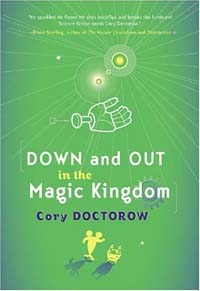
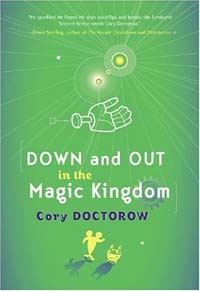
Down and Out in the Magic Kingdom - thoughts


When it comes to fiction, especially concerning the genre of the fantastic, there must be some thought given to the suspension of disbelief when it comes to setting. It is relatively easy for any reader to buy into the worlds created by ‘realistic’ authors such as Carol Shields and Roddy Doyle, as they fashion planes of existence that mirror day-to-day existence; it does not take a huge leap of faith to believe in stories of the mundane, as these are worlds in which we all find ourselves in, to varying degrees. Likewise, it does not stretch the imagination too far to be able to embrace, say, the gritty universes of Ed McBain, or the boggy trenches of Erich Maria Remarque. While these particular literary planes are personally unfamiliar to most, they are not outside the realm of possibility; we can believe these worlds exist, even if we have no first-hand knowledge, because we read the news, we watch television, we are aware that such people and events occur, even if they never touch us personally. Consequently, an author could skimp on details, or spend less time in the depiction of setting, as the reader can be expected to fill in missing elements with personal observations. This is not to impugn that authors are necessarily lazy when it comes to setting; a truly fine author will always pay attention to the details of setting. My life would be a little emptier without Raymond Chandler’s elegiac L.A., Doyle’s vivid Dublin, or Rohinton Mistry’s effervescent India. It’s just, well, a touch easier to cheat a bit in present-day realistic fiction. So what if the author never actually wrote that the police officer carried a gun? He’s a police officer, we all know they carry guns, and so, the bridge between the reader and the story is established.

Not so the fabulists. Where fantasy and science fiction is concerned, the world the authors create can make or break the story. It doesn’t matter if the characters are sterling, or the plot scintillating; if the reader doesn’t buy the world, at least in theory, then the story as a whole will never fully engage the reader. I could never get fully engaged with Tolkien’s dialogue, but his Middle-Earth was intensely real to me. Philip K. Dick’s decrepit world of rampant kipple and fake animals continues to haunt my dreams, and seems more real, more vital, with each passing year. Contrast these with the sci-fi shoot-‘em-up universes of John Ringo, an energetic writer whose stories entertain somewhat in the manner of lesser Star Trek episodes, but never linger in the dark recesses of your soul in the same way that those of Thomas M. Disch and Theodore Sturgeon do. Susanna Clarke recently wove a miraculous England of enchantment and magic in Jonathan Strange and Mr. Norell, a phantasmagoria of fairies, sprites, and spells that never felt anything less than real. Eric Idle, on the other hand, collapsed into tedium with The Road to Mars, a slightly humourous, Douglas Adams-lite sci-fi comedy that never convinced the reader that what was occurring was even remotely plausible, even to the characters that roamed its pages.

It’s not easy, is what I’m trying to say. Cory Doctorow sure makes it look that way, though.

Down and Out in the Magic Kingdom, Doctorow’s first novel, is a spectacularly inventive and incisive look at a future that, although implausible, is never outside the realm of possibility. Like the best authors, he crafts a world that functions on its own, and characters who behave as if this world is the way it has always been. Doctorow is not interested in presenting a thesis on future possibilities for humanity; neither (as anyone familiar with his fabulous work with Creative Commons, the Internet, and his website BoingBoing can attest) is he ignorant of the many pathways our species currently finds itself at the crossroads of. Like the best of Dick, Bruce Sterling, Neal Stephenson et al., Doctorow creates a future world to subtly comment on the past, i.e. our present.

In Doctorow’s future, death, by a fashion, is now obsolete. Technology allows the citizenry to archive their memories, creating a backup. Should the person happen to die, a clone body, complete with memory, can be up-and-running in less than a week. As well, people now can “deadhead;” that is, they can put themselves into suspended animation of a sort, hibernating for a few centuries, then waking up to see what’s new. In short, death is meaningless.

As well, Earth is now run by the “Bitchun society,” whereby energy is plentiful, labour is unnecessary, and money is archaic. Instead of money, people guide their lives by the amount of “Wuffie” they have, a continually updated ratings system that measures how much respect and admiration people have for you. The higher the rating, the easier it is to get by, as a high Wuffie ensures that you easily obtain items considered scarce, you get the best tables in restaurants, and you can jump to the head of the queue. It’s a strange, unique, and remarkably realized civilization, and the highest praise one can give Doctorow’s achievement is that it all seems remarkably plausible.

Into this utopia Doctorow drops Jules, an intelligent young man on his third life who has finally earned enough Wuffie to obtain his dream job: working at the Haunted Mansion at Disneyworld. Disneyworld is an anomaly, a perfectly intact antique of the twentieth century that is now run by rival ad-hoc committees that compete to gather the most Wuffie from their guests. While working on keeping the amusement ride open and operating, he also has to contend with plans a rival ad-hoc has to update the rides from their current/classic animatronic style to direct neural imprinting.

It is a strange, strange world, wholly distinctive yet highly familiar, and Doctorow layers it all together so perfectly as to make it seem effortless. As Jules becomes more involved, and more unhinged – he is murdered during the course of the plot, after all, and it is a mark of Doctorow’s complexity and style that revealing this does not ruin the story in the slightest – he realizes that technological advance is not inherently a good thing. In its way, Down and Out has an old-fashioned soul.

Doctorow is not a spectacular wordsmith; his true strength lies in story, not style, and consequently Down and Out lacks the lyrical quality of contemporaries such as Stephenson or Jeff Noon. But Down and Out, like the best sci-fi fiction, feels completely real. Doctorow’s first novel is a gift, a kick, and a reminder of what the best science fiction can achieve.

Old Book Covers

The lovely and interesting blog 50 Books has a great link here to a Flickr compendium of old Penguin Novel book covers. They are just fantastic, a reminder that covers can indeed be art. I tried to link directly to the set, but you'll have to go through the blog to get there.

UPDATE: Here's the direct link to the covers.

Oct 1, 2006

Paula Spencer - thoughts


From his boisterous first novel The Commitments onward, Irish novelist Roddy Doyle has continued to surprise his audience. Over the decades, he has matured into a Booker-award winning novelist, effortlessly evoking the tribulations of both modern-day and historical Ireland, and becoming the unofficial spokesman for contemporary Irish literature.

Now, Doyle unveils two new surprises in his novel Paula Spencer. First, he revisits a world he created ten years previous in his acclaimed The Woman Who Walked into Doors.

Second, he repeats himself.

Doors documented the ghastly day-to-day existence of Paula, an abused housewife who relates her story in a tone at once sardonic, tragic, and inspired. In the telling of her life, from falling in love with the dangerous Charlo to throwing him out of the house with a well-aimed frying pan, Doyle produced one of his most beloved characters.

Paula Spencer takes up her story a decade later, struggling after four months of sobriety. It hasn’t been an easy time for Paula. “There have been good months before. Paula could count them. They won’t add up to much more than a year.”

Becoming a middle-aged alcoholic has profoundly distressed the Paula of old, reducing her to a timid matron who wonders where her life went. “Charlo knocked it out of her. That must be it. The confidence, the guts – gone.”

As Paula sets about grappling with remaining sober, she begins to repair the fissures that have opened between herself and her children. Her daughter Leanne is following the same path Paula did, while son Jack is only now starting to understand the pain her mother has gone through.

Paula’s reality is now a constant balancing act. “She has to be careful. For the rest of her life. It’s killing her. She can feel it. Every word, every little decision. Chipping away.”

As in Doors, Doyle never sugarcoats or over-sentimentalizes the wretchedness of addiction. Most stirring are the quick asides: Paula waking in vomit next to her daughter; watching her son steal her television to feed his heroin addiction.

Despite the overwhelming depression inherent in such topics, Doyle never allows despair to swamp the narrative. Even in Spencer’s most harrowing scene, a devastating moment when the thirst for alcohol becomes overwhelming, Doyle manages the not-inconsiderable feat of capturing Paula’s humiliation while at the same moment expressing the possibility of redemption.

No one ever truly outruns addiction, and Doyle’s supposition that dependence harms the family as much as the individual is compelling. Yet Spencer, as brilliantly realized as the title character is, never brings anything new to the topic.

Consequently, Paula Spencer feels somewhat repetitive. Doors was masterful, a story that blindsided the reader with its power and compassion. Paula Spencer, while immensely affecting, feels superfluous, a repeat of themes that were fully examined the first times.

“You can’t leave things behind,” Paula thinks. “They come with you. You can manage. That’s the best you can expect.”

Paula Spencer manages, and in her own parlance, “She’s grand.” Doyle is also managing, but from someone of his caliber, he’s also coasting.

First printed in The Winnipeg Free Press, October 1, 2006.
Related Posts Plugin for WordPress, Blogger...